- NVIDIA H100 GPUs draw 700 W TDP each, per NVIDIA datasheets.
- Goldman Sachs projects 165 GW global data center demand by 2030.
- Campus battery storage cuts renewables curtailment 30%, per NREL studies.
University of Maine (UMaine) accelerates campus battery storage deployments. The university launches three AI degree programs this fall. These rely on NVIDIA H100 GPUs rated at 700 W TDP each (NVIDIA datasheets). Renewables correspondent Philip Trask reports from Orono, Maine.
AI clusters exceed grid capacity. Batteries buffer peaks for reliability.
AI Programs Strain Campus Grids
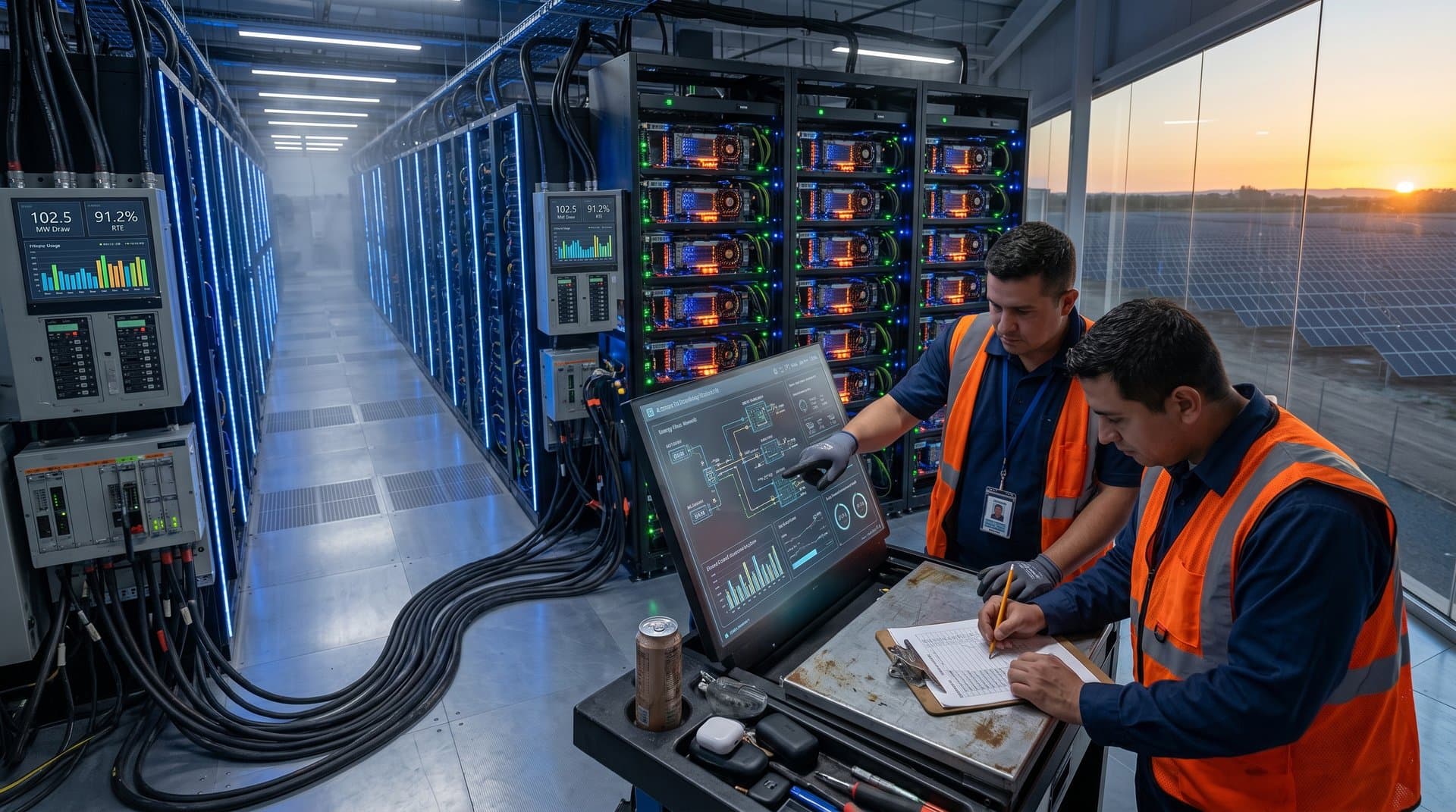
NVIDIA H100 GPUs draw 700 W TDP during training and inference (NVIDIA). Racks with 100 GPUs peak at 70 kW. Clusters scale to 50-100 kW.
Rapid AI growth hits campus limits. Lithium-ion batteries absorb spikes.
IEA projects data centers doubling energy use to 1,000 TWh annually by 2026 (IEA analysis). Goldman Sachs forecasts 165 GW global power demand by 2030.
AI lifts server utilization to 60-80%. Power density triples traditional HPC. Cooling adds 40% overhead (Uptime Institute).
Campus Renewables Pair with Batteries
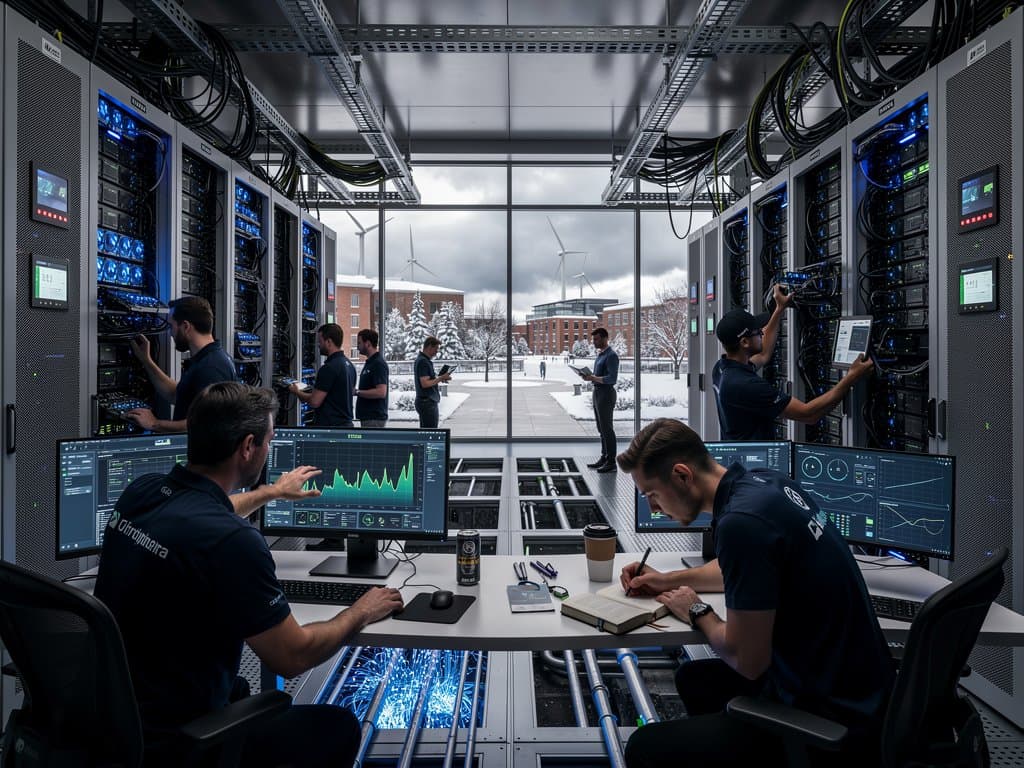
UMaine operates a 12 MW campus offshore wind turbine (university reports). Solar peaks daytime; AI runs evenings.
Lithium-ion batteries hit 92% round-trip efficiency at 1C discharge (Sandia National Laboratories). They manage 90% depth-of-discharge bursts.
Batteries store excess wind for dispatch. BloombergNEF forecasts 160% data center power growth by 2030.
Levelized cost of storage (LCOS) falls below USD 150/MWh (BloombergNEF). Microgrids hedge utility price swings. UMaine pilots vehicle-to-grid with EV fleets.
Batteries Tailored for AI Loads
Lithium iron phosphate (LFP) delivers 220 Wh/kg gravimetric density, 450 Wh/L volumetric, 6,000 cycles at 80% retention (CATL). Ideal for 4-hour daily cycles.
Sodium-ion batteries offer 160 Wh/kg at USD 40/kWh pack level for longer duration.
Flow batteries provide 50 Wh/L with 20,000 cycles (Invinity Energy Systems).
Iron-air targets 100-hour discharge at 30 Wh/kg. Solid-state prototypes claim 500 Wh/kg with higher safety (QuantumScape).
NREL microgrid studies show multi-MW campus systems cut renewables curtailment by 30%. UMaine expands with US LFP suppliers, dodging China supply risks.
UMaine Pioneers Market Strategy
Universities lead solar-plus-storage pilots. AI deployments prove economics before utility scale.
Northeast grids peak at 70 GW in winter. Batteries arbitrage prices via FERC Order 2222 aggregation.
Campuses stack revenues: energy markets, grants, demand response. Ivy League deploys 1-10 MW modular packs.
Prefabricated containers enable fast retrofits. Manufacturers target campus segments.
Unlocking Distributed Storage Markets
UMaine stretches batteries with AI loads. Success scales to 4,000 US campuses consuming 5% of regional power.
Campus battery storage accelerates renewables integration. Providers chase distributed opportunities. Grids gain flexible response capacity.
Frequently Asked Questions
Why does campus battery storage support University of Maine AI programs?
AI GPU clusters hit 100 kW per rack peaks. Batteries discharge instantly to avoid grid overloads. UMaine pairs them with 12 MW wind turbine for reliability.
How much power do AI workloads consume in campus data centers?
NVIDIA H100 GPUs use 700 W TDP each (NVIDIA). Clusters scale to MW peaks. Goldman Sachs projects 165 GW global demand by 2030.
What battery technologies fit campus battery storage for computing?
LFP lithium-ion: 220 Wh/kg, 6,000 cycles (CATL). Sodium-ion: lower cost. Flow batteries: 20,000 cycles for duration.
How does campus battery storage integrate with renewables at universities?
Captures solar/wind excess for evening AI peaks. LCOS under USD 150/MWh (BNEF). Microgrids reduce curtailment 30% (NREL).