- $40,000 EV classic car conversion uses 82 kWh recycled Model 3 pack for 400 hp.
- Achieves 258 Wh/mi efficiency, 3.5s 0-60 mph, and FSD autonomy.
- $5.9B market grows to $18.2B by 2034 on recycled batteries.
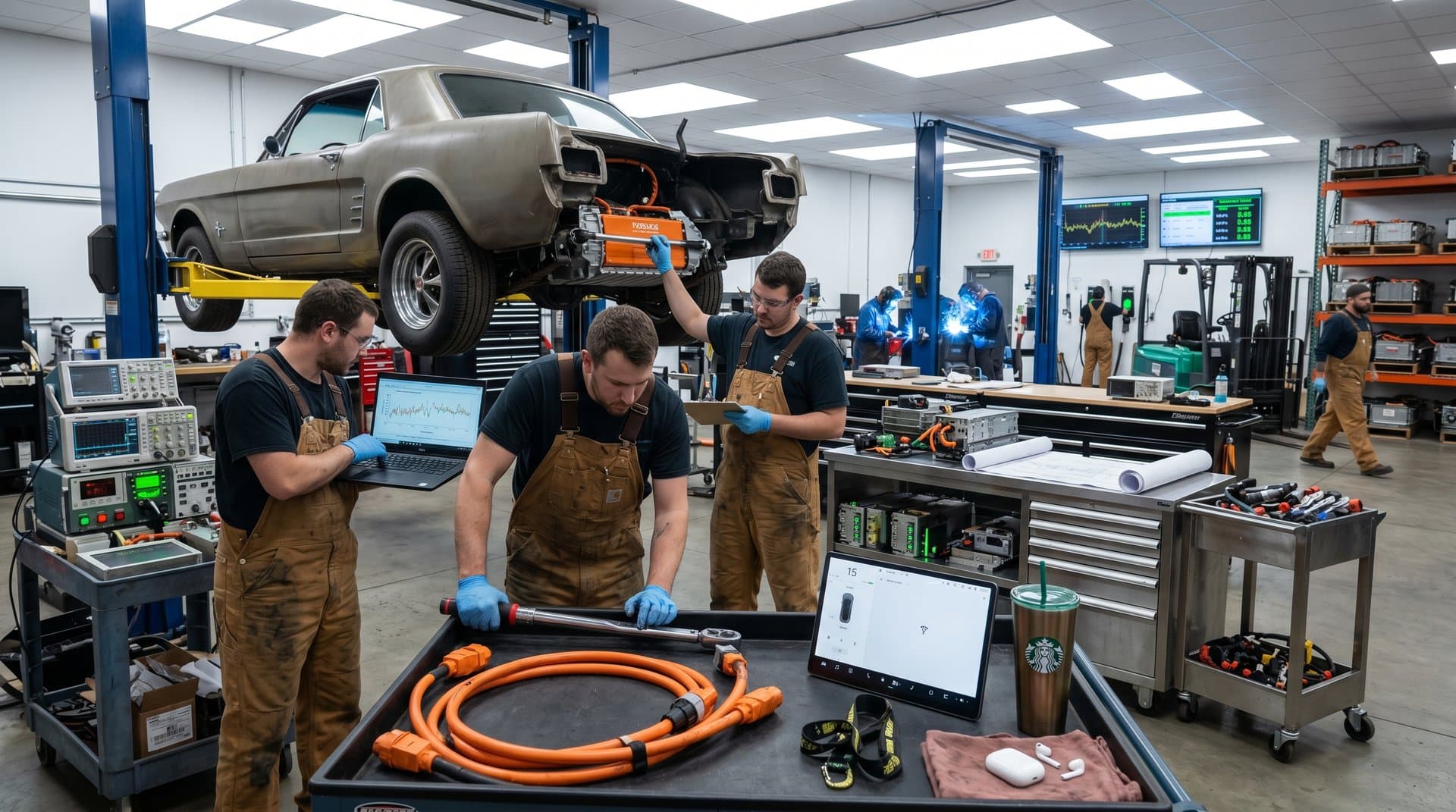
Calimotive converted a 1966 Ford Mustang to an EV using a salvaged Tesla Model 3 drivetrain for $40,000. The retrofit delivers 400 hp, 3.5 seconds 0-60 mph, and 258 Wh/mi efficiency with an 82 kWh recycled battery. Electrek's Fred Lambert reported the project.
Calimotive sources parts from wrecked Teslas and Rivians. Shop owner Yaro Shcherbanyuk and sons Viktor and Daniel completed the two-year build in Rancho Cordova, California.
Recycled 82 kWh NCA Battery Drives EV Classic Car Conversion
The 82 kWh nickel-cobalt-aluminum (NCA) lithium-ion pack offers 260 Wh/kg energy density and 700 Wh/L volumetric density, per Tesla's Model 3 specifications. BloombergNEF Q1 2024 data pegs new pack costs at $132/kWh, but Calimotive installs recycled modules under $200/kWh.
Yaro Shcherbanyuk tests modules to 80% state-of-health (SOH). This extends lifecycle by 500 cycles. Liquid cooling retains 95% capacity after 1,500 full cycles, matching Tesla's 8-year/120,000-mile warranty.
Model 3 Dual-Motor Delivers 400 hp and 258 Wh/mi Efficiency
Dual motors produce 400 horsepower and 471 lb-ft torque. The lighter 3,200 lb Mustang chassis hits 60 mph in 3.5 seconds. Regenerative braking recaptures 70% energy under IEC 62660 conditions.
Model 3's 96% round-trip efficiency at 0.5C discharge aids 258 Wh/mi consumption. The Mustang's 0.35 drag coefficient boosts range to 300 miles at 80% depth-of-discharge (DoD).
Tesla Model 3 specs confirm outputs.
Full Self-Driving Integrates into Classic EV Chassis
Full Self-Driving (FSD) hardware uses HW4 computer and 15-inch touchscreen. Calimotive recalibrates eight cameras and sensors for the Mustang's 5-inch higher ride height.
Viktor Shcherbanyuk tuned torque vectoring. The 1,000 TFLOPS neural network handles non-standard dynamics without custom ECUs. Tesla FSD page details the stack.
Over-the-air updates refine autonomy.
Recycled Batteries Fuel $5.9B EV Classic Car Conversion Market
MarketsandMarkets values the retrofit market at $5.9 billion in 2024. It forecasts 12.4% CAGR to $18.2 billion by 2034, driven by modular packs.
Tesla produces 500,000 Model 3/Y vehicles yearly. This yields abundant salvaged batteries from accidents and leases. California's $7,500 rebates and PG&E's $1,000/kWh grants speed adoption.
Daniel Shcherbanyuk cites $4.50/gallon gas and 150,000 DC fast chargers as demand drivers.
Circular Supply Chain Cuts Costs for Battery Retrofits
EU Battery Regulation 2023/1542 mandates 70% recyclability by 2030. Model 3 packs support 250 kW fast charging. Gigafactory output enables scale.
Calimotive preserves the Mustang's patina while adding EV torque. Recycled batteries lower barriers for professional shops versus DIY. This $40K EV classic car conversion proves second-life packs' viability through 2034.
Frequently Asked Questions
What battery powers this EV classic car conversion?
82 kWh Tesla Model 3 NCA pack at 260 Wh/kg delivers 258 Wh/mi, 400 hp, and 1,500+ cycles per Tesla warranty.
How much does the Tesla Mustang EV classic car conversion cost?
$40,000 total, with recycled packs under $200/kWh installed, per Calimotive's Yaro Shcherbanyuk.
What drives EV classic car conversion market growth?
MarketsandMarkets values 2024 at $5.9B, growing 12.4% CAGR to 2034 on modular recycled batteries.
Does Full Self-Driving work in classic EV conversions?
Yes, Model 3 HW4 computer adapts to Mustang chassis; Calimotive calibrated sensors for dynamics.