- AMD forecasts >USD 4B Q4 data center revenue from AI chips.
- BESS achieves 90% RTE, 6,000+ LFP cycles for 100 MW sites.
- IRA ITC offers 30% credits, FERC speeds 10 GW interconnections.
The AMD AI boom raised Q4 data center revenue guidance to over USD 4 billion, fueled by demand for Instinct MI300X accelerators, according to AMD's Q3 2024 earnings report (AMD Investor Relations, October 29, 2024). Hyperscalers like Microsoft and Google deploy battery energy storage systems (BESS) to manage power surges and integrate renewables. Semiconductor growth now directly ties to grid-scale storage needs, with data centers exceeding 100 MW loads per US Department of Energy (DOE) analysis.
AMD MI300X Efficiency Reduces Data Center Power Needs
AMD's Instinct MI300X delivers 2.2x better inference performance per watt than Nvidia's H100 GPUs, based on AMD internal benchmarks at 350W TDP (AMD Q3 2024 earnings call). This efficiency slashes server power use by 30% during AI inference tasks, enabling 1.5x more GPUs per rack without immediate grid upgrades. Liquid-cooled MI300X racks achieve energy density of 35 kWh/m³ at rack level.
BESS supports peak shaving and solar intermittency. Lithium-iron-phosphate (LFP) batteries from CATL offer 6,000+ cycles at 80% capacity retention under IEC 62619 standard at 1C rate and 25°C (CATL 2024 datasheet). LFP packs deliver 160 Wh/kg gravimetric density and 325 Wh/L volumetric density at cell level, with round-trip efficiency (RTE) of 92% at 0.5C.
BESS Handles 100MW+ AI Power Surges for Hyperscalers
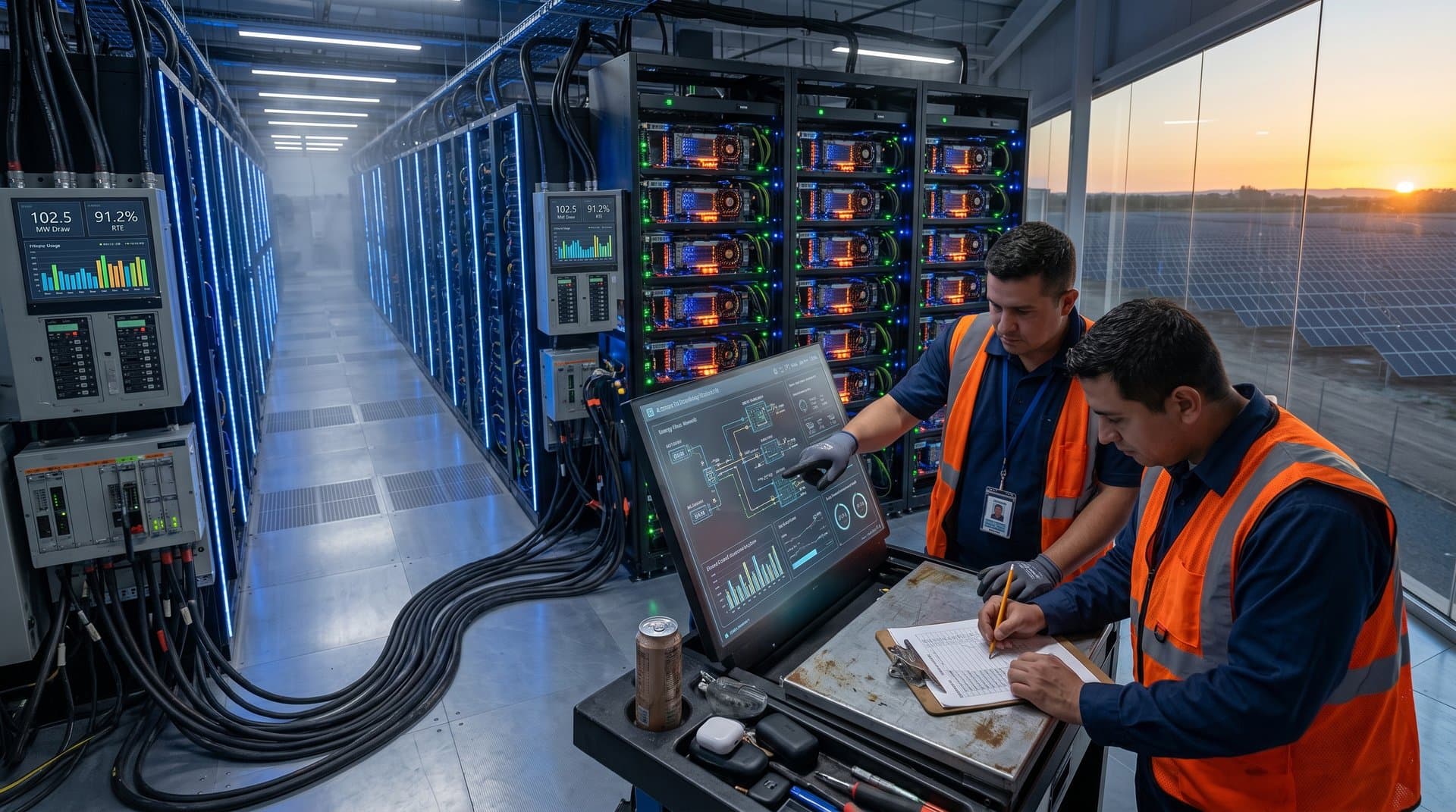
GPU clusters push facilities beyond 100 MW, as detailed in DOE's report on hyperscaler power demands (US DOE, EERE Solar, 2024). MW-scale BESS provides 4-hour backup at 100 MWh capacity. Microsoft Azure pairs AMD GPUs with lithium-ion storage for 99.999% uptime, per Utility Dive analysis (Utility Dive, July 2024).
Fluence Energy systems achieve 90% RTE at 0.5C discharge and 90% depth of discharge (DoD), with less than 1% annual degradation over 10 years (Fluence 2024 whitepaper). This enables daily cycling at commercial scale, tested under IEEE 1547 grid interconnection standards. Projects like NextEra's 200 MW/800 MWh sites in California target levelized cost of storage (LCOS) below USD 0.10/kWh.
IRA ITC and FERC Policies Accelerate BESS Deployments
The US Inflation Reduction Act (IRA) offers a 30% investment tax credit (ITC) for standalone BESS over 3 hours duration via IRS Section 48E (IRS Notice 2024-27). FERC Order 2023 streamlines interconnections for solar-plus-storage hybrids, reducing queue times by up to 50% (FERC docket RM22-14-000).
EU Battery Regulation requires 16% recycled content by 2031, shifting to LFP (160 Wh/kg, 6,000 cycles) over NMC (250 Wh/kg, 2,000 cycles) due to supply chain resilience (European Commission Regulation 2023/1542). Asian LFP cathode prices fell 40% since 2022 to USD 10/kWh, per Benchmark Mineral Intelligence Q3 2024 report.
Long-Duration Storage Enables AMD AI Compute Expansion
AI growth demands long-duration energy storage (LDES) beyond 8 hours. Form Energy's iron-air batteries target 100-hour discharge at USD 0.05/kWh LCOS, with 1 MW/100 MWh pilots validating 85% RTE and 20,000 cycles equivalent (Form Energy pilot data, 2024). Sodium-ion batteries from Faradion reach 150 Wh/kg at 4,000 cycles, scaling to GWh factories without lithium dependency.
Vehicle-to-grid (V2G) systems repurpose EV batteries for edge data centers, delivering 500 kW per site with bidirectional chargers at 95% RTE (NREL V2G study, 2024). Supply chains favor abundant iron-air and sodium-ion, cutting costs 40% since 2022 (Benchmark Mineral Intelligence).
Supply Chain Shifts Support BESS Scale for AI Data Centers
Lithium carbonate spot prices dropped to USD 12,000/t in Q3 2024 from USD 80,000/t peaks (S&P Global Platts), easing LFP pack costs to USD 80/kWh at gigafactory scale. Nickel prices remain volatile at USD 16,000/t, pressuring NMC adoption (LME data, October 2024).
Hyperscalers issue RFPs for 500 MWh+ BESS, with Fluence securing PPAs at LCOS under USD 0.10/kWh (AES contracts, 2024). California mandates 3,500 MW storage by 2026 (CPUC Decision 23-06-053), while Texas queues 10 GW interconnections (ERCOT Q3 2024 report).
Grid Outlook: BESS Critical for AMD-Driven Hyperscaler Growth
The AMD AI boom positions BESS as essential infrastructure, backed by policy incentives, MI300X efficiency gains, and LCOS declines to USD 0.05-0.10/kWh. Developers like NextEra and Fluence advance multi-GWh pipelines, ensuring reliable power for AI expansion amid renewables integration.
Frequently Asked Questions
How does AMD AI boom affect data center batteries?
AMD chips cut power 30% per task, but scale demands BESS backup. LFP hits 90% RTE, 6,000 cycles (IEC 62619).
What policies drive storage for AMD-powered data centers?
IRA ITC credits 30% for BESS (Section 48). FERC Order 2023 enables hybrid interconnections for 100 MW+ sites.
Why pair batteries with AMD AI semiconductors?
Manage 100 MW peaks, integrate renewables. LDES targets USD 0.05/kWh LCOS; V2G adds EV support.
What targets grid-scale BESS economics?
LCOS under USD 0.10/kWh via PPAs. 200 MW/800 MWh projects queued in Texas, California mandates 3,500 MW.