- Judge extended Orlando crypto Ponzi probe 60 days for $328M fraud.
- Florida solar curtailment reaches 5-10% from mining overloads.
- U.S. storage capacity grew 47% to 9 GW in 2023, NREL says.
Orlando Crypto Ponzi Probe Extended 60 Days
Federal Judge Gregory Presnell extended the Orlando crypto Ponzi probe on October 10, 2024. WESH reported the 60-day extension lets prosecutors trace $328 million from fake Bitcoin mining rigs promising 20% monthly returns. Operators leased data centers and power from Florida Power & Light (FPL) but produced zero Bitcoin.
Investor losses hit $328 million. FPL audits power contracts tied to these ghost mines, uncovering uncompensated demand spikes.
Fake Mining Spikes Florida Grid Demand
Fraudulent rigs billed phantom kilowatt-hours while driving real peaks. Legitimate Bitcoin mining consumed 121 TWh globally in 2023, IEA stated. Scams worsen impacts: investors lose funds, utilities handle loads without pay.
Central Florida solar farms curtail 5-10% of midday peaks, NREL calculated. Wind faces nighttime excess without storage for daytime shifts. Duke Energy logged 15-20% peaker costs from crypto surges, per Q3 2024 filings.
NextEra Manatee Batteries Cut Curtailment
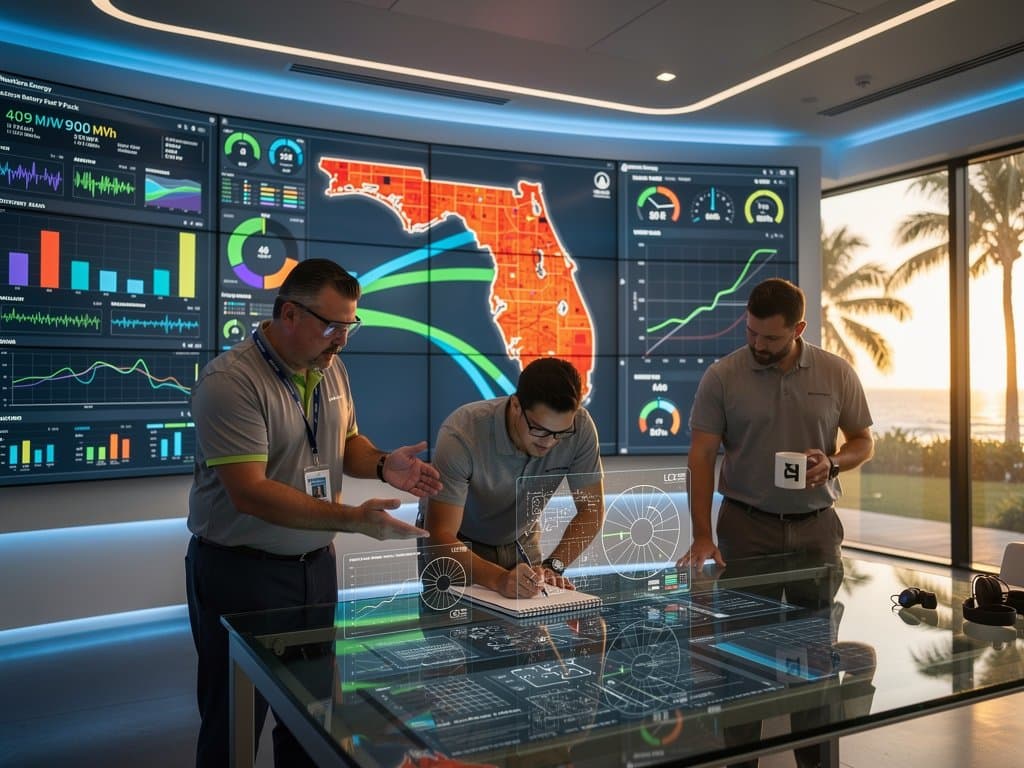
NextEra's Manatee Energy Storage Center provides 409 MW and 900 MWh. It delivers 88% round-trip efficiency at 0.25C under IEC 62619, per NextEra specs. The 2021 project pairs with solar, slashing curtailment 25% for 4-hour dispatch.
LCOS reaches $120/kWh over 15 years, undercutting gas peakers at $150/kWh. NextEra raised $400 million in green bonds with FPL's 10-year offtake at $45/MWh arbitrage.
Battery Chemistries for Renewables Match
Hybrids combine 100 MW solar with 400 MWh lithium-ion. Packs hit 250 Wh/kg and 650 Wh/L with 4,000 cycles at 80% DoD.
Reuters noted vanadium flow batteries serve 8-10 hours at 30 Wh/kg and $200/kWh with 10,000 cycles. Form Energy's iron-air targets 100 hours at 40 Wh/kg and $20/kWh.
- Chemistry: Li-ion · Energy Density (Wh/kg): 250 · Volumetric (Wh/L): 650 · Cycle Life: 4,000+ @80% DoD · Cost ($/kWh): 150
- Chemistry: Vanadium Flow · Energy Density (Wh/kg): 30 · Volumetric (Wh/L): 25 · Cycle Life: 10,000+ · Cost ($/kWh): 200
- Chemistry: Iron-Air · Energy Density (Wh/kg): 40 · Volumetric (Wh/L): 35 · Cycle Life: 20,000+ · Cost ($/kWh): 20
NREL 2024 ATB data assumes 2025 scale. Lithium-ion uses 60% Chinese cathodes; sodium-ion (160 Wh/kg) avoids this.
Probe Fuels Florida Storage Surge
FPL power deals face scrutiny in the $328 million case. IRA tax credits drive 2 GW utility-scale by 2026. NREL tracked U.S. growth to 9 GW in 2023, up 47%.
Florida operates 500 MW, including Duke's 200 MW/800 MWh Gulf project in Q4 2024. Deployments absorb 30% curtailed solar, per FPL filings. EPC costs average $250/kWh with 12-year warranties.
FERC Unlocks Battery Markets
FERC Order 2222 allows aggregation. Solar-plus-storage bids 200 MW/800 MWh in Gulf markets, stacking $15/MW regulation and $40/MWh arbitrage.
HiNa's sodium-ion pilot with NextEra tests 50 MW/200 MWh at 160 Wh/kg and 92% efficiency over 5,000 cycles. LCOS falls to $80/kWh by 2028. DOE grants fund 40 GWh U.S. lines.
Orlando crypto Ponzi probe highlights grid risks. Batteries turn solar and wind dispatchable, cutting 30% curtailment and stabilizing costs.
Frequently Asked Questions
What triggered the Orlando crypto Ponzi probe extension?
Judge granted 60 more days for $328M fraud investigation. WESH covered fake mining rigs promising 20% returns that wasted leased grid power.
How does fake mining impact Florida's grid?
Schemes bill phantom kWh, spiking demand. Solar curtailment reaches 5-10% per NREL, forcing gas peakers online without storage.
Why prioritize grid-scale battery storage?
Li-ion packs (250 Wh/kg, 88% RTE) store solar excess for 4-hour dispatch. NextEra's 409 MW/900 MWh Manatee center bridges renewables to 24/7 loads.
What storage growth supports renewables?
NREL: 47% rise to 9 GW in 2023. Florida targets 2 GW by 2026 via IRA, with sodium-ion (160 Wh/kg) pilots.