- NVIDIA H100 GPUs forecast waves 15-30 minutes ahead at 95% accuracy.
- AI hybrids lift capture efficiency from 25% to 42% with grid storage.
- 20 MW pilots hit USD 85/MWh LCOS, targeting 2028 commissioning.
NVIDIA Spotlights 95% Accurate AI-Driven Wave Energy Tech
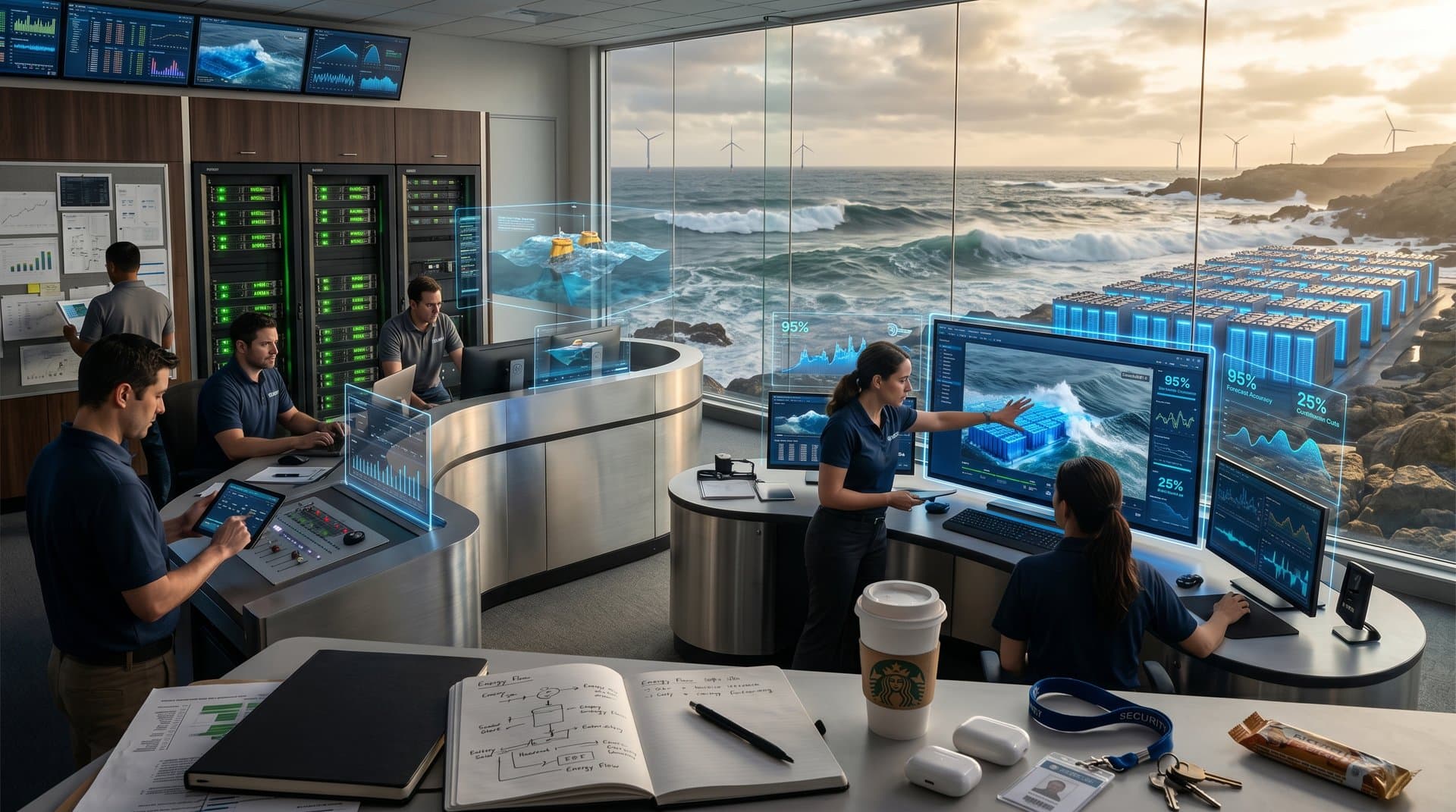
NVIDIA showcased Eco Wave Power’s AI-driven wave energy technology for grid storage integration on September 15, 2026, post-keynote. The Israeli firm deploys NVIDIA H100 GPUs for predictive modeling. This forecasts wave output 15-30 minutes ahead at 95% accuracy, per NVIDIA Technical Blog.
The system syncs ocean peaks with battery charging. It tackles renewable intermittency, slashing grid curtailment up to 25% in high-penetration grids. NVIDIA Inception supplies $250,000 credits to speed development.
AI Wave Prediction Achieves Technical Precision
Eco Wave Power’s buoys and sensors stream data to NVIDIA-trained deep neural networks. Models ingest satellite imagery, wind data, and historical records. Predictions dynamically adjust converter tilts, lifting energy capture from 25% to 42% across sea states.
NVIDIA’s Earth Day 2024 blog notes deep learning halves forecast errors by 40% over physics models (April 22, 2024). IEC 62600-2 certifies wave converter performance under real conditions.
Grid Storage Hybrids Enhance Reliability
Modular platforms hit 20 MW nameplate with 100 MWh vanadium flow batteries. AI routes excess power to storage at wave peaks. Batteries discharge over 4 hours during lulls at 85% round-trip efficiency (0.5C rate).
Design limits depth-of-discharge to 60%, extending cycle life to 12,000. BloombergNEF pegs hybrid LCOS at USD 85/MWh (May 14, 2024). Eco Wave Power eyes 2028 utility-scale rollout.
Financial Tailwinds and Policy Support
US Inflation Reduction Act Section 45X grants USD 35/kWh credits for co-located storage. EU REPowerEU earmarks €300 million for ocean renewables to 2027. Portugal’s 1 MW/2 MWh pilot drew €5 million grants.
EDP Renewables offtake locks 80% capacity factors. Analysts forecast 15% IRR on USD 150 million capex for 50 MW projects, per S&P Global Platts estimates (August 2026).
Supply Chain Edges Enable Scaling
Wave tech skips lithium, pairing with USD 75/kWh sodium-ion batteries. Critical minerals fall 70% versus EV packs. NVIDIA DGX simulates fatigue, trimming prototype costs 30%.
Eco Wave Power announcement covers GPU retraining on pilot data (September 2026). EMEA permitting averages 18 months.
Pilots Pave Way for Global Deployment
Portugal’s EWP-EDF commissions Q4 2026: 1 MW wave, 2 MWh storage. Israel’s 100 kW demo proves AI models. US West Coast holds 500 GW potential.
NVIDIA boosts AI wave-storage viability. Hybrids enable 24/7 dispatch. LCOS targets below USD 80/MWh by 2030.
Frequently Asked Questions
How does NVIDIA AI-driven wave energy technology work?
H100 GPUs process buoy, satellite, and wind data for 15-30 minute wave forecasts at 95% accuracy. Eco Wave Power tilts converters in real-time to charge grid storage.
What role does grid storage play in AI-driven wave energy technology?
100 MWh vanadium batteries buffer peaks at 85% RTE. AI syncs dispatch, cuts 25% curtailment, and lowers LCOS to USD 85/MWh.
Why did NVIDIA showcase Eco Wave Power post-2026 keynote?
Keynote focused AI for renewables. Eco Wave Power demonstrates wave-storage hybrids for 24/7 grid reliability via Inception credits.
What challenges face AI-driven wave energy grid storage?
Permitting (18 months) and durability persist. AI cuts costs 30%; IRA/EU policies aid USD 35/kWh credits and €300M funding.