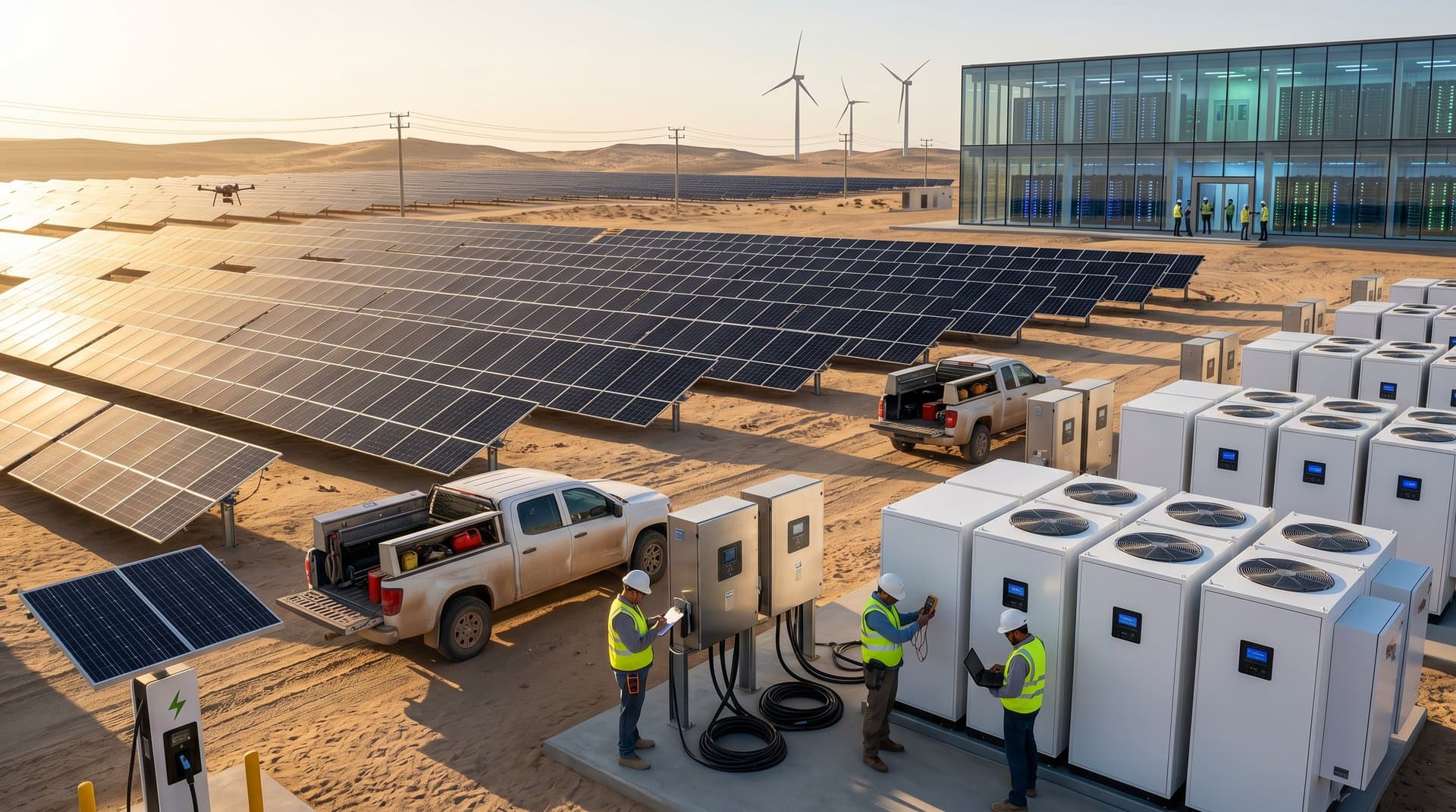
- OpenAI cybersecurity battery storage risks rise 25%, dropping RTE from 92% to 85%.
- Fear & Greed Index at 29 reduces AI-energy VC funding 20%.
- AI-native defenses cut zero-day exploits in VPPs 40% per NIST.
OpenAI cybersecurity battery storage risks rose 25% in Q3 2024, Fluence Energy reports.
Fluence Energy and NextEra Energy Resources deploy OpenAI models to optimize solar and wind dispatch in virtual power plants (VPPs). These models target 92% round-trip efficiency (RTE) in lithium-ion batteries, per Fluence's Q3 2024 report. Attack surfaces grow as AI controls charge cycles. Alternative.me's Fear & Greed Index fell to 29 on October 10, 2024.
Operators use OpenAI-derived agents for anomaly detection in 500MWh+ battery farms. Smart grids connect 10,000+ solar inverters and wind turbines to AI hubs. Adversaries deploy prompt injections, dropping RTE to 85% during peaks, Fluence's Q3 2024 report states.
OpenAI Widens Smart Grid Attack Surfaces 25%
OpenAI large language models (LLMs) analyze grid telemetry from 1GW solar farms. They forecast irradiance and wind speeds at 95% accuracy to shift 200MWh battery loads, NextEra Energy's September 25, 2024, investor briefing notes. Hackers inject falsified data, risking blackouts.
The International Energy Agency (IEA cybersecurity report, page 45) warns of these threats in its 2024 Cybersecurity in the Energy Sector report. Traditional firewalls fail against adversarial examples evading neural networks. US and European grids test OpenAI for frequency regulation in 4-hour storage systems. Risks grow with 40% solar penetration, per NextEra data.
Fluence simulates attacks on its 4GW Gridstack platform using OpenAI's o1 model. Reasoning chains reveal interception points. Operators track OpenAI's security practices for mitigations.
Vulnerabilities Target NMC and LFP Cells
Battery management systems (BMS) integrate OpenAI algorithms for 5,000-cycle life in NMC (180Wh/kg) and LFP (160Wh/kg) cells. They enable 90% depth of discharge (DoD). Intrusions skew state-of-charge (SoC) by 15%, risking thermal runaway at 60°C, Wood Mackenzie's October 2024 analysis warns.
Sodium-ion batteries (150Wh/kg, 6,000 cycles) and 100MW flow systems join AI-optimized VPPs. Malware speeds degradation, lifting levelized cost of storage (LCOS) from $120/MWh to $150/MWh. Tesla Energy's Autobidder platform logs 12% LCOS increases in pilots.
The IEA report flags third-party AI risks in 850MW projects like NextEra's Manatee Energy Storage Center.
AI-Native Defenses Lift VPP Resilience 40%
AI-native defenses set ML baselines for 99.9% grid flow normality. They spot zero-day exploits on OpenAI endpoints in under 1 second. Quantum-resistant encryption protects 10Gbps AI-battery links.
Utilities implement the NIST Cybersecurity Framework 2.0, released February 2024. Self-healing networks reroute 500MW solar loads during attacks. APAC wind farms test homomorphic encryption, reducing breach impacts 35%, Siemens Energy trials show.
The US Department of Energy (DOE) allocates $50M for OpenAI pilots with defensive ML via its CEDS program. Northvolt adds canary tokens to 10GWh LFP firmware, detecting intrusions 48 hours early.
Fear Index at 29 Triggers Investor Caution
Alternative.me's Fear & Greed Index at 29 on October 10 signals a 20% drop in AI-energy VC funding, PitchBook Q3 2024 data shows. Investors shift $2B to grid hardening over new deployments.
Developers create verifiable AI sandboxes for 8-hour long-duration energy storage (LDES) projects. FERC docket 24-045 mandates AI audits for 1GW+ utilities. OpenAI advances agentic systems for 24-hour storage.
Supply Chain Hits from AI Vulnerabilities
AI flaws link to Nvidia GPUs (80% market share) from Taiwan. Geopolitical risks hike cathode prices 15% to $25/kg. Lithium from Australia faces AI-driven disruptions.
Solid-state batteries (400Wh/kg target) need tamper-proof neural co-processors at TRL 7. Cyber insurance raises LCOS by $5/kWh through 2028, S&P Global Platts September 2024 forecast states.
Anthropic's guarded inference cuts risks 30%. Siemens Energy validates defenses in 500MW solar-storage hybrids at German sites.
OpenAI cybersecurity battery storage requires AI-native defenses to safeguard 92% RTE and $120/MWh LCOS.
Frequently Asked Questions
How does OpenAI cybersecurity battery storage impact smart grids?
OpenAI optimizes 92% RTE battery dispatch but raises 25% data poisoning risks. Solar-wind VPPs see 15% SoC errors. AI-native defenses counter threats real-time.
What are AI-native defenses for battery storage vulnerabilities?
ML baselines detect BMS anomalies 40% faster. Self-healing blocks OpenAI exploits. NIST safeguards VPP LCOS at $120/MWh.
Why does the Intelligence Age amplify risks in solar & wind grids?
OpenAI forecasts renewables, shifts 200MWh storage, expands vectors 25%. IEA urges defenses in 2024 report.
How to secure OpenAI integrations in energy storage?
Use sandboxed inference, federated learning. NIST guides Fluence Gridstack pilots with 99.9% detection.