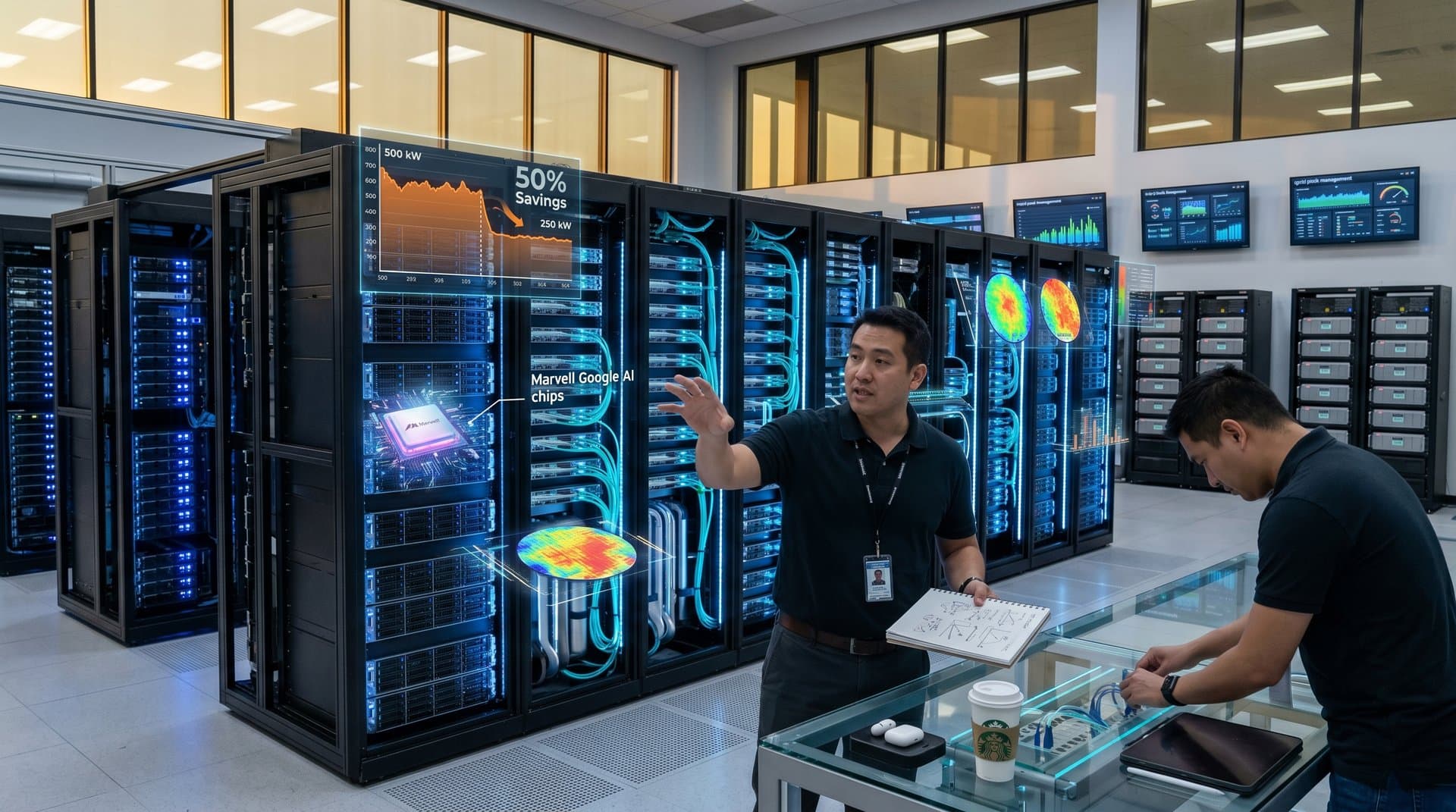
- Marvell negotiates 2 custom Marvell Google AI chips with Google.
- Chips cut data center power 50% per teraflop vs GPUs.
- Reduce 20 GW grid peaks by 2030, aiding storage LCOS.
Marvell Google AI Chips Negotiations Advance
Marvell Technology holds advanced talks with Google for two custom Marvell Google AI chips, Reuters reported October 10, 2024. These application-specific integrated circuits (ASICs) target AI training and inference. They aim to cut power use 50% per teraflop, per Marvell specs. Such efficiency eases grid strain from AI growth and supports battery storage.
Hyperscalers shift to custom silicon from GPUs. Marvell already supplies Google data processing units (DPUs) and ASICs. New chips prioritize watts-per-flop for AI scaling.
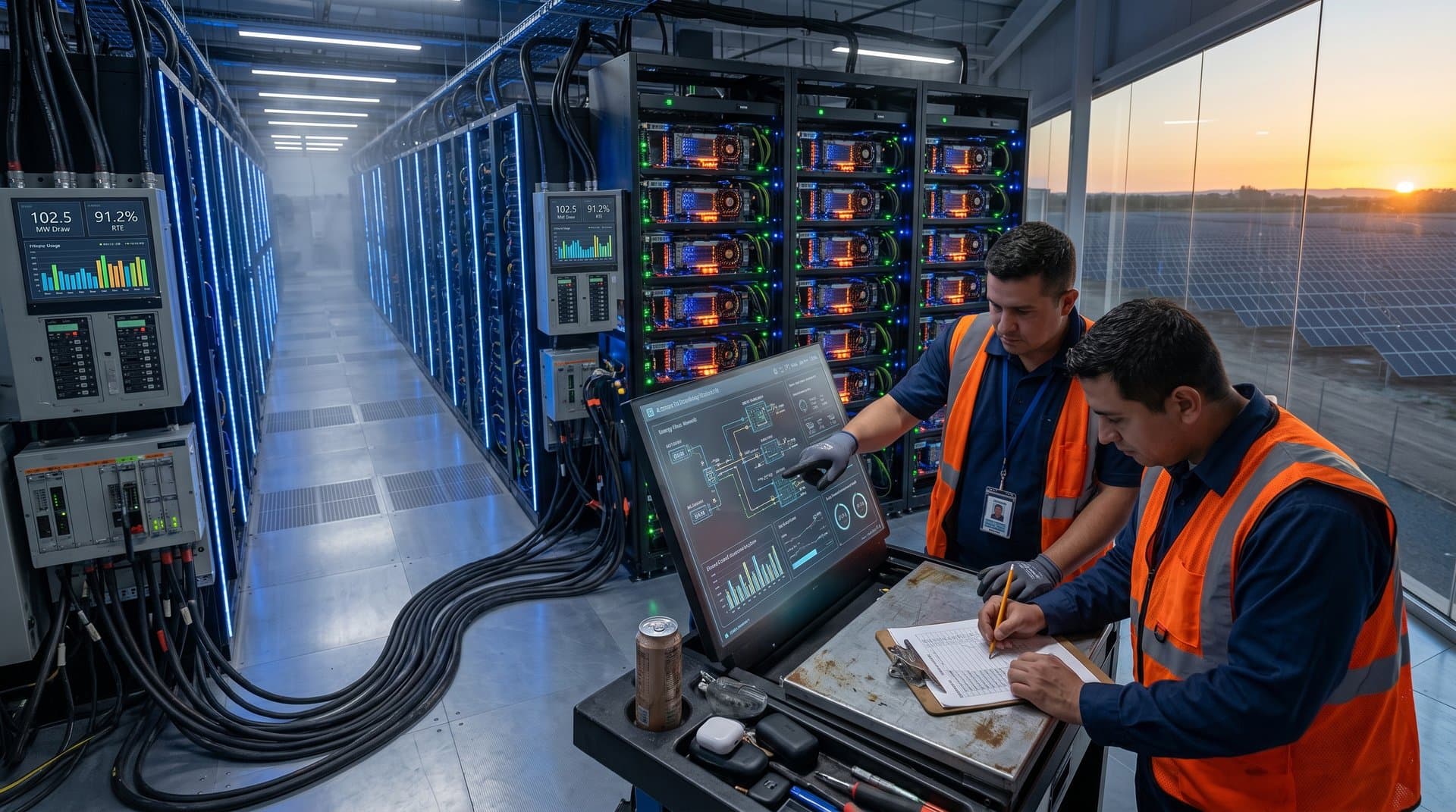
Data Centers Double Energy Use by 2026
Data centers used 460 TWh globally in 2022, per International Energy Agency (IEA) Electricity 2024 report. Demand doubles to 1,000 TWh by 2026. Racks hit 100 kW peaks; GPU clusters reach 500 kW. Marvell Google AI chips halve power while matching FLOPS.
Marvell shares jumped 11% post-Reuters report. Barclays analyst Jordan Klein said, "Custom ASICs challenge Nvidia's 80% AI accelerator share."
IEA Electricity 2024 notes cooling takes 40% of power. Chip savings amplify here.
Chip Specs Drive Efficiency Gains
Chips use TSMC 3nm nodes. These cut leakage 30% versus 5nm, Marvell datasheets state. Google demands tensor optimizations. Inference tasks (80% of runtime) see 20% voltage drops.
Marvell optical interconnects slash data energy 50%, per IEEE 802.3 benchmarks. Lower heat cuts cooling 40%, IEA studies confirm.
Platforms deliver 2x performance-per-watt over Nvidia GPUs. Google TPUs hit 4.7x gains, Google Cloud docs show.
Marvell AI solutions detail DPU roles.
Grid and Battery Storage Benefits
AI data centers add 20 GW to US peaks by 2030, US Energy Information Administration (EIA) Annual Energy Outlook 2024 forecasts. Efficient chips smooth loads. This extends lithium-ion cycles past 5,000 at 80% DoD.
4-hour utility batteries pair with solar at 15% shallower DoD. National Renewable Energy Laboratory (NREL) pegs LCOS at $0.08/kWh.
FERC Order 2222 (2021) enables storage aggregation. Freed capacity earns $50/MW-year in regulation, FERC dockets show.
EIA Annual Energy Outlook sees 8% yearly data center growth.
Production and Supply Chain Ramp
Tape-out hits Q4 2025. Volume production starts 2026 at TSMC Arizona. 3nm yields reach 80%, TSMC earnings report. Costs drop 40%.
CHIPS Act provides $52.7 billion, US Commerce Department states. Google offtakes target 10 million units.
US wafer output rises 25%. This avoids Asia risks.
Storage Roadmap Shifts
Chips delay 50 GW new batteries for AI, Wood Mackenzie's Amir Taqi estimates. IRA credits back 100 GW by 2030 at $200/kWh.
Second-life EV packs hit UPS at $100/kWh. CATL Q3 2024 sodium-ion nears $60/kWh, 150 Wh/kg, 4,000 cycles.
Reuters report by Yuvraj Malik. Q4 deal likely reshapes storage economics.
Frequently Asked Questions
What are the Marvell Google AI chips?
Two custom energy-efficient ASICs for Google data center AI workloads. Reuters reports active negotiations.
How much power do they save?
Up to 50% reduction versus GPUs via 3nm nodes and optimizations. IEA forecasts 1,000 TWh global savings by 2026.
How do they benefit battery storage?
Reduce grid peaks by 20 GW, extend cycle life, lower LCOS to $0.08/kWh. Supports FERC 2222 markets.
When is production?
Tape-out Q4 2025, ramp 2026 at TSMC. CHIPS Act funds US scaling.