- Grid-scale lithium-ion batteries hit 90%+ RTE at 1C rates (Reuters, Oct 2024).
- LFP delivers 5,000+ cycles at 80% DoD per IEC 62619 standard.
- AI data centers match city power by 2030 (Bloomberg, Oct 31, 2024).
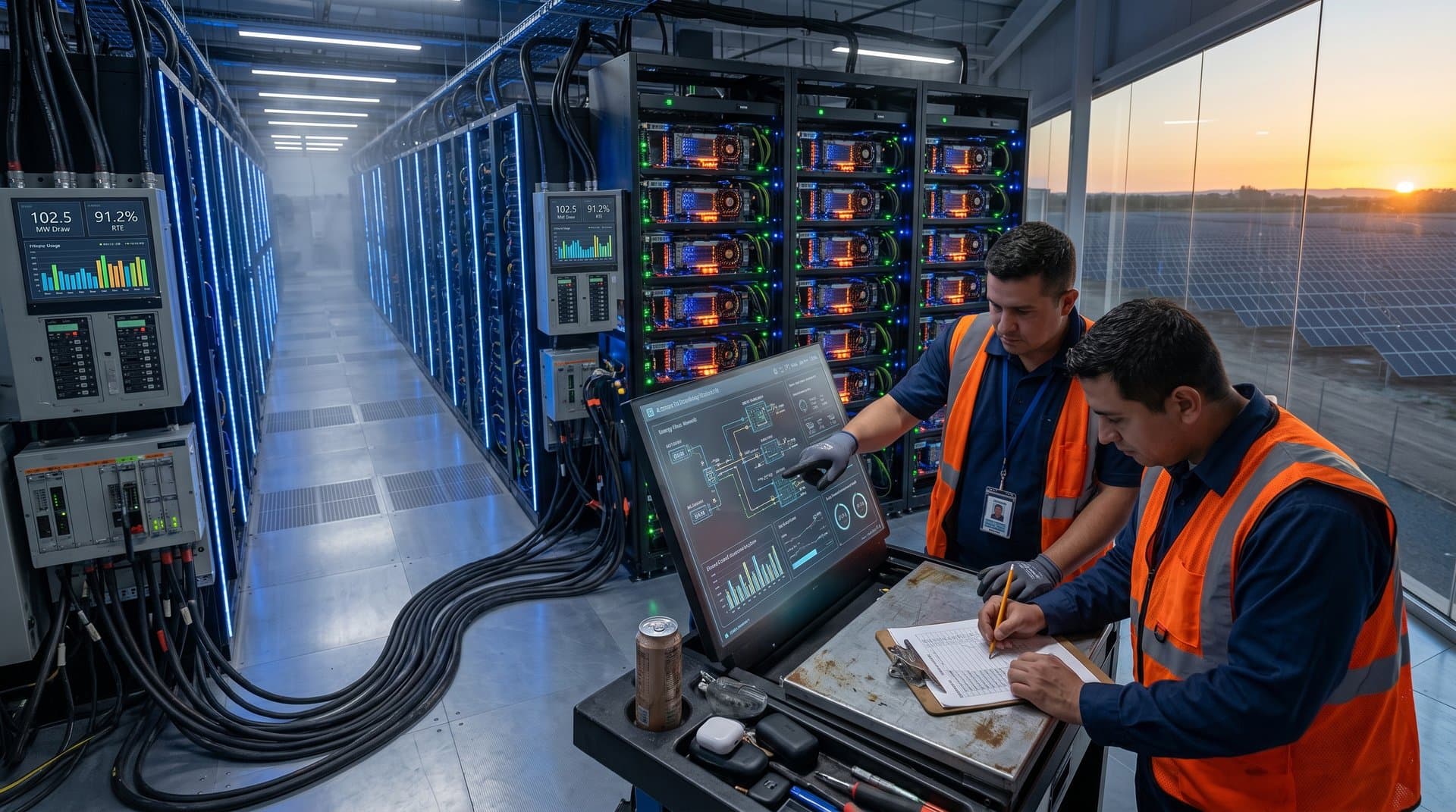
Grid-scale batteries achieve 90%+ round-trip efficiency (RTE) at 0.5C charge and 1C discharge rates. Reuters (Oct 17, 2024) cites utility pilots supporting AI data center growth. OpenAI's acquisition of Hiro advances RIA status, per RIABiz, driving MWh-scale power needs.
Hyperscalers expand facilities consuming 50-100 MW continuously. Batteries buffer renewable intermittency.
OpenAI RIA Acquisition Fuels AI Data Center Expansion
Hiro integrates generative AI for financial planning. Models process market data at high compute loads. Reuters equates AI power demand to crypto mining levels.
OpenAI partners with utilities for dedicated supply. Solar variability demands storage. Lithium-ion confirms 90% RTE in pilots.
Edge data centers handle low-latency AI inference. Load peaks rival small cities. Behind-the-meter batteries shave peaks and defer USD 1 million/km transmission upgrades.
LFP Batteries Dominate Grid-Scale AI Reliability
AI training creates baseload strain. RIA tools require uninterruptible power. Flow batteries offer durations beyond lithium-ion's 4-hour standard.
Lithium iron phosphate (LFP) cathodes lead deployments. They deliver 5,000+ cycles at 80% depth of discharge (DoD) and 25°C, per IEC 62619. Utility Dive (2024) reports developers targeting hyperscaler demand.
Co-located storage cuts transmission losses to 2-3%. LFP packs reach 160 Wh/kg gravimetric and 300 Wh/L volumetric density, per Fluence Megapack specs.
Iron-air batteries from Form Energy target 100+ hour discharge for extended AI workloads. US Inflation Reduction Act (IRA) investment tax credits cut LCOE by 30%.
Hyperscalers Drive Battery Deployment Acceleration
Hiro enables OpenAI's financial AI products. Liquid-cooled racks hit 100 kW/rack densities, but grids lag.
Four-hour lithium-ion scales to 500 MWh/year production. Solid-state prototypes eye 400 Wh/kg at Technology Readiness Level 4.
LFP levelized cost of storage (LCOS) falls to USD 150/kWh, targeting USD 100/kWh by 2030, per Wood Mackenzie. Bloomberg (Oct 31, 2024) projects AI data centers matching entire cities' electricity use by 2030.
EV second-life packs slash UPS costs 50%, per NREL analysis. V2G fleets build virtual power plants.
Policy Roadmap Scales Grid Batteries for AI
OpenAI deploys AI-driven maintenance, boosting cycles 20%, company states.
Wood Mackenzie forecasts long-duration energy storage (LDES) market doubling to USD 5 billion by 2030.
FERC Order No. 2023 (docket RM22-13) speeds interconnections. California LCFS credits and Texas ERCOT rules prioritize batteries. Hyperscaler PPAs dictate deployment timelines.
Grid-scale batteries prevent AI outages, enabling GWh-scale resilient compute.
Frequently Asked Questions
What RTE do grid-scale batteries achieve for AI data centers?
90%+ at 0.5C charge/1C discharge in utility pilots (Reuters, Oct 2024).
How does OpenAI's Hiro acquisition affect battery demand?
It ramps financial AI compute, accelerating grid-scale storage for reliability (RIABiz).
Which technologies suit AI power needs?
LFP leads at 5,000+ cycles, 160 Wh/kg (IEC 62619); iron-air for 100+ hours (Form Energy).
What policies support battery scaling?
IRA cuts costs 30%; FERC RM22-13 speeds queues; state mandates favor storage.