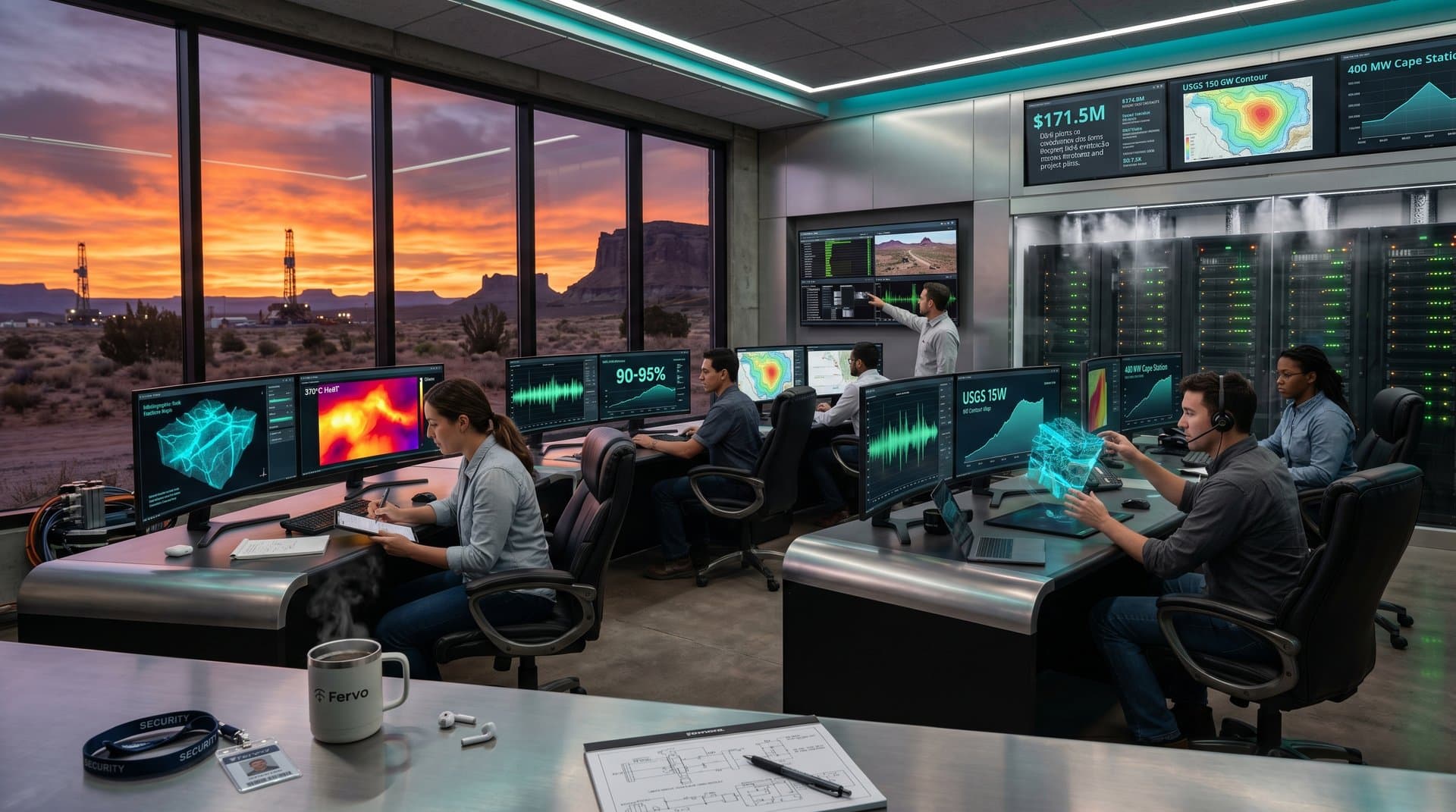
- DOE awards Fervo $171.5 million for EGS pilots across 3 states.
- USGS assesses 150 GW EGS capacity in US hot dry rocks.
- Cape Station delivers 400 MW commercial EGS power by 2026.
Fervo Energy unveiled a geothermal breakthrough advancing enhanced geothermal systems (EGS) to unlock 150 GW of US capacity. This firm power stabilizes grids amid renewables growth. Cape Station in Beaver County, Utah, breaks ground this year. The US Department of Energy (DOE) awarded Fervo $171.5 million on February 21, 2024. (38 words)
Paolo Bertuzzi, president of Turboden America, endorses EGS. "Geothermal energy will be essential in stabilising a strained power grid with clean, firm energy," Bertuzzi states in an OilPrice.com interview.
Fervo filed its IPO with the US Securities and Exchange Commission (SEC) on April 15, 2024, to fund nationwide expansion. Turboden readies turbine deliveries across the US. Bertuzzi adds: "We are prepared to scale delivery in the U.S. market and add megawatts wherever required."
The US Energy Information Administration (EIA) reports 99 operating geothermal plants as of 2023: 53 in California, 32 in Nevada, and others scattered. EIA geothermal data.
EGS Technology Delivers 150 GW Firm Power Potential
Fervo pioneers EGS by drilling into hot dry rocks at 370°C, beyond traditional hydrothermal reservoirs limited to permeable zones. The US Geological Survey (USGS) estimates this untapped resource base supports 150 GW nationwide capacity. USGS EGS assessment.
Cape Station aims for first commercial-scale EGS output in 2026 at 400 MW nameplate. Google secured power purchase from Fervo's Project Corsac in Nevada. EGS delivers dispatchable baseload power, complementing 4-hour lithium-ion batteries by handling daily cycling.
Operators hydraulically fracture hot rock, inject water via injection wells, heat it to superheated steam at 300-400°C, and circulate to production wells driving turbines. Sites hit 90-95% circulation efficiency in pilots, exceeding vanadium redox flow batteries' 70-80% round-trip efficiency, per Sandia National Laboratories field tests reported in 2023.
Horizontal drilling, adapted from shale oil techniques, slashes well costs 50% to $5-7 million per well from $10-15 million vertical baselines, Fervo discloses in SEC filings.
Geothermal Baseload Cuts Battery Storage Demands 20-30%
Geothermal baseload runs continuously for 30-50 years with near-zero degradation, unlike lithium-ion batteries limited to 4-6 hour duration and 3,000-5,000 cycles before 20% capacity fade. It firms intermittent solar and wind, slashing battery duty cycles and levelized cost of storage (LCOS).
Wood Mackenzie calculates hybrid EGS-battery systems lower total costs 20-30% by reserving batteries for peaks. California hosts 85% of US plants yet faces duck curve peaks; the California Energy Commission projects 200 GW solar by 2030, demanding firming capacity.
Turboden supplies organic Rankine cycle (ORC) turbines optimized for 150-200°C lower-temperature fluids, enabling EGS at new inland sites away from volcanic zones. This sidesteps lithium supply chain risks from China and Congo, per International Energy Agency (IEA) 2024 reports.
Grid operators gain 24/7 dispatchability at 95%+ availability, aligning with FERC Order 2222 for aggregated distributed resources including storage.
DOE's $171.5 Million Accelerates EGS Pilots Nationwide
DOE's $171.5 million funds EGS demonstration pilots in Utah, Oregon, and Idaho—states with 4 plants each in Oregon/Utah and 1 in Idaho per EIA. DOE funding announcement.
Hawaii and Alaska, operating 2 plants each, eye EGS for isolated grids. Inflation Reduction Act (IRA) production tax credits offer $0.0275/kWh base plus adders up to $0.015/kWh, lifting project internal rates of return (IRRs) to 10-12%, DOE models show.
Fervo's IPO targets initial $500 million to build Cape Station's 400 MW in phases. Geothermal achieves levelized cost of energy (LCOE) of $50-70/MWh at scale, rivaling combined-cycle gas at $45-60/MWh, Fervo reports in IPO prospectus.
Nevada mandates 4 GW storage by 2030; EGS provides equivalent infinite-duration storage without recharge limits.
150 GW EGS Transforms Storage and Renewables Landscape
USGS data indicates EGS could generate 10% of US electricity, matching nuclear's 100 GW contribution. Wood Mackenzie forecasts 5 GW EGS online by 2035 with policy tailwinds.
Fervo-Google contracts de-risk financing, attracting EPC firms. Iceland's 800 MW geothermal fleet proves 99% uptime scalability over decades.
Fervo's breakthroughs set 2026 milestones for commercial validation. EGS integrates with batteries to optimize grid economics, per DOE trajectories. OilPrice.com analysis.
Frequently Asked Questions
What is Fervo's geothermal breakthrough?
EGS drills into 370°C hot dry rocks, injects water for steam turbines. USGS estimates 150 GW US potential for firm grid power.
How does EGS support grid storage?
Provides baseload to firm renewables, cuts battery cycling needs. Optimizes LCOS; hybrids with 4-hour Li-ion save 20-30% system costs.
What DOE funding backs EGS projects?
$171.5 million awarded February 2024 for Utah, Oregon, Idaho pilots. IRA credits add up to $0.0425/kWh, lifting IRRs to 10-12%.
Where are US geothermal plants located?
99 total per EIA: California (53), Nevada (32), Oregon/Utah (4 each), Idaho (1), Hawaii/Alaska (2 each).