- 500 MW AI campus matches 500 MWe nuclear output.
- 200 MW/800 MWh BESS shaves 20% of peaks.
- NJ BPU mandates 2 GW storage by 2030.
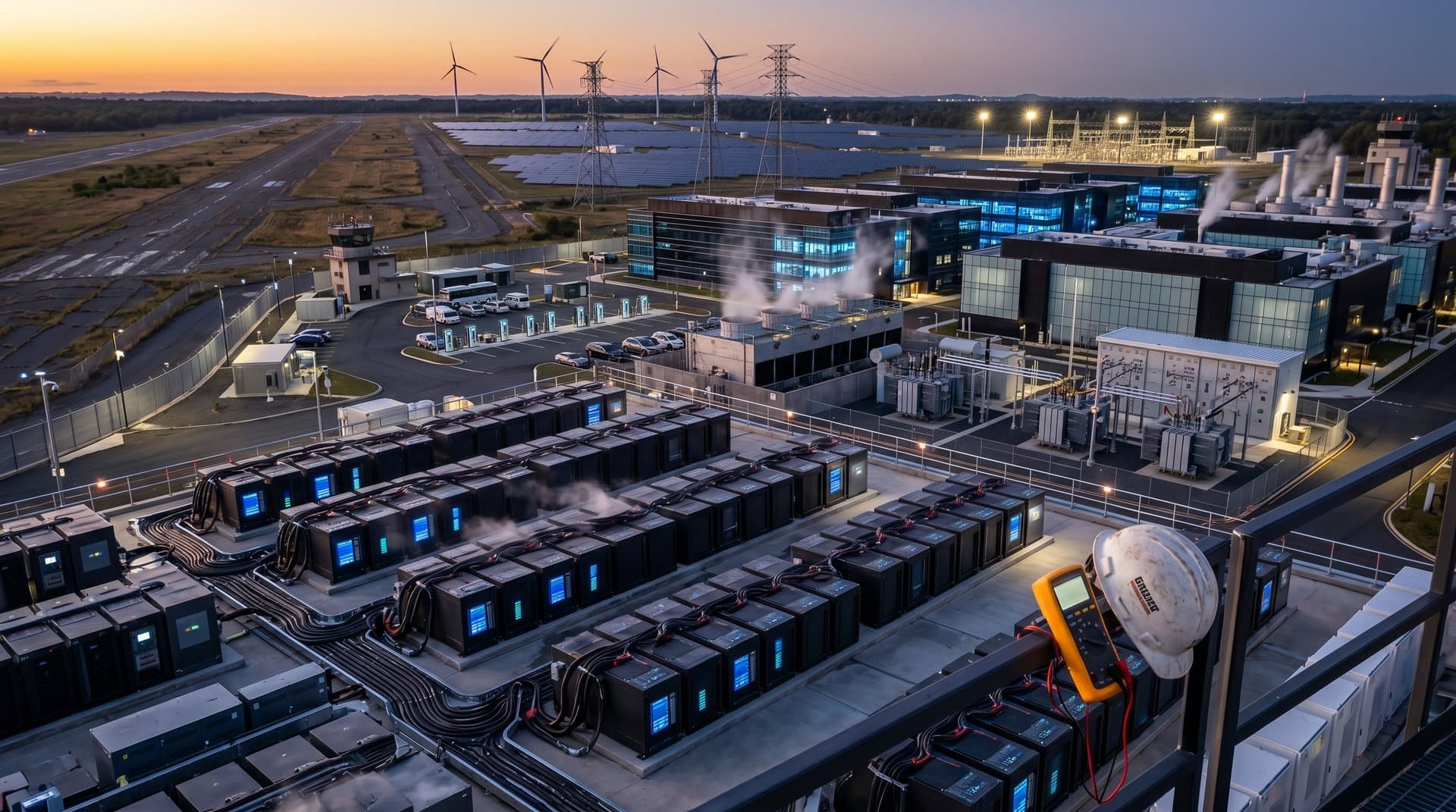
PSE&G evaluates 200 MW/800 MWh grid storage at a decommissioned New Jersey airport for a 500 MW AI data center campus. The four-hour lithium-ion battery energy storage system (BESS) targets peak shaving and PJM capacity markets.
The 1,000-acre site sits near 345 kV substations, cutting upgrade costs.
500 MW AI Data Centers Rival Nuclear Plant Output
AI data centers demand 500 MW continuously, matching a 500 MWe nuclear reactor. Cooling boosts total draw by 50%. IEA report forecasts global data center power doubling to 1,000 TWh by 2026 (IEA, "Data Centres and Data Transmission Networks," 2024).
PSE&G interconnection studies identify voltage stability risks without storage. BESS provides 20% peak shaving through arbitrage and frequency services.
Repurposed Airports Accelerate AI Data Center Builds
Airport runways enable heavy truck access for cooling towers. Zoning approvals complete in months versus years on greenfield sites. New Jersey grants 30-year property tax abatements.
Proximity to fiber optics delivers sub-1 ms latency. CBRE reports land costs 70% lower than urban alternatives.
PJM transmission queues stretch 5-7 years. Co-located behind-the-meter BESS avoids them.
Lithium-Ion BESS Stabilizes 500 MW AI Loads
Lithium-ion BESS responds in milliseconds per IEC 62933-5-4 standards. It achieves 90% round-trip efficiency at 0.25C discharge and 250 Wh/kg energy density (typical LFP cells, CATL specs). Daily 90% depth-of-discharge sustains four-hour duration over 10,000 cycles at 80% retention.
NREL profile documents the 400 MW/1,600 MWh Moss Landing BESS handling CAISO peaks similarly (NREL, 2021).
Inflation Reduction Act Section 48 investment tax credit (ITC) offers 30-50% value, reducing levelized cost of storage (LCOS) to USD 140/MWh per Fluence estimates.
- Metric: Continuous Power (MW) · Traditional DC: 50-100 · AI DC Campus: 500 · With 200 MW BESS: 20% peaks shaved
- Metric: Storage Capacity (MWh) · Traditional DC: 0 · AI DC Campus: 0 · With 200 MW BESS: 800 (4-hour)
- Metric: Energy Density (Wh/kg) · Traditional DC: N/A · AI DC Campus: N/A · With 200 MW BESS: 250
- Metric: Stacked Revenues · Traditional DC: Basic · AI DC Campus: Ancillary · With 200 MW BESS: +30% (PJM markets)
New Jersey Targets 2 GW Utility-Scale Storage by 2030
NJ Board of Public Utilities (BPU) mandates 2 GW BESS procurement. RFPs prioritize data center co-location. PJM reforms slash queues by 50%.
FERC summary mandates BESS integration in transmission plans (FERC, 2024). Hyperscalers commit USD 100 billion to US data centers; New Jersey targets 5% share.
AI Surge Fuels 25% Annual BESS Growth
Wood Mackenzie projects 25% compound annual growth for co-located BESS through 2030. New Jersey's pipeline exceeds 1 GW. Bloomberg analysis identifies 35 GW US data center additions by 2030 (BloombergNEF, May 2024).
Tesla Megapack four-hour units scale via virtual power plants (VPPs). PSE&G RFPs launch Q2 2026, granting first-mover rights to 200 MW grid storage projects.
Frequently Asked Questions
Why grid storage for NJ AI data centers?
Handles 500 MW GPU peaks. Enables PJM arbitrage. PSE&G deploys for stability.
AI power vs. BESS capacity?
300-500 MW draw. 200 MW/800 MWh four-hour BESS shaves 20% peaks (NREL).
NJ policies for airport storage?
IRA 50% ITC. BPU 2 GW by 2030. FERC 1920 prioritizes queues.
Airports for AI with BESS?
1,000 acres, substations ready. Ensures 99.999% uptime.