- Belgium nuclear policy retains ENGIE's 7 reactors at 2.9 GW (4 active).
- Reverses 2025 phase-out via 80% majority 2024 vote.
- Cuts battery LCOS 20-30%, drives 20% LDES growth to 2030.
Belgium nuclear policy changes. Prime Minister Bart De Wever halts ENGIE's seven-reactor decommissioning. Four reactors run at 2.9 GW total capacity; three await upgrades. This reverses the 2003 Nuclear Phase-Out Act's 2025 deadline after an 80% parliamentary majority vote in 2024 (DPA International, October 2024).
De Wever prioritizes baseload power. "This government chooses safe, affordable, sustainable energy with less fossil import dependence," he stated Thursday (DPA International).
Nuclear complements renewables. It cuts curtailment by 15-20%, per IEA models (IEA Nuclear Power and Secure Energy Transitions, 2022). Batteries gain 4,000+ cycles and LCOS drops below $150/MWh.
ENGIE's 2.9 GW Fleet at Doel, Tihange
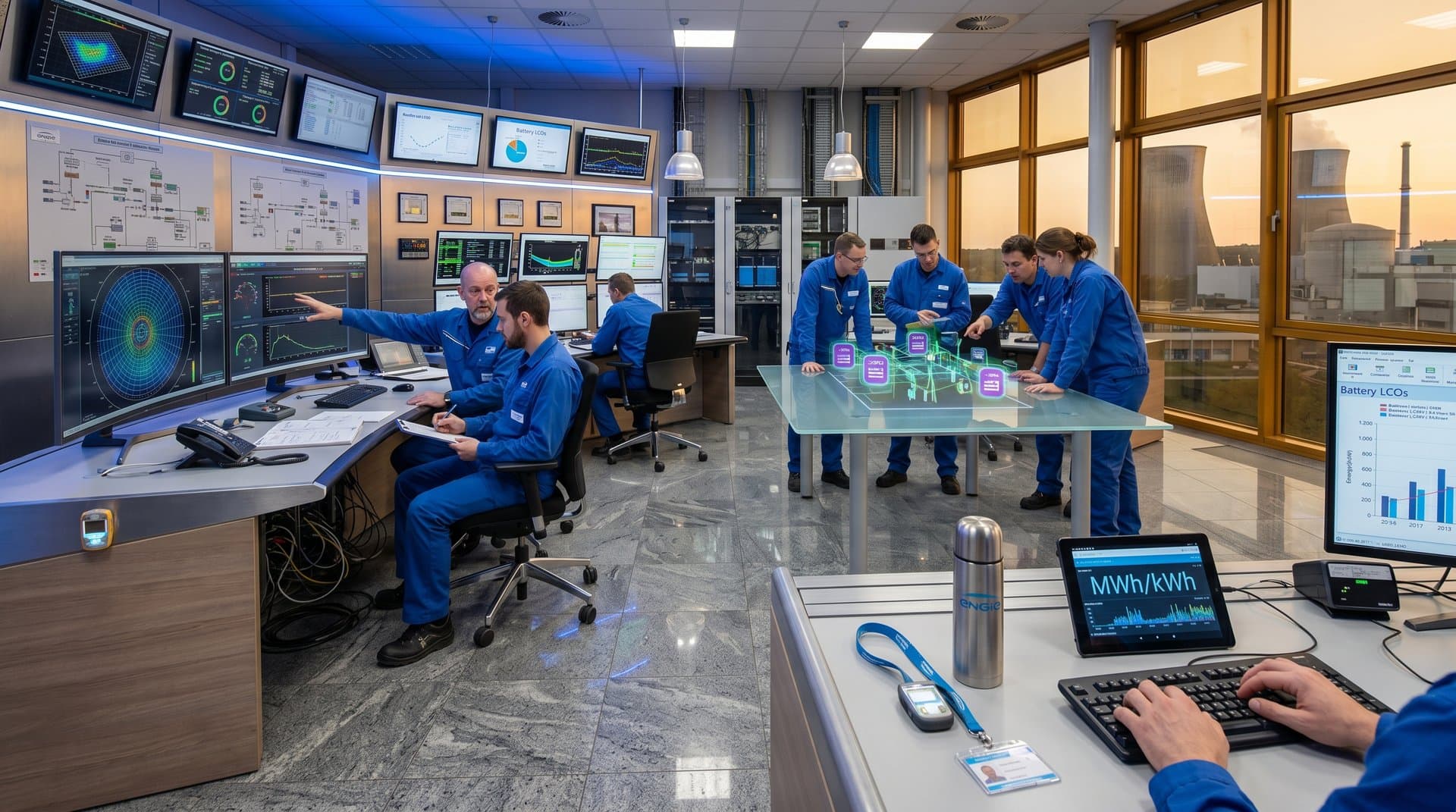
ENGIE operates Doel 1-4 (2.6 GW) and Tihange 1-3 (0.3 GW). Doel 3 outputs 1 GW after 2023 refits meeting IAEA standards (World Nuclear Association Belgium profile, 2024).
Nuclear dispatch fits EU Electricity Market Design (Regulation 2019/943). Storage arbitrage uses €0.02-0.05/kWh spreads from wind and solar excess.
Lithium-ion batteries reach 85-90% round-trip efficiency (RTE) at 0.5C per IEC 62660-1. They handle nuclear's steady cycles without degradation.
Timeline: 2003 Act to 2040 Extensions
The 2003 law set 2025 exit. Russia's 2022 crisis and 2024 vote (76-23) enabled extensions.
Federal Agency for Nuclear Control (FANC) reviews under Royal Decree 2003. ENGIE seeks 10-year licenses to 2035-2040, investing €500 million (ENGIE nuclear operations, 2024).
Revenues support 100 MW+ nuclear-storage hybrids.
Nuclear Baseload Cuts Battery LCOS 25%
Nuclear flattens duck curves. Batteries utilize 20-30% more via predictable recharge (BloombergNEF Q2 2024 Battery Report). Arbitrage stabilizes at €40-60/MWh.
Belgium eyes 10 GW renewables by 2030 (Federal Planning Bureau). Batteries manage frequency response; nuclear adds inertia.
Vanadium flow batteries offer 4-hour duration, 75% RTE, 20,000 cycles (G2V standard). Iron-air provides 100-hour at $20/kWh (Form Energy).
Top Battery Chemistries for Nuclear Pairing
Lithium-ion leads short-duration at $120/kWh (BloombergNEF Q2 2024). It delivers 6,000 cycles at 80% depth-of-discharge with baseload.
Sodium-ion hits $90/kWh by 2027 (CATL). Nuclear enables 10,000+ cycles via zero-marginal-cost recharge.
ENGIE tests 50 MW V2G at Doel with second-life EV packs (2,000 cycles). EU Battery Regulation 2023/1542 requires 16% recycled content by 2031.
Stakeholder Views and Hurdles
ENGIE reports 92% capacity factor, LCOE at €30/MWh (World Nuclear Association). Greens demand waste plans per BFE law.
Battery firms eye TenneT hybrid tenders. Regulators update capacity markets (EU Clean Energy Package).
Licensing risks $50 million/MW, but 95% availability offsets costs post-FANC approval.
Global Benchmarks: Nuclear-Storage Hybrids
France uses 56 reactors for 70% power, minimal storage. Germany adds 5 GW batteries post-exit.
- Country: Belgium · Reactors: 7 · % Power: ~40% · Storage (GW by 2030): 2 GW firming hybrids
- Country: France · Reactors: 56 · % Power: 70% · Storage (GW by 2030): 0.5 GW export balance
- Country: Germany · Reactors: 0 · % Power: 0% · Storage (GW by 2030): 15 GW peaker replace
Sources: World Nuclear Association, 2024; IRENA Renewables Outlook.
Belgium mirrors US IRA ($7.5/MWh credit). Nuclear drives 20% LDES CAGR to 2030 (BloombergNEF). Batteries secure 800 MWh projects post-FANC nods, optimizing grid storage economics.
Frequently Asked Questions
What triggered Belgium's nuclear policy change?
2024 parliamentary vote (80% majority) overturned 2003 Act's 2025 phase-out. PM De Wever halted decommissioning Thursday (DPA).
How does Belgium nuclear policy aid grid storage?
Baseload reduces curtailment 15-20%, optimizes cycles, lowers LCOS to <$150/MWh (IEA). Enables hybrids and frequency services.
Who operates Belgium's nuclear reactors?
ENGIE runs 7 reactors (2.9 GW) at Doel and Tihange; 4 active after FANC safety reviews (World Nuclear Association).
What battery tech pairs best with nuclear?
Li-ion (85-90% RTE, $120/kWh, 6,000 cycles), Na-ion ($90/kWh), flow (20,000 cycles). EU Reg 2023/1542 aligns recycling.