- Goldman Sachs forecasts 160% power demand increase from AI data centers by 2030.
- IEA projects data center electricity doubling to 2-3% of global total by 2026.
- FERC Order No. 1920 unlocks 300 GW including 100 GW storage from queues.
Goldman Sachs forecasts a 160% increase in US power demand from AI data centers by 2030. Battery storage emerges as a key battleground in 2026 elections. Texas grids strain under AI facilities near Lufkin, according to ERCOT reports. FERC Order No. 1920 speeds transmission planning, but battery queues stretch years long.
IEA data projects global data center electricity doubling to 2-3% of total demand by 2026. This boom drives urgent need for long-duration energy storage (LDES) solutions.
AI Data Centers Strain Texas Grids, Spike Battery Demand
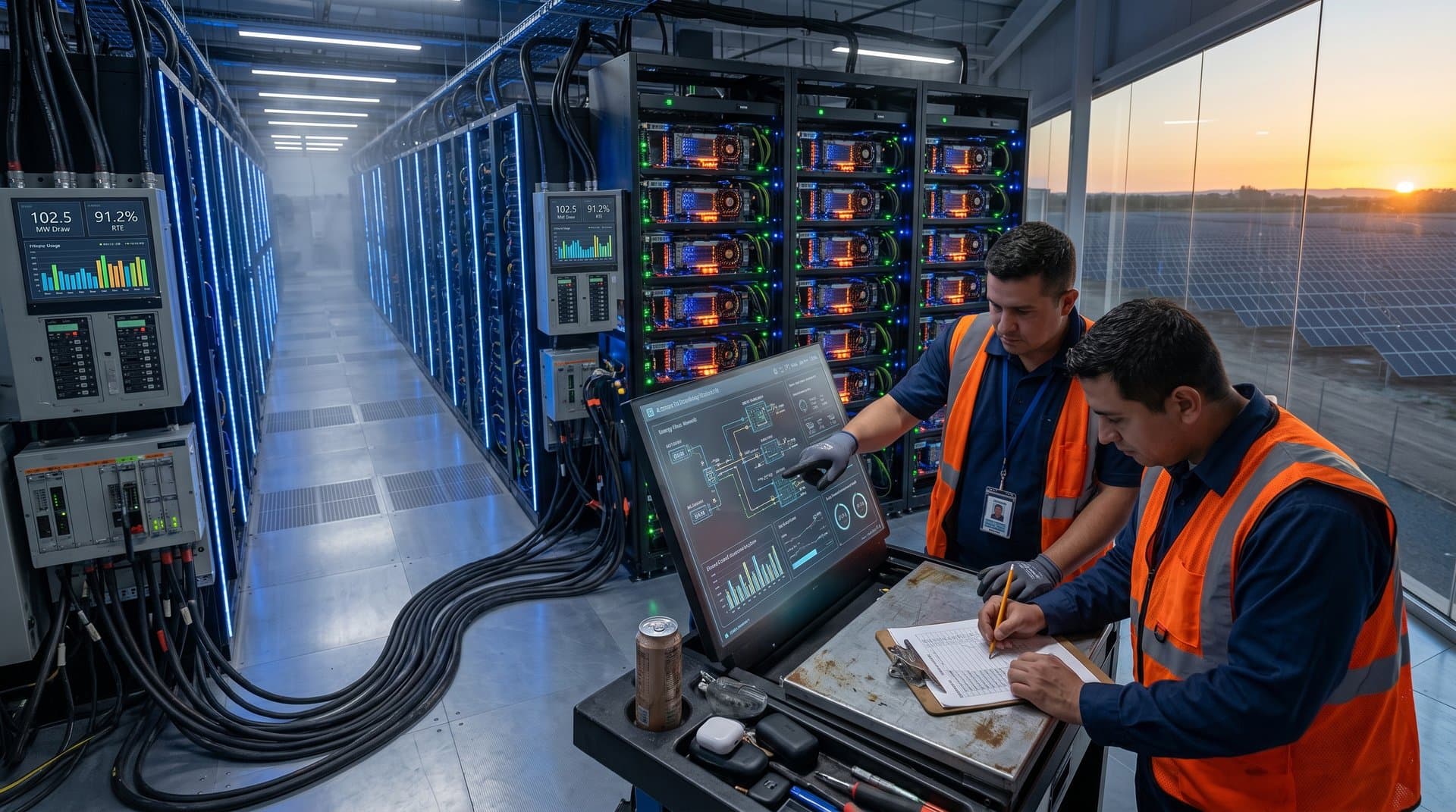
AI training clusters consume power rivaling small cities. Microsoft and Google erect massive campuses in Texas and Virginia. Data center loads grow faster than grid expansions.
IEA confirms this electricity doubling by 2026. ERCOT data pegs data centers at 10% of new load growth in the Lufkin region.
Lithium-ion batteries deliver blackstart capabilities for rapid outage recovery. They offer millisecond frequency regulation with over 90% round-trip efficiency (RTE) and 90% depth of discharge (DoD), per NREL testing.
Batteries Provide Firm Capacity for AI's 24/7 Needs
Battery systems deliver firm, dispatchable capacity for nonstop AI operations. Flow batteries and iron-air batteries enable LDES beyond 10 hours, surpassing lithium-ion's typical 4-hour duration.
LFP cathodes lead grid applications with 160 Wh/kg gravimetric density and 400 Wh/L volumetric density at costs below NMC's 250 Wh/kg and 700 Wh/L.
- Technology: LFP Lithium-ion · Energy Density (Wh/kg / Wh/L): 160 / 400 · Duration: 2-4 hours · Cycle Life: 6,000+ · Cost (USD/kWh): 150
- Technology: NMC Lithium-ion · Energy Density (Wh/kg / Wh/L): 250 / 700 · Duration: 2-4 hours · Cycle Life: 2,000+ · Cost (USD/kWh): 200
- Technology: Flow Batteries · Energy Density (Wh/kg / Wh/L): 30-50 / 40-60 · Duration: 8+ hours · Cycle Life: 10,000+ · Cost (USD/kWh): 250
- Technology: Iron-Air · Energy Density (Wh/kg / Wh/L): 100+ / 200+ · Duration: 100 hours · Cycle Life: 5,000+ · Cost (USD/kWh): 100 (target)
NREL's 2023 benchmarks validate these metrics under IEC 62619 standards. Utilities combine short-duration batteries with pumped hydro for hybrid solutions. Goldman Sachs links modular battery storage to capex savings—at half the cost per MW of new transmission lines.
FERC Order 1920 Tackles 2,000 GW Interconnection Backlog
FERC documents show 2,000 GW stuck in US interconnection queues. Order No. 1920 mandates cluster studies, unlocking 300 GW—including 100 GW of storage projects.
ERCOT operates 10 GW of batteries online today. AI hubs near Lufkin demand rapid expansions. Reuters reports data center power needs tripling by 2028.
The IRA's 30% Investment Tax Credit (ITC) for standalone storage drove fivefold deployment growth since 2022, US Department of Energy (DOE) data reveals. Democrats champion IRA extensions; Republicans push faster permitting for nuclear and fossil alternatives.
Supply Chain Shifts Accelerate Battery Deployment
Solid-state prototypes hit 400 Wh/kg at Argonne National Laboratory. QuantumScape demonstrates 1,000+ cycles at 80% DoD without dendrite formation, targeting 2026 commercialization.
EV second-life battery packs slash levelized cost of storage (LCOS) below USD 0.10/kWh, NREL calculates. Ford's F-150 Lightning vehicle-to-grid (V2G) pilots aggregate fleet capacity for grid backups, delivering 10 MW per site.
Lithium carbonate prices dropped 50% from 2023 peaks, thanks to IRA incentives, Benchmark Mineral Intelligence tracks. CATL exports LFP cells from China to US projects, navigating 25% tariffs via Mexico assembly.
Rare earth dependencies for NMC cathodes prompt diversification. Australia and Chile supply 70% of global lithium, facing US trade scrutiny under IRA domestic content rules.
LDES Scales Up on AI Demand and Policy Momentum
AI transforms LDES from niche to essential grid infrastructure. Form Energy commissions an 85 MW/8,500 MWh iron-air facility in Minnesota—the world's first 100-hour discharge commercial plant.
BloombergNEF projects USD 50 billion in annual storage capex through 2030. FERC reforms and potential IRA extensions propel this growth. The 2026 elections will dictate permitting speeds for transmission and storage alike.
Geopolitical tensions shadow supply chains: 70% lithium reliance on Australia-Chile invites tariffs. Battery storage bridges AI power gaps today, preventing blackouts through targeted policy alignment and rapid deployments.
Frequently Asked Questions
How does the AI data center boom impact battery storage demand?
AI requires constant power, so batteries handle peaks and backups. Goldman Sachs projects 160% demand growth, boosting LDES. Systems achieve 90%+ round-trip efficiency.
What battery storage policies face 2026 election debate?
IRA tax credits and FERC Order No. 1920 lead discussions. Democrats back renewables; Republicans seek permitting reforms. ERCOT needs 10 GW more for AI.
Why do grid upgrades matter for AI data centers?
Queues hit 2,000 GW per FERC. Order No. 1920 enables 300 GW via cluster studies. Batteries fill gaps pre-transmission.
How does battery tech ensure AI power reliability?
LFP provides millisecond frequency response. Iron-air delivers 100-hour LDES. NREL notes LCOS under $0.10/kWh via second-life packs.