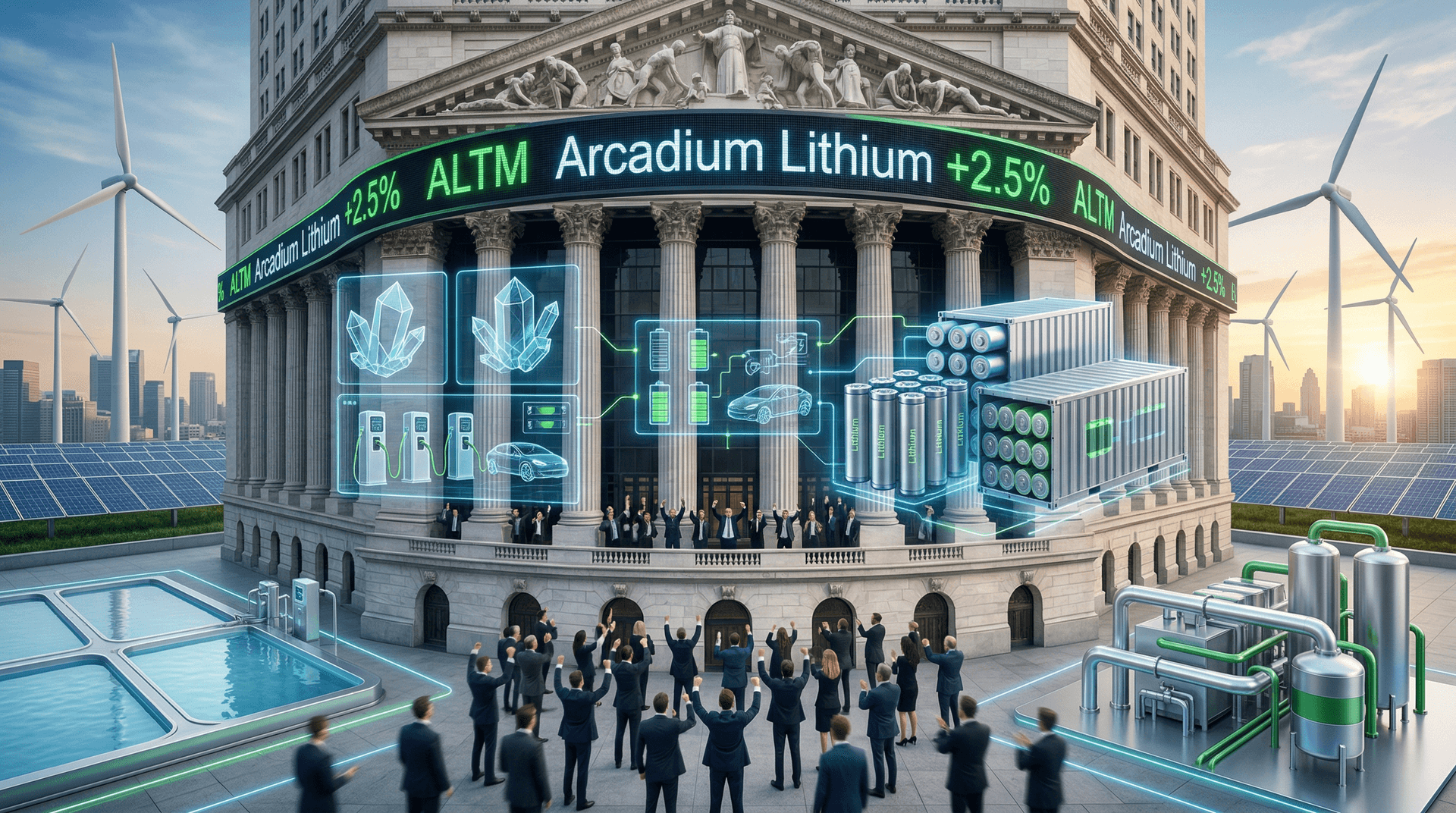
New York, June 5, 2024 – In a landmark moment for the battery technology sector, Arcadium Lithium Corporation (NYSE: ALTM) rang the opening bell at the New York Stock Exchange on June 3, 2024, marking its debut as a publicly traded company. The entity emerged from the all-share merger of U.S.-based Livent Corporation and Australia-listed Allkem Limited, valued at approximately $10.6 billion, creating the world's third-largest producer of lithium chemicals by capacity.
Merger Background and Strategic Rationale
The merger, first announced in January 2024, closed on May 31, 2024, after receiving regulatory approvals across multiple jurisdictions, including the U.S., Australia, Argentina, and China. Paul Graves, former CEO of Livent, now leads Arcadium as CEO, with Allkem's Martín Salinas serving as president. The combined company boasts a diversified portfolio of lithium assets spanning the Americas and Australia, including hard-rock mines, brine operations, and downstream conversion facilities.
Key assets include:
- Salinas Grandes and Cauchari-Olaroz in Argentina: High-grade brine projects ramping up production.
- Olaroz lithium operation: Already producing lithium carbonate.
- Mt. Cattlin in Western Australia: Spodumene concentrate mine.
- Nemaska Lithium in Quebec, Canada: Under development for hydroxide production.
- Kemerton and Kwinana plants in Australia: Lithium hydroxide facilities.
This geographic diversity mitigates supply risks associated with single-region dependency, a critical factor as global battery demand escalates. Arcadium now holds about 15% market share in lithium chemicals, trailing only Albemarle and Sociedad Química y Minera (SQM).
Implications for Battery Technology
Lithium remains the cornerstone of lithium-ion batteries powering electric vehicles (EVs), consumer electronics, and increasingly, grid-scale energy storage systems (BESS). Arcadium's scale enables it to supply battery-grade lithium carbonate and hydroxide optimized for both nickel-manganese-cobalt (NMC) and lithium-iron-phosphate (LFP) cathodes.
In energy storage applications, where cycle life and safety are paramount, LFP chemistries are gaining traction. According to BloombergNEF, LFP accounted for over 40% of EV battery demand in 2023, a trend extending to stationary storage. Arcadium's hydroxide products support high-nickel cathodes for energy-dense BESS, essential for long-duration storage to integrate renewables.
"The formation of Arcadium Lithium strengthens the global battery supply chain at a pivotal time," said Graves in a statement. "Our integrated model from mine to market will deliver reliable, sustainable lithium to meet the explosive growth in electrification and energy storage."
Lithium Market Dynamics
The timing of Arcadium's debut coincides with a lithium market in flux. Spot prices for lithium carbonate have plummeted over 80% from 2022 peaks due to oversupply from new capacity in Australia and China, hovering around $12,000-$15,000 per tonne in Q2 2024. However, structural deficits are projected by 2026 as EV sales and BESS deployments accelerate.
Global energy storage installations hit 100 GW cumulative by end-2023, with China leading at 80% of additions. In the U.S., the Inflation Reduction Act (IRA) has spurred over 20 GW of BESS projects in development, reliant on secure domestic-aligned supply chains. Arcadium's U.S. and Canadian assets position it favorably for IRA incentives, including tax credits for critical minerals.
| Metric | Pre-Merger (Livent + Allkem) | Arcadium Lithium |
|---|---|---|
| Lithium Carbonate Capacity | ~100 ktpa | 180 ktpa |
| Lithium Hydroxide Capacity | ~20 ktpa | 50 ktpa (ramping) |
| Market Cap (est.) | $10B+ | $9.5B (at debut) |
| Geographic Spread | Americas/Australia | Enhanced diversification |
Technological Edge in Battery Materials
Arcadium emphasizes sustainable production and innovation. Its facilities incorporate direct lithium extraction (DLE) technologies at projects like Rincón in Argentina, promising 50% lower water use compared to traditional evaporation ponds. This aligns with ESG demands from battery makers like Tesla, CATL, and LG Energy Solution, who prioritize low-carbon footprints.
For battery technologists, consistent high-purity lithium (>99.5% for hydroxide) is vital to minimize impurities that degrade cell performance. Arcadium's downstream capabilities ensure tailored chemistries: high-nickel for premium EV packs (energy densities >250 Wh/kg) and standard-grade for cost-sensitive ESS (>150 Wh/kg).
In grid applications, BESS require batteries enduring 10,000+ cycles. Lithium supply stability directly impacts megafactory ramps, such as Tesla's Lathrop Megafactory or Fluence's global projects. Disruptions seen in 2022 underscored the need for players like Arcadium.
Challenges and Outlook
Near-term headwinds include price volatility and Chinese dominance (70% of refining). Arcadium plans $1B+ capex in 2024-2025 for expansions, targeting 260 ktpa carbonate equivalent by 2028. Debt levels post-merger stand at manageable ~1.5x EBITDA.
Analysts view the debut positively, with JPMorgan initiating coverage at 'Overweight' citing cost synergies of $100M+ annually. Shares traded flat to slightly up on debut amid broader market caution on commodities.
A Milestone for Energy Storage
Arcadium Lithium's NYSE listing caps a transformative deal, bolstering the battery ecosystem. As deployments surge—U.S. alone added 7 GW BESS in 2023—the company's role in fueling the energy transition cannot be overstated. Watch for offtake deals with majors and project milestones as indicators of rebounding lithium fortunes.
For battery engineers and financiers, this event signals consolidation in upstream materials, paving the way for next-gen tech like solid-state and sodium-ion hybrids, all underpinned by lithium.
Word count: 912