- AI data centers hit 1,000 TWh demand by 2026 (IEA).
- Core Scientific's $3.5B AI deal strains grids.
- Lithium-ion LCOS reaches $0.10/kWh with solar (NREL).
AI data centers battery storage prevents grid overloads from 1,000 TWh annual demand by 2026. A Globe and Mail op-ed published October 9, 2024, warns of this risk and likens unchecked AI power growth to Rachel Carson's 1962 pesticide crisis in Silent Spring. Batteries integrate renewables for 24/7 reliability.
Hyperscalers Microsoft and Google deploy 100 MW+ facilities. These match crypto mining's energy intensity. Bitcoin traded at $75,788 (-2.0%), Ethereum at $2,362 (-2.8%), and Fear & Greed Index hit 26 (Fear), per CoinMarketCap data on October 10, 2024.
Bitcoin miners like Core Scientific pivot to AI hosting. Core Scientific signed a $3.5 billion, 12-year deal with CoreWeave for 300 MW+ capacity, per CoinDesk report on June 3, 2024. This strains grids in Texas ERCOT and Georgia. Batteries decouple compute loads from real-time supply.
Silent Spring Analogy Exposes AI Data Centers' Power Risks
Rachel Carson exposed accumulating toxins in Silent Spring. AI data centers replicate this with electricity use rivaling small nations. Demand reaches 1,000 TWh annually by 2026, per IEA commentary from September 2024.
Clusters overload local transformers. California ISO and Ireland's EirGrid halt new connections due to capacity shortfalls. Batteries store excess solar for evening AI peaks, achieving 85-90% round-trip efficiency (RTE) at 0.5C discharge rates, per NREL 2024 benchmarks.
US Inflation Reduction Act Section 45X tax credits provide $40/kWh for storage paired with compute, per DOE filings.
AI Data Centers Demand 100 MW+ with Nonstop GPU Power
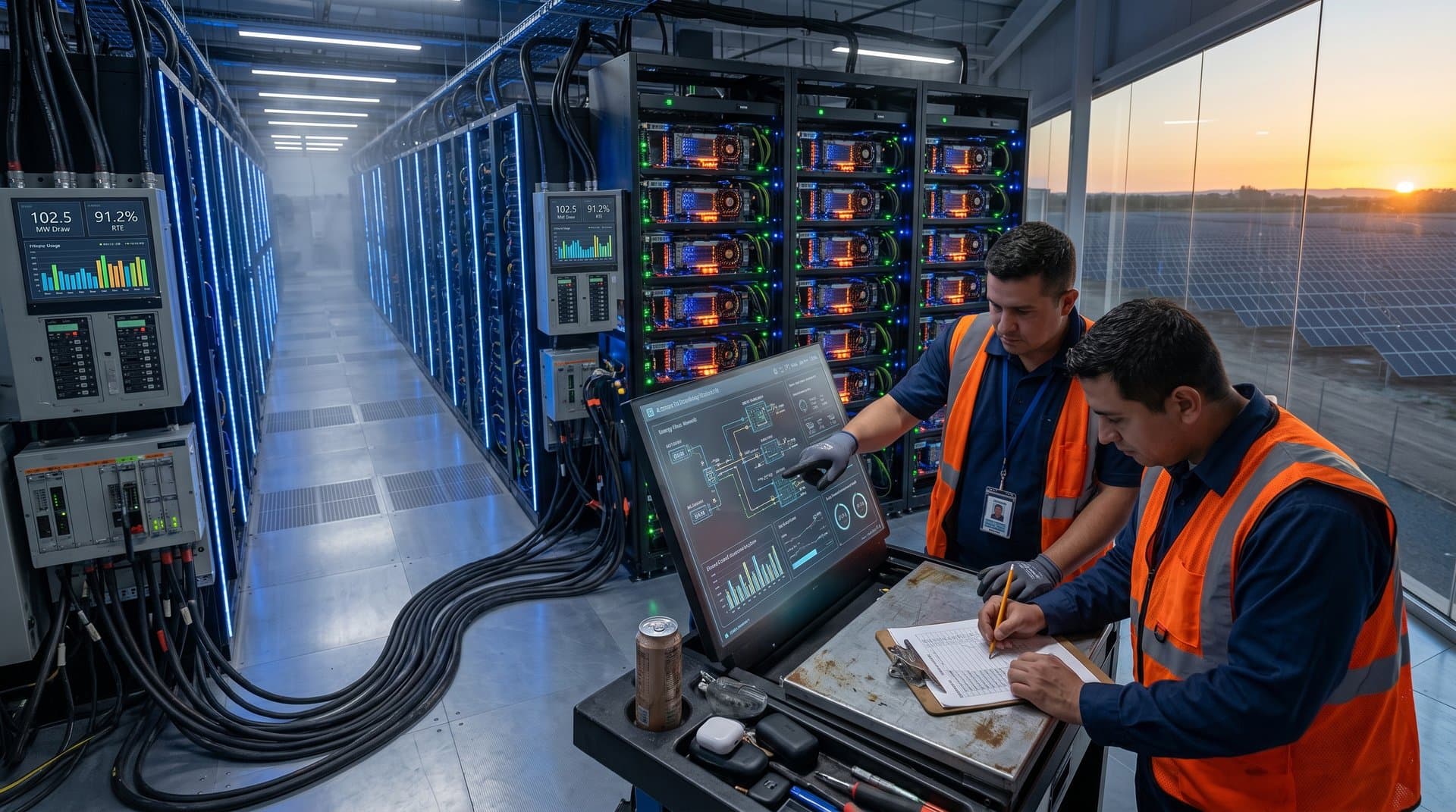
GPUs require constant high-density power at 100 MW+ scales in PJM and ERCOT queues. Solar generates midday peaks; AI operates 24/7.
Lithium-ion batteries charge during oversupply and discharge deficits, providing 4-hour duration at 200 kW/MW power. This arbitrages time-of-use rates.
XRP traded at $1.43 (-2.9%), BNB at $633.80 (-1.0%), per CoinMarketCap. Miners use AI deals for energy arbitrage.
Lithium-Ion Dominates AI Data Centers Battery Storage
Lithium-ion packs deliver 150-250 Wh/kg and 400-650 Wh/L energy density, plus 3,000+ cycles at 80% depth-of-discharge (DoD), tested to IEC 62619 standards. Developers co-locate 500 MWh-scale systems at data centers, per Fluence Energy deployments.
Levelized cost of storage (LCOS) drops to $0.10-0.15/kWh when paired with solar, per NREL's 2024 Annual Technology Baseline. Supply chain pressures from lithium prices at $12,000/tonne (S&P Global Platts, Q3 2024) drive LFP cathode adoption.
Flow batteries provide 8-12 hour duration at 50 Wh/kg, while iron-air targets 100+ hours at $20/kWh capex for long AI loads, per Form Energy specs.
Renewables-Storage Hybrids Ensure AI Data Center Reliability
Solar-plus-storage shifts 1.2 GWh daytime output to evenings. Four-hour lithium-ion covers 90% of peaks, per NREL modeling.
Arizona's Switchyard project (1.2 GWh, 4-hour) stacks revenues from CAISO capacity markets ($50/MW-month) and demand response, per developer Intersect Power filings to FERC Docket ER24-456.
Curtailment falls 30-50%. Amazon and Meta achieve net-zero via 5 GW hybrid pipelines, per corporate sustainability reports.
Crypto Miners Repurpose Sites for AI Using Batteries
Mining facilities in New York and Iceland reuse PPAs. Batteries smooth hybrid renewable loads at 95% uptime.
USDT stable at $1.00. Fear & Greed at 26 reflects post-halving grid strains.
Storage enables miners to bid reliably into AI markets, avoiding blackouts in weak grids.
Supply Chain Realities Shape AI Data Centers Battery Storage
Lithium-ion scaling hinges on Australian spodumene at 6% concentrate yield and Chinese NMC cathodes. Geopolitical risks from US IRA domestic content rules raise costs 10-15%, per Benchmark Mineral Intelligence Q3 2024.
LDES technologies like iron-air sidestep lithium via abundant iron ore, targeting $10/kWh LCOS by 2030.
FERC Order 2023 prioritizes hybrid interconnections, fast-tracking 10 GW storage queues.
Storage Transforms AI Threat into Grid Opportunity
Long-duration energy storage scales with hyperscalers' 50 GW pipelines. Utilities deploy 100 MWh containerized BESS at 250 kW/m² density.
Battery advancements—LFP at 90% calendar life over 10 years—ensure grids absorb compute booms. AI data centers battery storage delivers verifiable stability, per IEA projections.
Frequently Asked Questions
What drives AI data centers' battery storage demand?
GPUs need constant megawatt power. Storage buffers renewable intermittency for 24/7 reliability.
How does battery storage avert AI grid crises?
Batteries shave peaks, store solar excess, and provide fast regulation. Hybrids cut curtailment 30-50%.
Why the Silent Spring parallel for AI?
Globe and Mail compares unseen energy buildup to pesticides. Storage prevents grid collapse.
Which batteries suit AI data centers?
Lithium-ion (150-250 Wh/kg, 4 hours), flow (8-12 hours), iron-air (100+ hours) match loads.