- Vesuvius AI decodes 2,000+ characters at 1-5 micron resolution.
- NREL CT achieves sub-micron voxels for 95% defect detection.
- NDT cuts solar R&D time 80%, avoids teardowns for GWh scale.
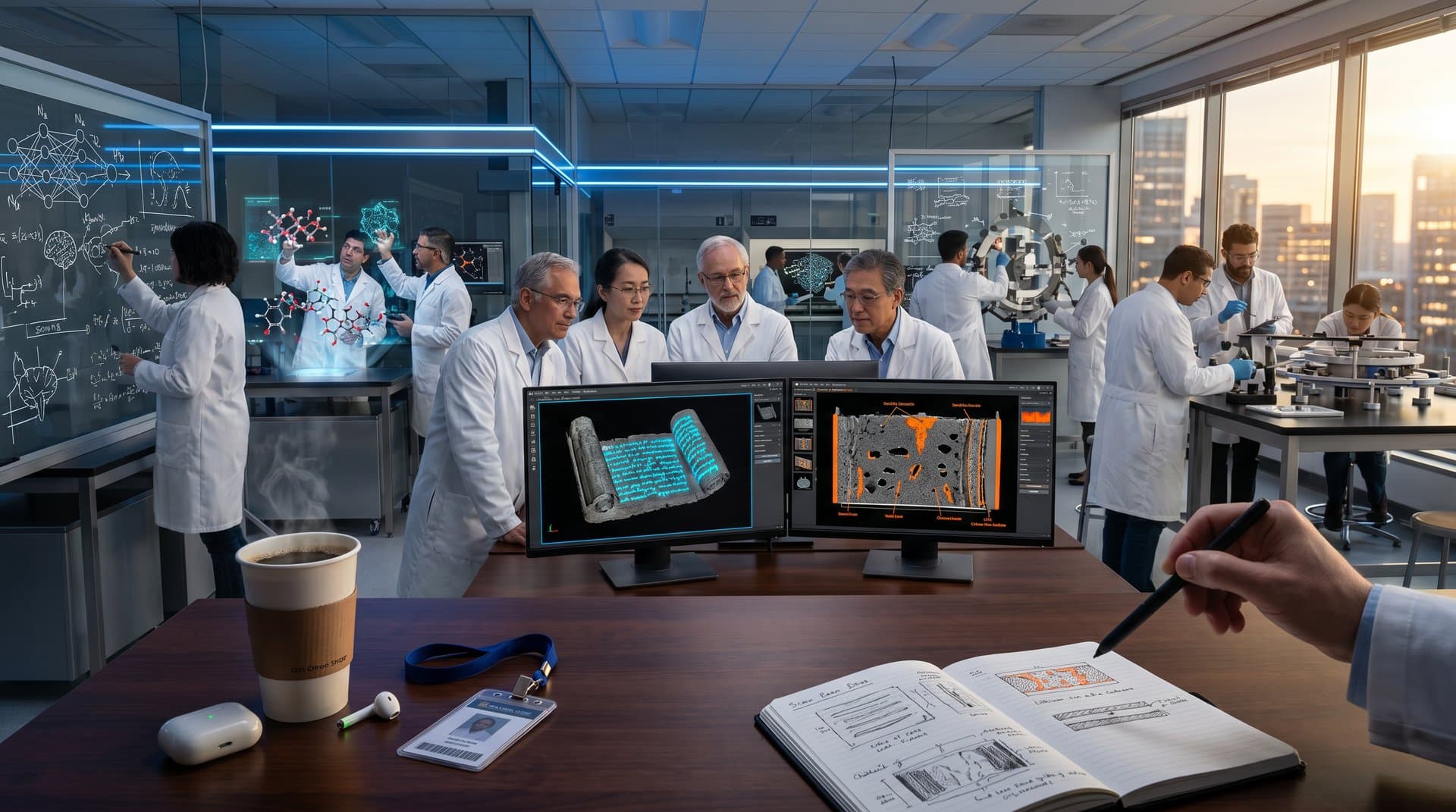
Vesuvius Challenge AI decodes over 2,000 characters from carbonized Herculaneum scrolls. This CT scan and machine learning method achieves 1-5 micron resolution for non-destructive battery testing. Energy storage developers adapt it for lithium-ion defects in solar projects. Vesuvius Challenge researchers announced results February 28, 2024 (link).
CT imaging maps 3D density in multi-layer materials. AI distinguishes faint ink from papyrus or electrode defects from solid electrolyte interphase (SEI). The National Renewable Energy Laboratory (NREL) uses phase-contrast CT on pouch cells for sub-micron voxels. NREL's 2021 report details 3D X-ray imaging of battery microstructures (link).
Non-Destructive Battery Testing from Papyrus Techniques
Herculaneum scrolls survived the 79 AD Vesuvius eruption at 500°C. Lab CT reveals ink amid charring. Battery labs apply synchrotron CT to map lithium plating on graphite anodes at 1-micron scale, following NREL protocols.
AI trains on simulated voids, cracks, and dendrites from 500+ cycles. Models segment defects with 95% accuracy. Developers avoid teardowns, speeding NMC-811 cathode iterations (250 Wh/kg, 3,000 cycles at 80% retention) for 4-hour solar profiles.
Pre-grid tests confirm IEC 62660 compliance. Solid-state batteries target 400 Wh/kg; sodium-ion hits 160 Wh/kg over 4,000 cycles.
Solar Storage Gains from Non-Destructive Battery Testing
Solar farms pair 100 MWac with 400 MWh lithium-ion storage to firm output. Dendrite faults risk failures across 10,000 modules. AI-CT scans packs in hours, not weeks.
Wind-storage hybrids face 5,000 thermal cycles yearly. Imaging spots 2-micron electrolyte dry-out, extending life from 10 to 15 years. Projects earn USD 50/MWh arbitrage and regulation revenue.
Fluence's Gridstack (2.25 MWh per 20-foot unit) integrates CT validation. Tesla Megapacks (3.9 MWh, 190 MW) use NDT for 500,000+ cells.
Grid-Scale Non-Destructive Battery Testing Pipelines
Portable systems target 50 MW wind-storage. Software merges CT with ultrasound for 90% DoD maps. This forecasts 70% capacity end-of-life, aiding EV second-life at 75% density.
Asia-Pacific scales sodium-ion to 50 GWh by 2027. EU Battery Directive 2023/1542 mandates audits. US IRA Section 45X offers USD 35/kWh credits.
Synchrotron CT at Argonne National Lab costs USD 100,000 per pack. AI cuts analysis from days to hours, saving 80% time.
Financial Impacts of Non-Destructive Battery Testing
Lazard's 2023 LCOS sets solar-plus-storage at USD 142-240/MWh. Faults raise opex 20% via USD 200/kWh replacements. NDT lowers insurance (2-3% capex) and warranties.
V2G pilots image LFP swelling (170 Wh/kg). Iron-air LDES needs stack checks for 100-hour hybrids at 150 Wh/kg.
Nature journal covered AI scroll methods in 2024, confirming techniques (link). Non-destructive battery testing scales papyrus precision to GWh solar and wind arrays through 2030. Grid operators deploy it for IEEE 1547 safety and faster CAISO permitting, cutting 24 to 12 months.
Drone X-ray imagers cut logistics 50% for 10,000-unit GW farms. US queues hold 2 TW renewables-plus-storage.
Frequently Asked Questions
What is non-destructive battery testing?
Non-destructive battery testing uses CT scans and AI to image internals without disassembly. It detects lithium plating and cracks at micron scale. Solar developers validate packs pre-deployment.
How does papyrus AI decoding advance non-destructive battery testing?
Papyrus AI segments faint ink on CT data. Batteries adapt this for electrode defects. It speeds R&D for wind-storage hybrids, skipping destructive analysis.
Why deploy non-destructive battery testing in solar projects?
Solar-plus-storage requires fault-free grid services. NDT identifies degradation early, reduces downtime. It qualifies 200 MW / 800 MWh systems for IRA incentives.
What future roles await AI imaging in grid storage?
Portable NDT scanners enable in-situ LDES checks. AI integrates ultrasound for predictions. This scales to GWh renewables fleets.