- $720B AI capex from Microsoft and Alphabet boosts grid-scale battery storage demand.
- LFP delivers 250 Wh/kg, 6,000 cycles (IEC 62619) for 100MW+ peaks.
- BNEF sees 300 GWh deployed by 2030 with 50 GW data centers.
Microsoft and Alphabet commit $720 billion in AI capex through 2028. This surges demand for grid-scale battery storage. Data centers hit 100 MW+ peaks per site and strain grids, per Yahoo Finance.
Lithium-ion batteries deliver 85-90% round-trip efficiency (RTE) at 0.5C discharge, states BloombergNEF Q2 2024 Battery Handbook.
AI Hyperscalers' Capex Strains Grids
Microsoft and Alphabet add gigawatts of data center capacity yearly. Grids struggle with ramp-up for these loads. Grid-scale battery storage dispatches power in milliseconds to firm peaks.
FERC Order 2222 opens wholesale markets to storage. California mandates 5 GW by 2026 via CPUC Docket 19-IE-01. AI growth speeds these deadlines.
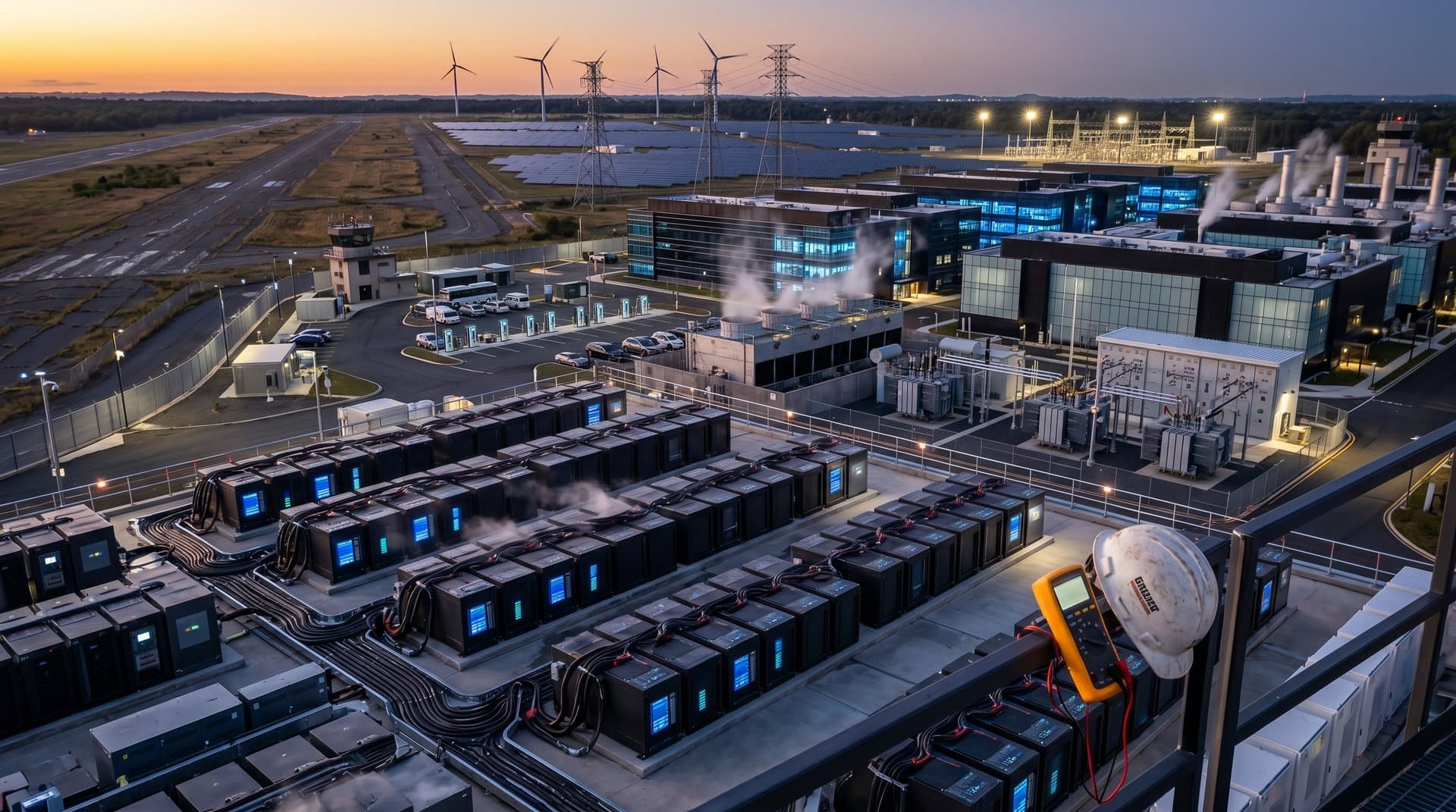
Hyperscalers co-locate batteries with data centers. This cuts transmission losses to 2-3%. Levelized cost of storage (LCOS) drops below USD 150/MWh for 4-hour systems, per BloombergNEF Q2 2024.
Battery Technologies for AI Power Needs
AI clusters consume power like small cities. Lithium iron phosphate (LFP) cathodes dominate at 250 Wh/kg gravimetric density, 500 Wh/L volumetric density, and 6,000 cycles at 80% depth of discharge (DoD) per IEC 62619.
Vanadium redox flow batteries provide 10-hour discharge. Rongke Power's 200 MW/800 MWh Dalian project scales commercially to 100 MWh units.
Iron-air batteries target long-duration energy storage (LDES) at USD 20/kWh system cost. Form Energy's pilots achieve 100-hour duration at technology readiness level (TRL) 7, per company filings.
Data center electricity demand triples by 2026, projects the IEA Electricity 2024 report.
Supply Chains Fuel Battery Boom
Sodium-ion batteries slash costs to USD 50/kWh pack level. CATL scales 10 GWh lines at TRL 8, per company announcements.
Solid-state batteries boost ionic conductivity twofold versus liquid electrolytes. QuantumScape eyes 2026 volume production.
Hyperscalers buy Fluence and Tesla Megapacks: 3.9 MWh capacity, 1.9 MW power, 4-hour duration per unit.
The US Inflation Reduction Act (IRA) boosts domestic capacity to 100 GWh annually. Lithium prices hold at USD 12,000/tonne, says Benchmark Mineral Intelligence Q3 2024.
Key Projects and Financing Trends
The $720B capex rolls out 50 GW data centers over five years. Grid-scale battery storage tracks at 20 GW pace. BloombergNEF forecasts 300 GWh global deployment by 2030.
Power purchase agreements (PPAs) secure 15-year rates at USD 40-60/MWh. Meta installs 1 GWh onsite at Prineville, Oregon (commissioned 2024, 4-hour duration).
Amazon aims for 500 MW/2 GWh across US sites by 2027. Permitting delays hit 2 TW interconnection queues. Behind-the-meter batteries sidestep queues.
Microsoft teams with Dominion Energy for 765 MW solar + 300 MWh storage in Virginia (commissioned 2026, Fluence EPC).
Reuters warns AI data centers may outpace some cities' electricity use by 2030.
Grid-Scale Battery Storage Outlook
$720B AI capex forces grid upgrades. Grid-scale battery storage fuses renewables with AI growth. Watch 2026 LDES pilots for USD 20/kWh scale-up, per NREL LDES 2024 roadmap.
Frequently Asked Questions
How does $720B AI capex impact grid-scale battery storage?
Microsoft and Alphabet add 50 GW data centers. Grid-scale battery storage grows at 20 GW pace to 2030, per BloombergNEF.
Why do hyperscalers need grid-scale battery storage?
AI requires uninterrupted power to avoid costly outages. LFP delivers 85-90% RTE and millisecond response.
Which batteries support AI growth?
LFP: 250 Wh/kg, 6,000 cycles. Flow and iron-air enable LDES at USD 20/kWh. Sodium-ion hits USD 50/kWh.
When does grid-scale battery storage accelerate?
2026 marks TRL 9 pilots. IRA drives 100 GWh US capacity. PPAs secure long-term financing.