- AI data centers demand 35 GW by 2030, per NYT.
- FERC queues hold 104 GW of battery capacity.
- BNEF forecasts 140 GW annual storage installs by 2030.
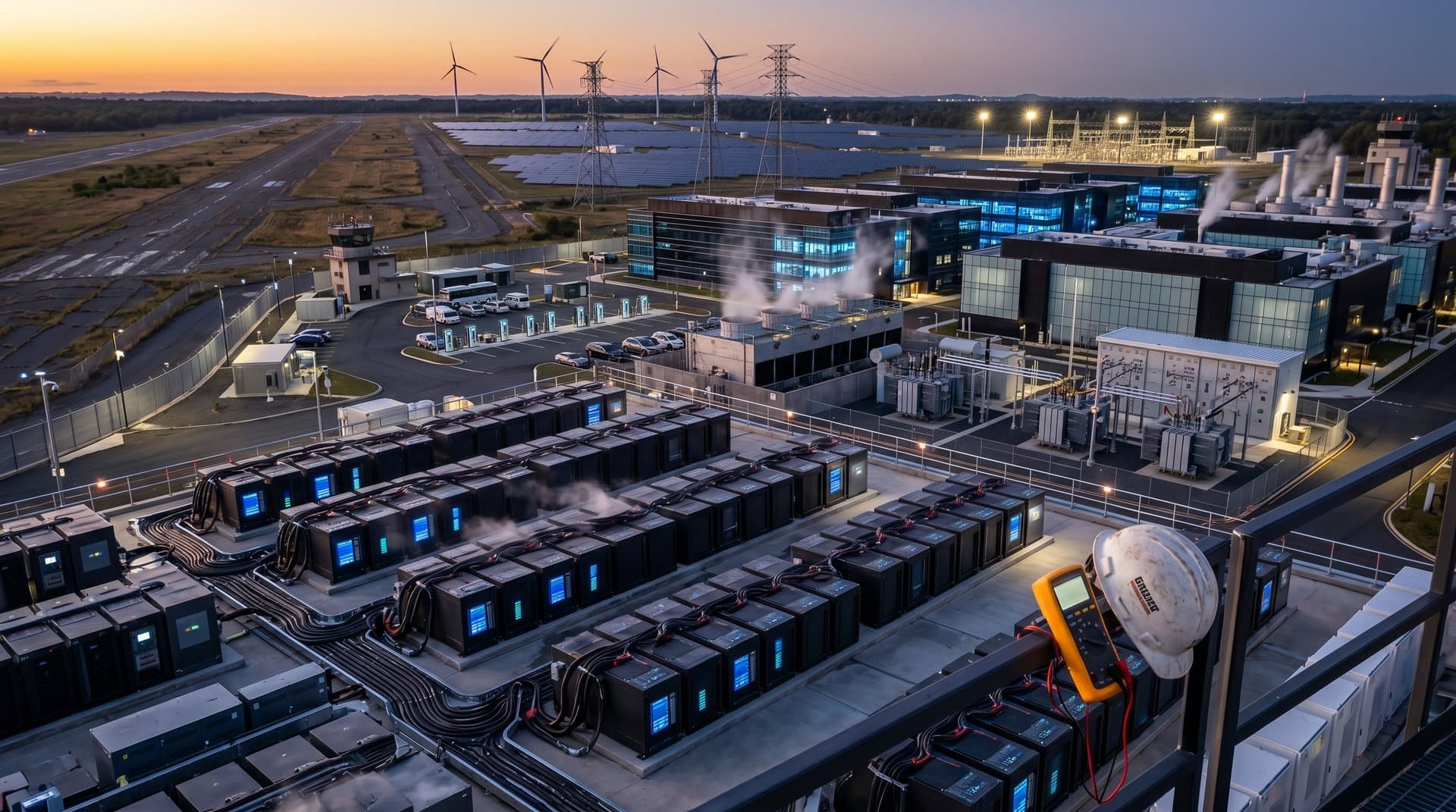
AI firms plan 35 GW of data center power by 2030, straining US grid storage, per New York Times reporting. FERC interconnection queues reached 104 GW of batteries in Q2 2024. LFP batteries dominate to balance renewables.
Microsoft, OpenAI, and Google drive this demand. Their Virginia and Texas clusters match nuclear plant baseloads, NYT's Brad Plumer and Nadja Popovich report.
AI Power Demands Overload Grid Storage
Data centers require 24/7 power amid 40% renewable penetration. One cluster equals 100,000 households' consumption, per IEA Electricity 2024.
LFP batteries deliver 85% round-trip efficiency (RTE) at 1C rates and 6,000 cycles at 80% depth of discharge (DoD), per CATL specs under IEC 62660-1.
National Renewable Energy Laboratory (NREL) 2024 benchmarks show levelized cost of storage (LCOS) below USD 100/MWh in high-solar areas.
LFP achieves 200-300 Wh/kg gravimetric density and 400-500 Wh/L volumetric density at C/3 rates. It retains 90% capacity after five years at 25°C.
IEA projects AI data centers consume 1,000 TWh globally by 2026, matching Japan's electricity use.
Batteries arbitrage: charge at USD 20/MWh solar lows, discharge at USD 200/MWh peaks in CAISO.
Battery Production Scales for AI Grids
Tesla Megapacks (3.9 MWh/unit, 85% RTE) support hyperscalers. Fluence and AES deploy 1 GW/4 GWh in Australia.
CATL targets USD 50/kWh sodium-ion by 2028 with 3,000 cycles at 80% DoD.
Vanadium flow batteries provide 10-hour discharge at 50 mW/cm². BloombergNEF forecasts 140 GW annual installs by 2030.
Australia supplies 60% of lithium; China provides phosphates at USD 30,000/tonne. US IRA tax credits cut 40% of LFP costs, per EIA.
Ford and GM test vehicle-to-grid with 10 kW chargers.
Policies and Costs Accelerate Storage Boom
EIA projects data centers at 8% of US generation by 2030, up from 3% in 2023.
NREL data shows installed costs drop to USD 140/kWh in 2025 from USD 300/kWh in 2020.
NextEra procures 2 GWh from Powin for Florida data centers.
FERC Order 2023 speeds queue clustering. EU rules mandate 70% recycled content by 2030.
LG Energy Solution scales LFP to 500 GWh/year. Form Energy's iron-air hits 100-hour duration at USD 30/kWh LCOS.
QuantumScape claims 1,000 cycles at 400 Wh/kg, verified at 10% lab density under UL 9540A.
Tesla holds 50% US utility share. Reuters reports Arizona AI hubs secure 5 GW transmission with 2 GWh storage.
Virtual power plants aggregate 1 million EVs, deferring USD 1 million/mile upgrades.
Grid storage becomes AI's backbone. FERC reforms and long-duration pilots ensure 200 GW global scaling by 2030.
Frequently Asked Questions
How do AI power demands strain grid storage?
AI data centers demand gigawatt baseload amid renewables growth. FERC queues top 104 GW batteries. LFP systems ensure stability with 6,000+ cycles.
What role does grid storage play in the AI boom?
Grid storage balances constant AI loads against intermittent renewables at 85% efficiency over 4 hours. IEA forecasts 1,000 TWh demand by 2026.
Which battery technologies suit AI grid storage?
LFP dominates at 200-300 Wh/kg, USD 140/kWh, 6,000 cycles. Sodium-ion eyes USD 50/kWh; flow batteries offer 10-hour discharge.
What policies accelerate grid storage for AI?
IRA credits cut 40% of US LFP costs. FERC Order 2023 speeds queues. EU mandates 70% recycling by 2030 for LDES.