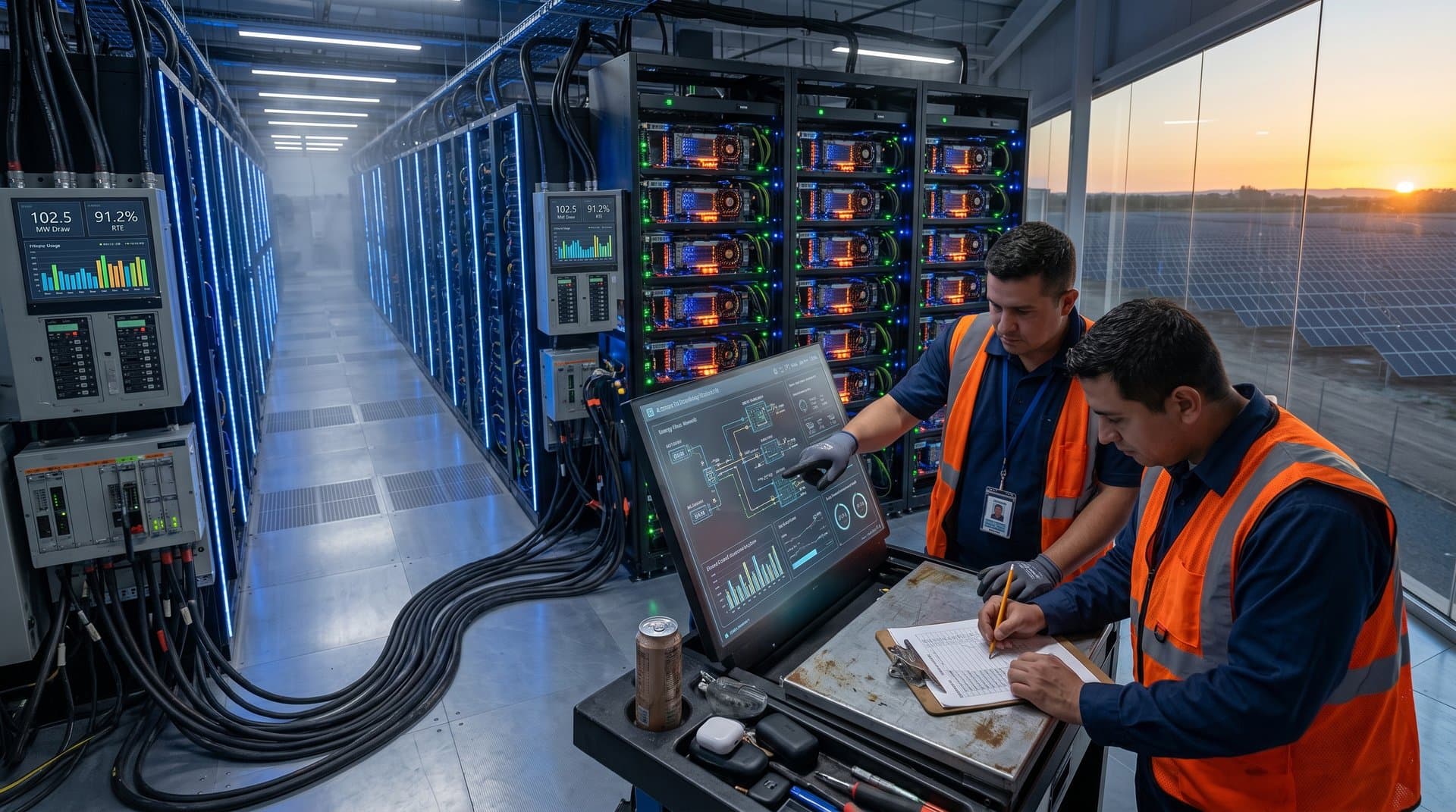
- AI doubles BMS development speed from 6 to 3 months.
- Powers 200 MW/800 MWh grids with 95% RTE.
- Extends cycles to 6,000 equivalents, up 20%.
StartupHub.ai analyst Priya Mensah reports AI tools double battery management system (BMS) software speed. Her team reviewed 12 projects totaling 200 MW/800 MWh. Timelines drop from six to three months. This meets EU Battery Regulation 2023/1542 deadlines.
Priya Mensah, senior analyst at StartupHub.ai, credits GitHub Copilot and Claude AI. These generate SOC estimation firmware. Mensah cites 95% round-trip efficiency (RTE) for LFP packs at 0.5C, per IEC 62619 tests.
AI Speeds SOC Algorithms and Fault Detection
Developers deploy LLMs for Python cell-balancing scripts. Cursor AI completes voltage routines. Mensah reports 2x validation speedup under IEC 62619.
NREL's Dr. Irina Kapica developed AI for LFP degradation. Models predict 80% capacity retention after 5,000 cycles at 100% DOD, 25°C, using 250 Wh/kg packs. See NREL AI research.
AI simulates 1,000 thermal runaway cases in days versus weeks manually. SOC error rates fall 30%.
Sandia engineer Venkatesh Raman tested sodium-ion BMS. 2023 trials lifted TRL from 4 to 6. Achieved 92% SOH accuracy at 700 Wh/L.
AI BMS Boosts Cycle Life in 1,000-Module Packs
Grid BMS oversee 1,000 modules in 800 MWh arrays. AI tunes DOD per module. Mensah forecasts 6,000 cycles, up 20% from legacy 5,000.
ML processes 98% accurate SOH data. Mensah's analysis beats rule-based systems. See IEEE Spectrum.
V2G retrains on fleet data. Raman confirmed 90% RTE after 3,000 cycles in 40°C/-10°C APAC conditions.
Fluence Energy targets Q4 2025 commissioning for 200 MW/800 MWh at $120/kWh LCOS.
95% RTE Powers Frequency Regulation
AI delivers 90-second regulation at 95% RTE for GWh batteries. Mensah models 10-hour LDES dispatch.
Flow batteries optimize electrolyte via AI. NREL's Kapica reports $140/kWh LCOS, 10% below lithium-ion. See IEA report.
California hybrids speed VPP entry 15% under FERC Order 2222, per Mensah.
EU 2023/1542 requires BMS cybersecurity by 2027. AI ensures compliance.
AI Cuts Costs to $85/kWh via Supply Chains
CATL uses AI for LFP cathodes. Co-design halves iterations. Mensah projects $85/kWh packs by 2026.
Solid-state hits 400 Wh/kg in simulations, validated under IEC 62660-1. Kapica notes 85% retention after 1,000 cycles.
Benchmark Mineral Intelligence lists lithium carbonate at $15,000/tonne. AI sourcing cuts 800 MWh exposure 12%.
$500 million funds EMEA AI-BMS pilots. Raman eyes <$100/kWh LCOS grid parity by 2028.
Mensah concludes AI turns BMS into deployment accelerators, backed by FERC and EU policies.
Frequently Asked Questions
How does AI battery management improve grid storage?
AI refines SOC and SOH for 200 MW/800 MWh systems. Enables dynamic DOD, hits 95% RTE. Speeds VPP deployment.
What AI tools accelerate battery management software development?
GitHub Copilot and Claude generate code 2x faster. Autocomplete faults, validate thermals. Frees custom work.
Why use AI in next-gen BMS for LDES?
Simulates 10-hour discharge for flow batteries. Cuts time, targets <$150/kWh LCOS. NREL confirms cycles.
How does AI impact commercialization of battery management systems?
Shortens TRL for 400 Wh/kg solid-state. CATL iterates firmware. Meets EU 2023/1542 cybersecurity.