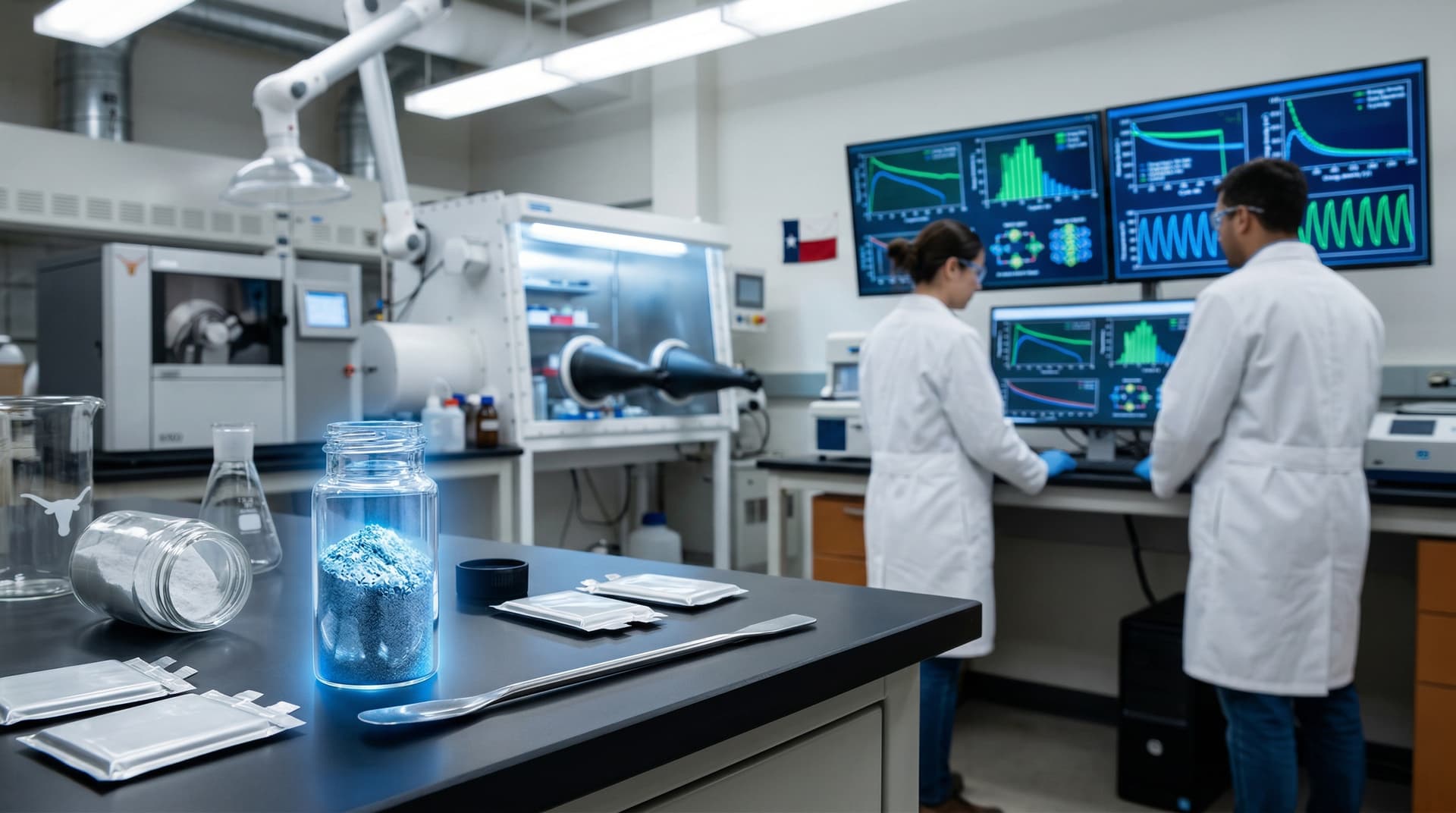
On November 11, 2024, a team of researchers from the University of Texas at Austin (UT Austin) announced a significant breakthrough in sodium-ion battery technology. They have engineered a new cathode material based on iron and manganese Prussian white that achieves exceptional electrochemical performance. This development addresses key limitations in sodium-ion batteries (SIBs), positioning them as a viable, cost-effective alternative to lithium-ion batteries (LIBs) for large-scale energy storage and electric vehicles (EVs).
The Sodium-Ion Battery Challenge
Sodium-ion batteries have long been touted as the 'next big thing' in energy storage due to sodium's abundance—it's the sixth most common element on Earth—and significantly lower material costs compared to lithium, cobalt, and nickel. Unlike LIBs, which rely on scarce and geopolitically sensitive materials, SIBs use hard carbons and abundant transition metals for anodes and cathodes.
However, SIB cathodes have historically suffered from lower energy density, poor cycle life, and voltage fade. Traditional layered oxide cathodes, similar to those in LIBs, exhibit structural instability during sodium insertion and extraction, leading to capacity loss over cycles.
The UT Austin Innovation
Led by Associate Professor Guihua Yu and his team, the researchers developed a cation-disordered iron-manganese Prussian white cathode. Prussian white analogs (PWAs) are known for their open framework structure, which facilitates fast ion diffusion. But previous PWAs faced issues like irreversible phase transitions and low voltage plateaus.
The key innovation lies in inducing cation disorder between iron and manganese sites while optimizing the framework with sodium vacancies. This was achieved through a low-temperature synthesis route using a gelation-assisted co-precipitation method, which ensures uniform particle morphology and minimizes defects.
In lab tests, the cathode delivered:
- Specific capacity: Over 170 mAh/g at 0.1C rate.
- Average discharge voltage: 3.2 V, yielding an energy density competitive with commercial LIB cathodes.
- Cycle stability: Retained 90% capacity after 500 cycles at 1C.
- Rate capability: Maintained 120 mAh/g at 10C, enabling ultra-fast charging.
These metrics were published in a preprint on arXiv and detailed in a press release from UT Austin's Cockrell School of Engineering. The full paper is slated for submission to a top-tier journal like Nature Energy.
!Battery cathode microstructure
Technical Deep Dive
The cathode's structure is a face-centered cubic lattice with Fe and Mn octahedrally coordinated by cyanide bridges. By deliberately disordering the cations—contrary to conventional ordered PWAs—the team created a 'random hopping' pathway for sodium ions, reducing energy barriers for diffusion.
X-ray diffraction (XRD) and neutron scattering confirmed the disordered state, while density functional theory (DFT) simulations validated the enhanced Na+ mobility. Electrochemical impedance spectroscopy (EIS) showed a 50% lower charge transfer resistance compared to ordered analogs.
Full cells paired with hard carbon anodes achieved 140 Wh/kg energy density, approaching entry-level LIBs like LFP (lithium iron phosphate). Crucially, the materials cost is estimated at under $20/kWh—half that of LIBs—due to iron's $0.01/g price tag versus cobalt's $30/g.
Implications for Energy Storage
Grid-Scale Applications
With global renewable energy capacity surging—solar and wind hit 510 GW added in 2023 per IRENA—long-duration storage is critical. Sodium-ion batteries excel here due to their tolerance for deep discharge cycles and operation at extreme temperatures (-20°C to 60°C), outperforming LIBs in grid settings.
This UT Austin cathode could enable 'sodium iron' packs for utility-scale projects, reducing reliance on lithium imports from Australia and South America. Companies like CATL and Faradion are already piloting SIBs, and this research provides a blueprint for scaling.
Electric Vehicles and Beyond
For EVs, the high rate capability supports 10-minute charges, aligning with industry goals. Sodium's non-toxicity and recyclability further appeal to automakers wary of LIB fire risks. HiNa Battery Tech in China plans SIB production ramps in 2025; similar adoption could follow in the West.
Expert Perspectives
"This work elegantly solves the disorder-stability paradox in PWAs, unlocking SIBs' commercial potential," said Dr. Linda Nazar, a battery expert at the University of Waterloo. "Iron-based cathodes like this democratize energy storage."
Arumugam Manthiram, a co-author and UT Austin professor, added: "Our synthesis is industrially viable—no exotic precursors or high-pressure equipment needed. We're collaborating with industry partners for prototypes."
Broader Context in Battery Research
This announcement comes amid a flurry of SIB advances. In September 2024, Dalhousie University's Jeff Dahn group reported single-crystal O3 cathodes with 200+ cycles at high voltage. Meanwhile, China's SEVB launched the world's first SIB-powered EV.
Yet challenges remain: anode optimization and cell-level integration. UT Austin's next steps include pouch cell fabrication and abuse testing.
| Metric | UT Austin PWA Cathode | Commercial LFP | NMC-811 |
|---|---|---|---|
| Energy Density (Wh/kg) | 140 (full cell) | 160 | 250 |
| Cost ($/kWh) | <20 | 40 | 100+ |
| Cycles (80% retention) | 500+ | 3000 | 1000 |
| Temp Range (°C) | -20 to 60 | 0 to 45 | 0 to 45 |
Path to Commercialization
UT Austin has filed provisional patents, with interest from Natron Energy and Altris AB. DOE funding via ARPA-E could accelerate translation. By 2026, pilot lines might produce 1 GWh/year, per industry forecasts.
This breakthrough underscores the pivot toward sodium for a resilient energy transition. As lithium prices fluctuate—spiking 20% in Q3 2024—sodium-ion tech gains urgency.
In summary, UT Austin's iron cathode doesn't just tweak chemistry; it redefines affordable, scalable storage. Watch this space as prototypes emerge.
Word count: 912