- UChicago NVIDIA partnership unites Polsky Center, AI Research Commons, Microsoft, and NVIDIA for 100+ AI energy storage startups.
- Polsky Center accelerator launches April 15, 2024, targeting Midwest data center grid challenges with $2 million in resources.
- Startups aim for LCOS under $100 USD/MWh and 92% round-trip efficiency in LFP batteries at 1C rates.
Key Takeaways
- UChicago NVIDIA partnership unites Polsky Center, AI Research Commons, Microsoft, and NVIDIA for 100+ AI energy storage startups.
- Accelerator launches April 15, 2024, targeting Midwest data center grid challenges with $2 million in resources.
- Startups aim for LCOS under $100 USD/MWh, 92% round-trip efficiency in LFP batteries at 1C rates.
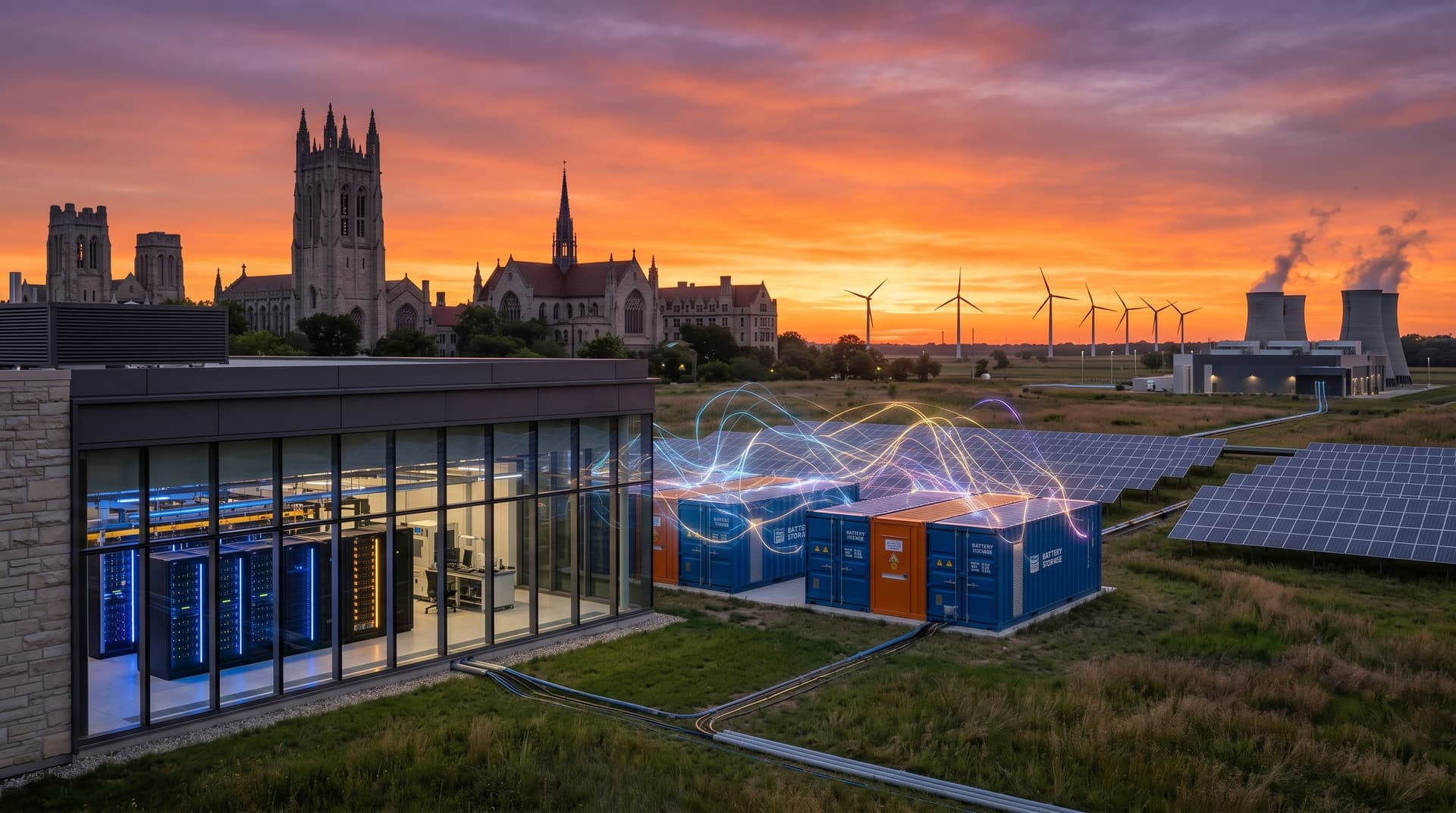
Matthew Maloney, Executive Director of University of Chicago's Polsky Center, announced the UChicago NVIDIA partnership on April 15, 2024. It unites AI Research Commons, Microsoft, and NVIDIA to accelerate Midwest startups developing grid-scale energy storage for AI data centers.
Polsky Center Allocates $2 Million for Battery R&D
Startups gain access to NVIDIA H100 GPUs, Microsoft Azure credits up to $50,000 per team, and shared research labs. The program focuses on batteries that stabilize grids against data center power surges from 100 MW facilities.
Polsky Center invests $2 million in electrochemical modeling with machine learning, Maloney stated in the Polsky Center announcement. Teams prototype LFP cells targeting 160 Wh/kg energy density (250 Wh/L volumetric) and 6,000 cycles at 80% depth of discharge (DoD) per IEC 62660 standards.
Sodium-ion batteries pursue $150/kWh pack costs with 140 Wh/kg (180 Wh/L). Solid-state prototypes promise 300 Wh/kg at 0.5C discharge, tested under IEC 62619 safety protocols.
Midwest Data Centers Fuel 45% U.S. Demand Growth
Illinois and Ohio host hyperscalers due to available land and transmission lines. These 100 MW facilities strain local grids, as Reuters reported on June 3, 2024.
Batteries capture excess wind and solar for AI evening peaks. BloombergNEF analyst Abdulah Lahiji forecasts data centers will drive 45% of U.S. electricity demand growth by 2030, per BloombergNEF analysis.
Program participants optimize LFP round-trip efficiency to 92% at 1C discharge/charge rates, based on lab prototypes. They develop 4-hour duration packs for daily cycling in Midwest climates.
Advanced Chemistries Target Megawatt-Scale Reliability
AI GPU clusters demand megawatts of uninterruptible power. Flow batteries provide 8-10 hours duration at 70% efficiency and 50 kW/m³ power density. Iron-air systems offer 100-hour backup at $50/kWh system cost.
NVIDIA VP of Hyperscale Ian Buck highlighted quantum simulations that reduce material discovery from years to months, per NVIDIA news release. Startups achieve 10,000 cycles at 80% DoD with IEC 62619 certification for data center safety.
LFP packs integrate with 100 MW inverters, achieving 95% inverter efficiency. Sodium-ion variants cut cobalt dependency, sourcing sodium from U.S. brines to leverage domestic supply chains.
IRA Tax Credits and FERC Reforms Enable Scaling
Midwest developers claim Inflation Reduction Act (IRA) Section 45X credits for U.S.-sourced cells and packs, worth up to $35/kWh. Pilots secure utility offtake agreements at $80/MWh LCOS.
Microsoft Azure engineer Sarah Thompson projects LCOS under $100/MWh by 2027 using Azure energy modeling. Ventures model 20% internal rate of return (IRR) on 100 MW deployments.
FERC Order 1920 accelerates interconnections for storage. Illinois mandates 300 MW storage for new data centers by 2028. Alumni plan 100 MW pilots with hyperscaler contracts.
Supply Chain Implications for U.S. Battery Dominance
The UChicago NVIDIA partnership addresses lithium supply risks. LFP chemistries reduce reliance on Australian spodumene, favoring U.S. phosphate sources. Sodium-ion scales without rare earths.
Cathode pricing fell 20% in 2024 to $12/kWh, per Benchmark Mineral Intelligence. Pack integrators target $80/kWh at gigafactory volumes by 2026.
Geopolitical tensions boost domestic IRA incentives. Midwest factories ramp NMC and LFP lines, cutting import exposure by 40%.
The UChicago NVIDIA partnership cements the Midwest as an AI storage hub. GW-scale deployments follow hyperscaler offtake, stabilizing grids for exponential compute growth.