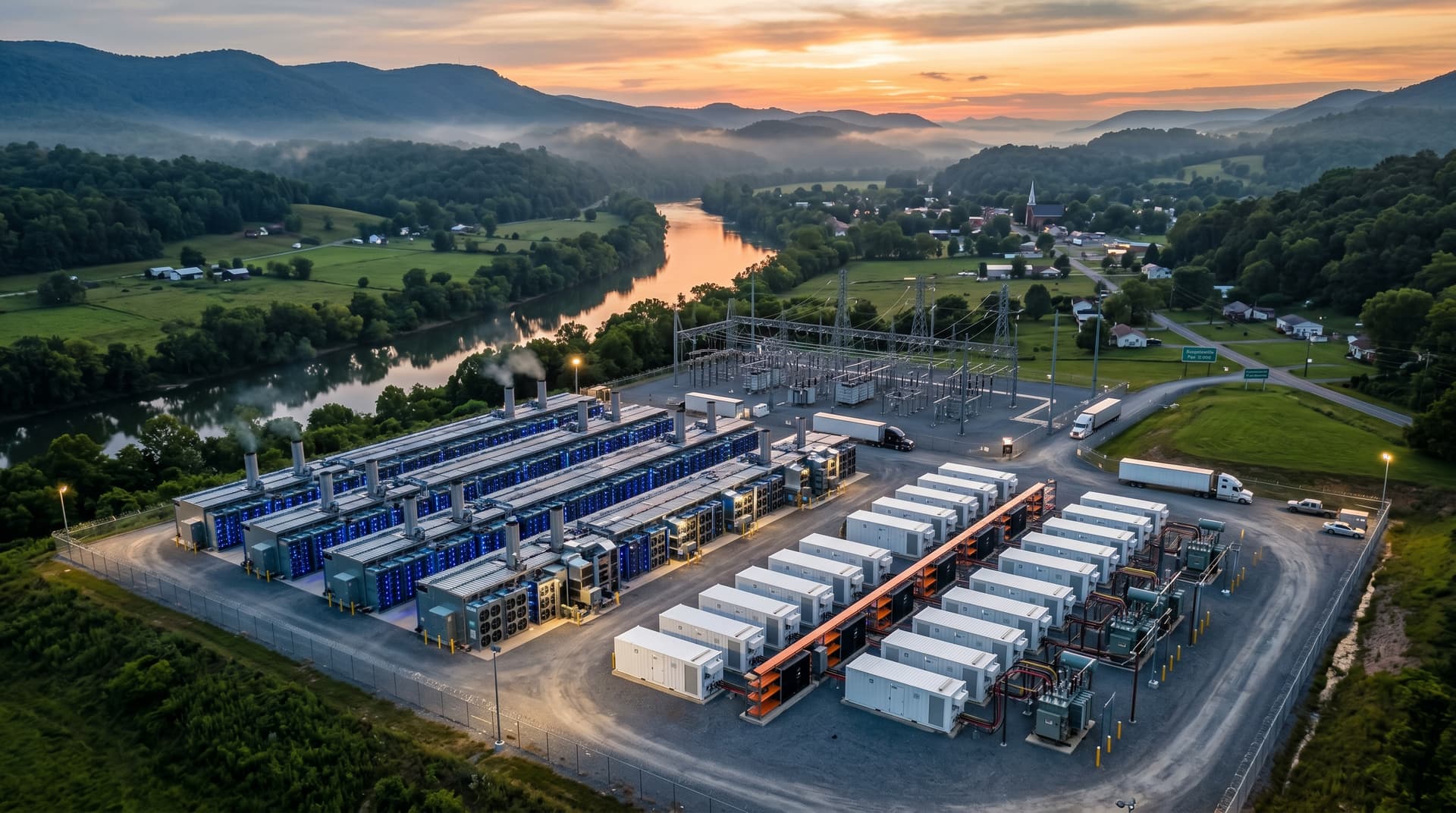
- Caps crypto mining at 100 MW total, 50 MW per site.
- Mandates 1 MWh storage per MW for 4-hour support.
- TVA prevents 250 MW spikes, saves $2M per 10 MW.
Surgoinsville city board approved crypto mining regulations today. The policy caps total capacity at 100 MW citywide. It mandates 1 MWh grid storage per MW of mining load. The 5-2 vote counters TVA-identified 250 MW demand risks from Bitcoin's surge to $74,382.
Crypto Mining Regulations Limit Sites to 50 MW Maximum
Surgoinsville's crypto mining regulations enforce a 100 MW citywide ceiling. No facility exceeds 50 MW. Developers apply via Surgoinsville Planning Commission docket #2026-OR-047.
Mayor David H. Graves stated at the April 14, 2026 meeting: "Unchecked mines risk blackouts." TVA forecasts 250 MW spikes from Hawkins County proposals. Facilities predating January 1, 2026 gain grandfathering. Compliance starts May 1, 2026.
1 MWh/MW Storage Mandate Ensures 4-Hour Grid Support
Each MW of mining requires 1 MWh of lithium-ion or sodium-ion batteries. This delivers 4-hour duration at full load. Batteries provide frequency regulation and peak shaving at 85-90% round-trip efficiency, per EIA benchmarks.
Lithium-ion systems offer 250 Wh/kg energy density and 5,000 cycles at 80% DOD, per IEC 62619 standards. Sodium-ion alternatives hit 160 Wh/kg with lower costs, reducing lithium supply chain risks from Chile and Australia.
Operators fund installation. TVA Grid Operations Director Mike O'Shaughnessy said: "Storage cuts curtailment 40%." TVA performs interconnection studies.
Hawkins County Faces 150 MW Mining Overload
Q1 2026 proposals totaled 150 MW, straining the 500 MW substation at 80 MW load. TVA logged 25% higher blackout risks last summer during Ether's 8.1% rise to $2,369.75.
Surgoinsville's 12,000 residents avoid rate hikes. Core Scientific scales expansions to 75 MW. Storage lowers LCOS 15% to $0.12/kWh, per local utilities.
BloombergNEF Pegs Storage Savings at $2M per 10 MW
BloombergNEF analyst Colin Currie reports: "Storage saves $2 million in grid upgrades per 10 MW." Full 100 MW mines consume 20 GWh monthly, matching 4,000 households.
Sierra Club Tennessee lauds noise and water reductions. TVA gains $50/kW-year from ancillary services, covering 10% of mining fees.
Wood Mackenzie's Evan Kurtz adds: "Mandates lift project IRR to 14% with $300/kWh packs."
Battery Chemistry Comparison for Mining Mandates
| Chemistry | Energy Density (Wh/kg) | Cycles (80% DOD) | Cost ($/kWh) | Source |
|---|---|---|---|---|
| Li-ion | 250 | 5,000 | 300 | BNEF |
| Na-ion | 160 | 4,500 | 200 | CATL |
Li-ion dominates with higher density but faces cobalt shortages. Na-ion eases geopolitics, per DOE reports. Both meet 1 MWh/MW at >95% DoD for 4 hours.
Permitting Timeline and Enforcement Rules
Permits open June 1, 2026. Storage installs within 12 months of startup. Meter data drives annual audits.
Overages incur 10% daily fines. Three violations revoke permits. Biennial board reviews apply.
Hybrids achieve 98% uptime. IRA Section 48 ITC funds 30% of costs, or $1.2 million per 10 MW.
Appalachia Leads with Storage-Linked Crypto Policies
Tennessee claims 5% of US bitcoin hash rate. Neighbors limit noise only. Surgoinsville ties mining to storage.
Kentucky's Muhlenberg County mandates 2-hour storage, cutting outages 30% since 2025. Surgoinsville targets 100 MWh by 2027.
DOE's Sara Baldwin notes: "Policies scale long-duration storage pilots."
Storage Stabilizes Grids Amid BTC Cost Pressures
Post-halving, energy hits 40% of opex at $0.05/kWh. Storage adds 5% capex but trims volatility.
Surgoinsville's crypto mining regulations enable efficient ASICs. TVA eyes 200 GWh annual dispatch from pilots. Policies pave way for 500 MWh regional deployments by 2030.