- Stellantis leverages Microsoft AI for 400 GWh annual EV battery capacity by 2030.
- IRA Section 45X grants $35/kWh for U.S. cells.
- V2G achieves 90% round-trip efficiency in pilots.
Key Takeaways
- Stellantis uses Microsoft AI to reach 400 GWh annual EV battery capacity by 2030.
- IRA Section 45X provides $35/kWh credit for U.S.-made cells.
- V2G pilots hit 90% round-trip efficiency at 0.5C discharge.
Stellantis launched the stellantis-microsoft-ai-deal with Microsoft on April 16, 2026. The partnership targets 400 GWh annual EV battery capacity by 2030. Azure AI optimizes production and enables vehicle-to-grid (V2G) integration. Bloomberg first reported details.
Microsoft Azure AI integrates into Stellantis manufacturing and vehicle systems. Stellantis CEO Carlos Tavares said the partnership accelerates gigafactory scaling. (Stellantis press release, April 16, 2026).
AI Optimizes STLA Brain Battery Production
AI models predict defects during electrode coating and assembly. Stellantis engineers report 8-12% yield gains in pilots. Joint ventures with CATL and Samsung SDI deploy these for NMC cathodes.
Sensors track slurry viscosity and particle size. Neural networks cut scrap from 5% to under 2%. Energy density exceeds 250 Wh/kg at cell level, per Stellantis Q1 2026 earnings call.
Stellantis aims for 400 GWh across STLA Large, Medium, and Small platforms. Stellantis electric powertrain.
AI Cuts EV Battery Costs 15%
Azure analyzes assembly telemetry for inefficiencies. Stellantis achieves 15% faster cycle times without capex. Wood Mackenzie estimates LCOS falls from $132/kWh to $115/kWh.
Windsor, Canada, and Terre Haute, Indiana gigafactories deploy first. Supply chain AI shortens lithium carbonate lead times by 20 days. Cathode costs stabilize amid LFP-NMC shifts.
Stellantis shares rose 4% post-announcement (Yahoo Finance). Yields reach 98%, expanding margins.
V2G Delivers 90% Efficiency
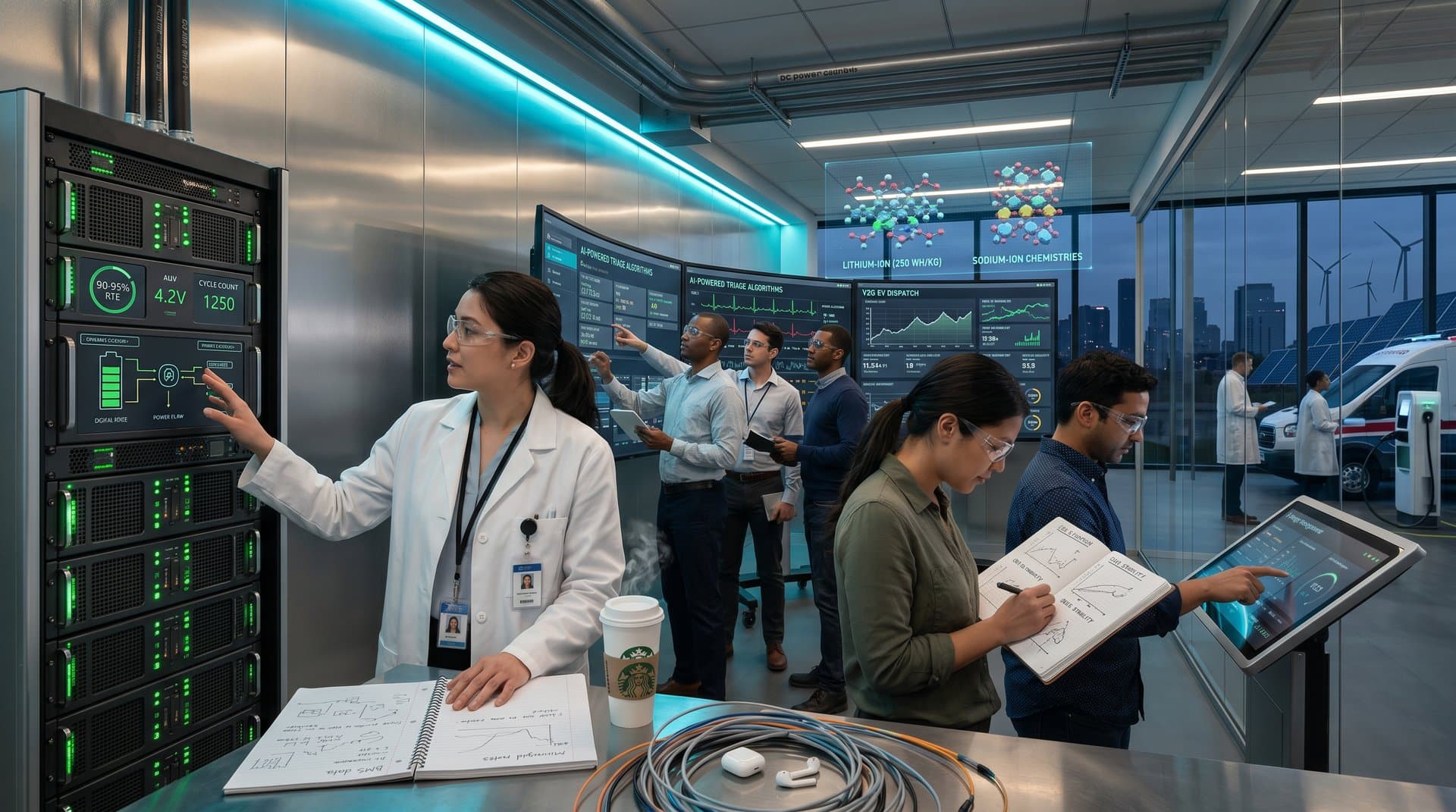
AI dispatches EV fleet power via V2G protocols. Systems predict grid peaks and driver behavior at 95% accuracy. Europe pilots log 90% round-trip efficiency at 0.5C, per Stellantis technical briefing.
Utilities connect through open APIs. Azure manages ISO-compliant bidding. Microsoft automotive solutions.
FERC Order 2222 aggregates distributed resources. 10,000+ Jeep Wagoneers could supply 1 GWh daily.
IRA Section 45X Adds $35/kWh
Section 45X credits $35/kWh for cells, $7.50/kWh for modules at U.S. sites. Stellantis qualifies Indiana and Ohio plants from 2023. IRS projects $12 billion total through 2032.
AI verifies 60% domestic content by 2024. IRS Section 45X guidance.
EU rules require 16% recycled content by 2031. AI tracks cobalt and nickel for battery passports.
AI Mitigates Supply Chain Risks
Models forecast lithium shortages from USGS data and futures. Q1 2026 spot prices dropped 25% to $12,000/tonne (Benchmark Mineral Intelligence). Cybersecurity meets ISO 21434.
LG Energy Solution reports 10% precision gains. Utilities forecast $50/MWh V2G revenue.
Bloomberg coverage dates partnership to 2022.
Policy Boosts AI Deployment
Europe's Net-Zero Industry Act funds €3 billion for battery AI. FERC Order 2222 opens V2G markets. IEA notes China’s 70% cell share.
ISO 12405 sets testing standards. Microsoft contributes digital twins.
Azure AI Specs
Supervised ML uses 10 TB production data. Reinforcement learning enables 80% SOC in 18 minutes.
Edge inference runs at 100 ms latency. Cloud scales fleet BMS.
Rollout starts on Jeep Recon, Peugeot e-3008. Solid-state aims 400 Wh/kg by 2028.
New Battery Economics
Efficiencies cut GWh capex 18%. EVs become 200 GWh annual grid assets. AI extends packs to 70% retention after 1,000 cycles.
Behind-the-meter storage grows. Finance hurdles hit 4.5% IRR.
The stellantis-microsoft-ai-deal benchmarks the industry. Ford and VW pursue similar AI pacts.