Seven countries achieved 100% renewable grids throughout 2025, per IRENA's April 12, 2026 report. Albania, Bhutan, Iceland, Kenya, Paraguay, Costa Rica and Uruguay generated all electricity from renewables. Storage systems balanced intermittency.
Countries and Their Renewable Mixes
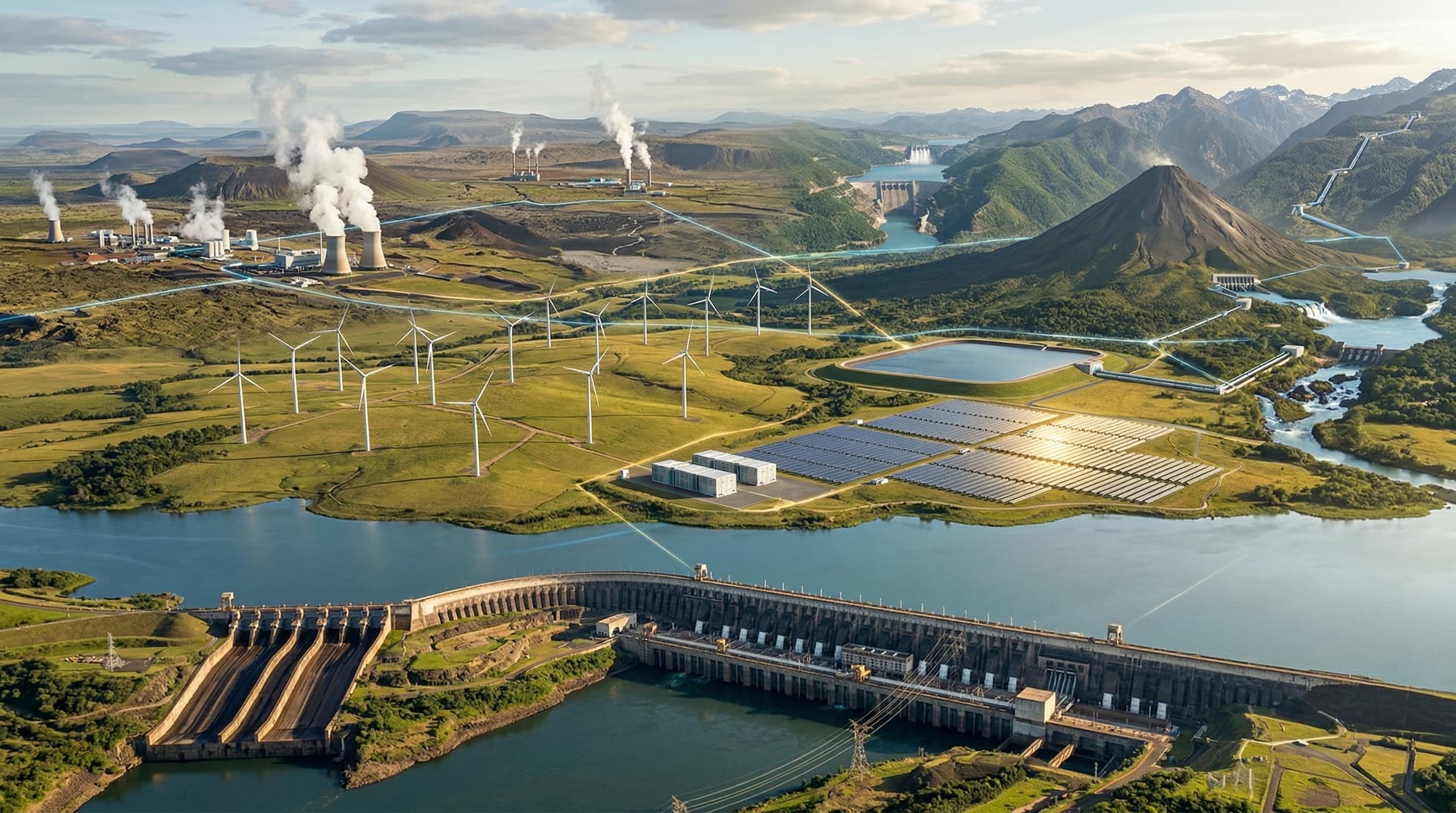
Albania sources 100% from hydropower, with 2.8 GW capacity across 200 plants, per IRENA. Bhutan matches this with 2.3 GW hydro dominating its 2.4 GW total generation. Iceland blends 75% hydro and 25% geothermal for 3.2 GW output.
Kenya integrates 45% geothermal, 36% hydro and 19% wind-solar, totaling 3.1 GW. Paraguay runs on 15 GW Itaipu and Yacyretá hydro dams. Costa Rica achieves 98% hydro-geothermal, 1.5% wind and 0.5% solar at 3 GW scale.
Uruguay pioneers with 42% wind, 35% hydro and 23% solar, per grid operator UTE. These mixes delivered 100% renewables without fossil backups in 2025.
Storage Technologies Stabilize 100% Renewable Grids
Pumped hydro storage anchors most grids. Paraguay deploys 500 MW/3 GWh at Yacyretá for 6-hour duration, per IRENA. Iceland uses 150 MW/1 GWh hydro reservoirs for frequency regulation.
Uruguay installed 140 MW/280 MWh lithium-ion batteries by 2025, per UTE data. These provide 2-hour dispatch at 95% round-trip efficiency. Kenya added 100 MW/200 MWh BESS (battery energy storage systems) from ACWA Power, supporting geothermal-wind balancing.
Costa Rica operates 12.5 MW/100 MWh flow batteries from Redflow. These deliver 8-hour discharge for drought-prone hydro support. Albania plans 200 MW pumped hydro expansion by 2027, targeting 4-hour duration, per national grid operator.
Policy Frameworks Drive Adoption
National mandates enforce renewables. Uruguay's Law 19.370 requires 100% by 2030; auctions met the target early. Costa Rica's 2019 decarbonization plan bans fossils post-2025.
Kenya's Vision 2030 targets 100% renewables with geothermal incentives. IRENA notes USD 15 billion in cumulative investments across these grids since 2020. Feed-in tariffs averaged 8-12 cents USD/kWh.
Bhutan's constitution prioritizes hydro exports to India. Paraguay's binational dams secure Itaipu revenues at USD 2 billion annually. Policies pair with storage procurement to handle peak demand.
Financial Metrics and Costs
Levelized cost of storage (LCOS) fell to USD 120/MWh for lithium-ion in Uruguay, per BloombergNEF April 2026 update. Pumped hydro LCOS hits USD 80/MWh in Paraguay.
Total grid investments reached USD 25 billion by 2025, IRENA reports. Uruguay's 140 MW batteries cost USD 200 million, or USD 1.43 million/MW power capacity (USD 714,000/MWh energy capacity), per UTE. Revenue stacks include arbitrage and ancillary services at USD 50/MWh.
Kenya's BESS yields 12% IRR via capacity payments, per ACWA Power. Global capital flows USD 5 billion yearly to similar projects, per Wood Mackenzie. These metrics attract developers; supply chains lean on LFP cathodes from China, cutting costs 20% since 2023.
Scalable Storage for Global Markets
Lithium-ion scales to multi-GWh globally; 15 GWh deployed in 2025, per Wood Mackenzie. Flow and iron-air batteries target 10-hour long-duration energy storage (LDES) by 2030.
These countries prove 100% renewable grids viability with 5-10% storage penetration, per IRENA. Uruguay's grid handles 50% instantaneous wind penetration via BESS. IRENA forecasts 20 countries by 2030.
Market Implications and Forecasts
Global renewable capacity hits 4,500 GW in 2025, per IRENA. Storage adds 250 GW, up 40% year-over-year. 100% renewable grids cut import dependence by 100% in Paraguay.
Wholesale prices stabilize at USD 30/MWh average in Uruguay. Capacity markets value storage at USD 100/kW-year. BloombergNEF projects USD 1 trillion storage investments by 2035.
Utility procurement accelerates. US FERC Order 2023 queues 50 GW storage. These pioneers benchmark LCOS declines to USD 50/MWh by 2030.
The Bottom Line
Seven countries validate 100% renewable grids through diverse renewables and storage. Scalable batteries and hydro reservoirs ensure stability. Investors and policymakers gain blueprints for terawatt-scale transitions worldwide.