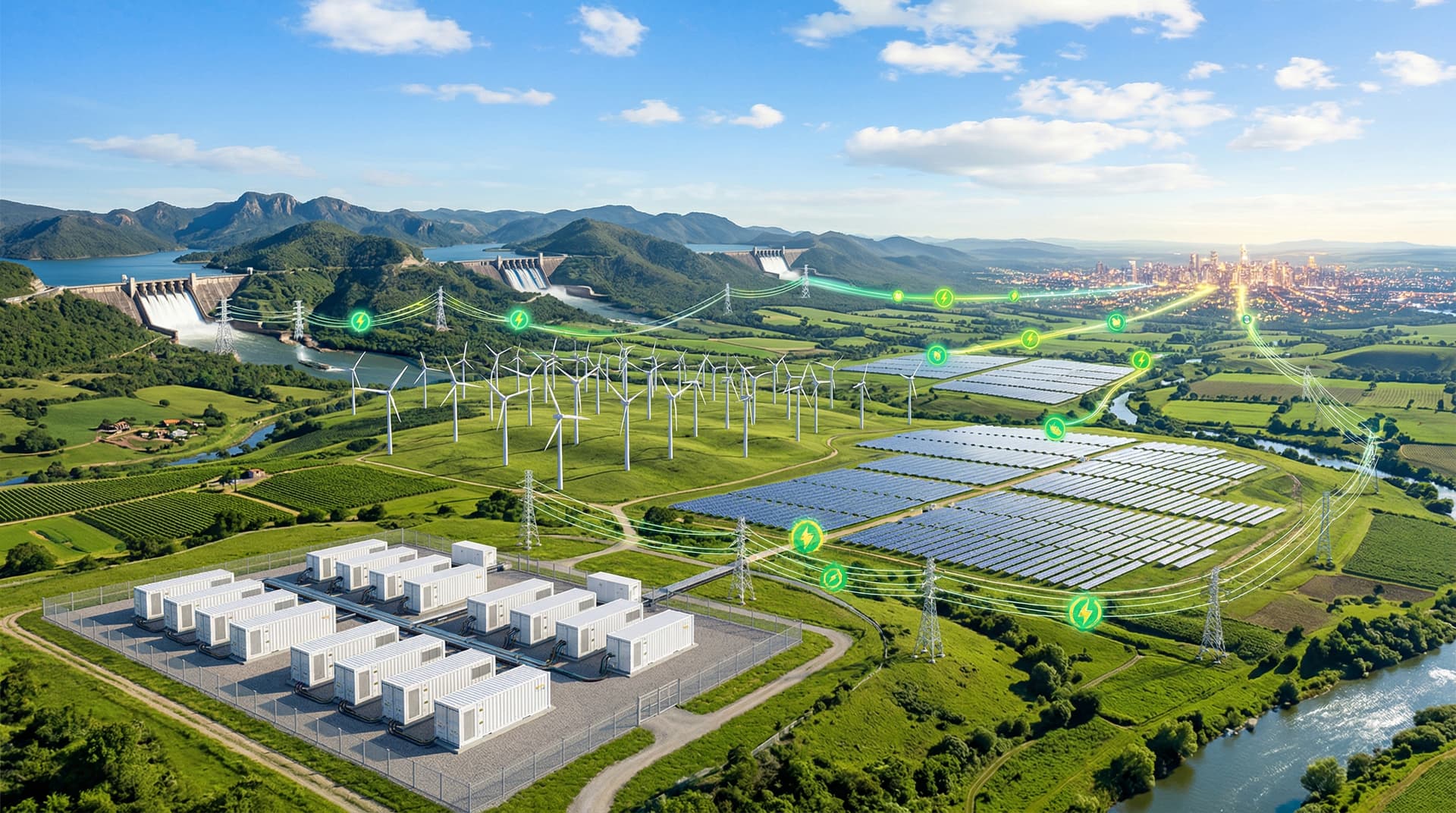
Seven countries—Iceland, Norway, Albania, Bhutan, Paraguay, Costa Rica, and Uruguay—achieve 100% renewable electricity generation as of April 12, 2026. Energy storage stabilizes their grids against solar and wind variability, IRENA confirms using 2025 data.
Pioneers' Energy Mixes Rely on Storage
Iceland generates 70% geothermal and 30% hydro power, Landsvirkjun reports. Its baseload stability limits storage needs. Norway produces 98% hydro and 2% wind, backed by Statkraft's 1.2 GW pumped hydro storage.
Albania draws 100% from hydro sources, per Eurostat's April 12 data. Bhutan depends on run-of-river hydro, Druk Green Power confirms. Paraguay reaches the target through Itaipu Dam's 14 GW hydro capacity shared with Brazil, ANDE states.
Costa Rica mixes 70% hydro, 15% geothermal, 10% wind, and 5% solar, IRENA notes. Uruguay blends 45% wind, 35% hydro, 15% solar, and 5% biomass. Storage supports Uruguay's high variable renewable share.
Storage Enables Grid Reliability
Storage captures excess generation and dispatches power during shortfalls. Uruguay runs 320 MW/880 MWh lithium-ion batteries from Senergy since 2025. They deliver 85% round-trip efficiency at 0.5C discharge, UTE data shows.
Costa Rica deploys 150 MW/400 MWh flow batteries from Redflow for wind smoothing. These batteries reduce curtailment by 25%, ICE reports on April 12. Nationwide pumped hydro adds 500 MW capacity.
Norway develops 2 GW pumped storage, Statkraft announced April 12. Lithium-ion pilots total 100 MW/200 MWh for vehicle-to-grid tests. They handle 4-hour peaks at 90% depth of discharge.
Flow batteries target long-duration needs. Uruguay pilots 50 MW/1 GWh iron-air systems from Form Energy for 100-hour discharge. Levelized cost of storage (LCOS) reaches USD 0.08/kWh, Wood Mackenzie estimates.
Policies Drive Storage Adoption
Uruguay's 2015 law mandated 50% renewables by 2017, which it exceeded. Tax credits cover 30% of storage costs and attract USD 1.2 billion in investment since 2020, per Ministry of Industry data.
Costa Rica pursues carbon neutrality since 2013 via auctions. Recent bids award 200 MW solar-plus-storage at USD 25/MWh LCOE, CNFL reports April 12.
EU directives grant Albania EUR 500 million for grid upgrades. Norway's sovereign wealth fund finances Statkraft projects. Bhutan prioritizes exports to India. Paraguay gains from Mercosur agreements.
These frameworks mandate 20% dispatchable battery capacity in new renewable projects.
Financing Fuels Expansion
Investors commit USD 15 billion to these grids since 2023, BloombergNEF tracks. Uruguay projects deliver 8-10% IRR with storage co-location. IDB financing covers 60% at 4% interest rates.
Costa Rica issues USD 300 million green bonds maturing 2035 at 3.5% yields. Sodium-ion pilots cut costs 20% versus lithium-ion batteries.
Analysts predict 50 countries will reach 100% renewables by 2035 with storage growth. Global storage hits 50 GW in 2026, Rystad Energy updates April 12.
LFP cathodes from APAC suppliers stabilize supply chains. Pack-level prices fall to USD 80/kWh, CATL quotes.
Innovations Integrate Renewables
Uruguay pairs a 100 MW wind farm with 50 MW/150 MWh batteries. Curtailment drops from 12% to 2%, UTE confirms.
Costa Rica's geothermal-wind hybrids use AI dispatch. They hit 95% utilization. 5,000 EVs supply 20 MW vehicle-to-grid flexibility.
Norway pilots 200 MW/1 GWh compressed air storage at 70% efficiency, rivaling pumped hydro. It aids 2027 offshore wind integration.
Zinc-bromine batteries achieve 100% depth of discharge over 10,000 cycles, ESS Inc. trials report April 12.
Remaining Challenges
Uruguay curbs 10% of solar peaks without more storage. Albania needs 200 MW batteries by 2028 to counter hydro droughts. The group faces USD 2 billion financing gaps, World Bank assesses.
Subsidy phase-outs loom. Uruguay ends credits in 2027 and targets LCOS below USD 0.05/kWh.
Global Implications for 100% Renewables
These pioneers prove 100% renewable electricity works with storage. They slash emissions 100% versus fossil fuels, IPCC models show. Grids worldwide can copy this via policies and technologies. Storage delivers resilience and USD 0.10/kWh savings, IRENA states.