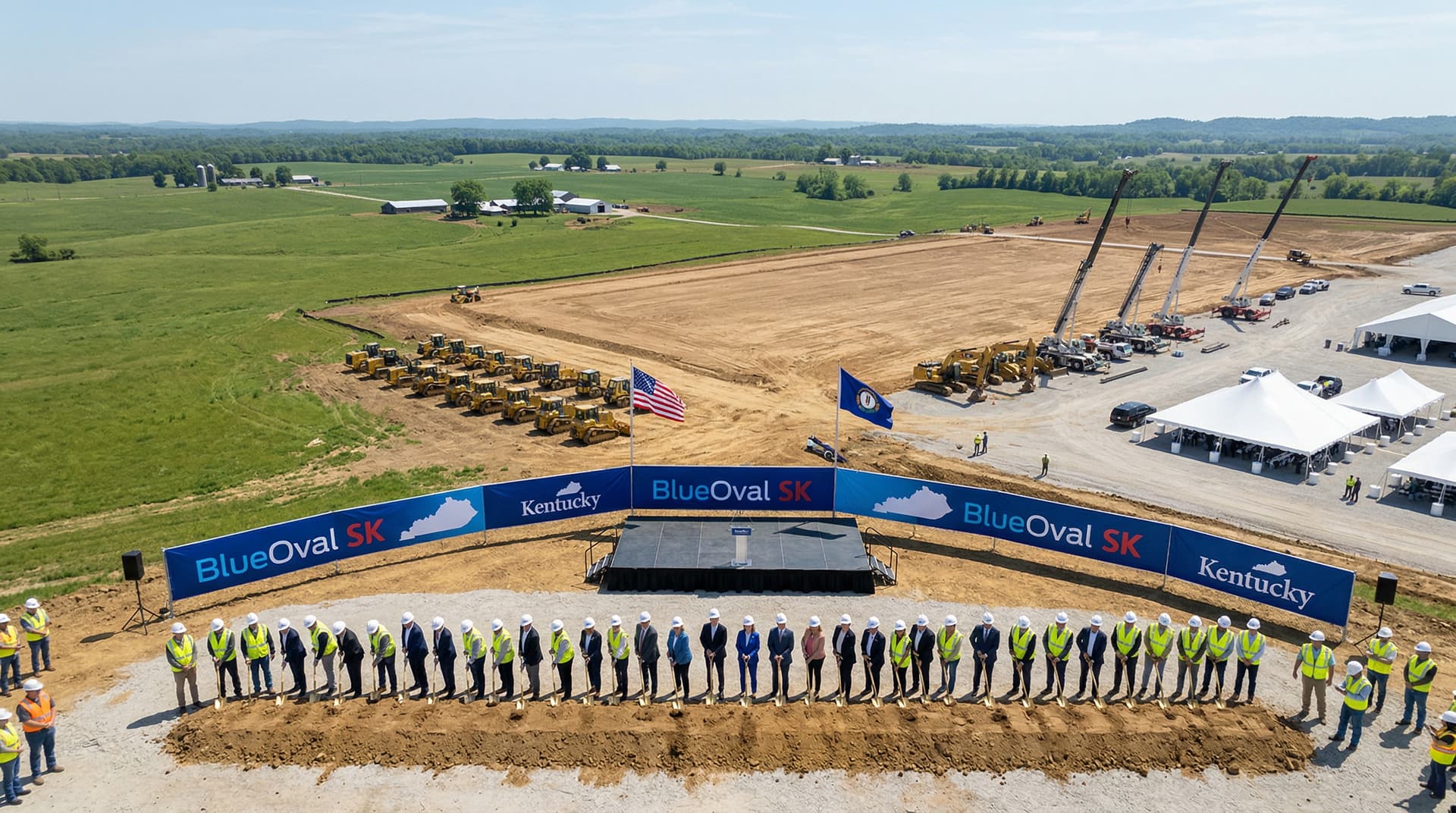
Glendale, Kentucky – May 4, 2023 – In a significant step toward bolstering domestic electric vehicle (EV) battery production, Ford Motor Company and SK On held a ceremonial groundbreaking for their first joint-venture battery manufacturing plant in Glendale, Kentucky. The BlueOval SK facility represents a $5.8 billion investment and is poised to become one of the largest EV battery plants in North America, with an annual capacity of 43 gigawatt-hours (GWh). This output is expected to power approximately 650,000 EVs per year, supporting Ford's ambitious electrification strategy.
The event, attended by Kentucky Governor Andy Beshear, U.S. Secretary of Energy Jennifer Granholm, and Ford CEO Jim Farley, underscores the Biden administration's push for a robust U.S. battery supply chain through the Inflation Reduction Act (IRA). The IRA provides incentives like the Advanced Manufacturing Production Credit, which rewards domestic battery production and sourcing of critical minerals.
A Strategic Partnership for EV Scale-Up
BlueOval SK is a 50-50 joint venture between Ford and South Korea's SK On, a leading lithium-ion battery producer. Announced in 2021, the partnership has already secured $9.2 billion in federal and state incentives across its U.S. projects. The Kentucky plant is the first of two BlueOval SK facilities, with a second $6.6 billion plant planned for Stanford, Tennessee, expected to add another 45 GWh of capacity.
Construction on the 1,800-acre Kentucky site began immediately after the groundbreaking, with commercial production slated for 2026. The plant will employ around 2,000 workers initially, with potential for more as production ramps up. Ford emphasized that the facility will produce nickel-manganese-cobalt (NMC) and lithium-iron-phosphate (LFP) cathodes, offering flexibility to meet diverse EV needs.
"This is a game-changer for American manufacturing and our transition to an all-electric future," said Jim Farley, Ford CEO. "By building these batteries here at home, we're creating jobs, securing our supply chain, and accelerating EV adoption."
SK On President Chi Yung-jong echoed the sentiment: "We're committed to localizing battery production to support the U.S. EV market's explosive growth. This plant will deliver high-performance, cost-competitive cells for Ford's lineup."
Implications for Energy Storage and Grid Stability
While focused on EVs, the BlueOval SK plant has broader implications for energy storage. Large-scale battery production enhances grid-scale storage capabilities, as EV batteries share technology with stationary systems. Ford's vertical integration—controlling battery production—reduces costs and improves supply chain resilience, critical amid global raw material shortages.
The U.S. currently imports over 70% of its EV batteries, primarily from Asia. Facilities like BlueOval SK aim to reverse this, targeting 40% domestic content by 2026 to qualify for IRA tax credits up to $7,500 per EV. This shift could lower EV prices, making them competitive with internal combustion engine vehicles.
Kentucky's selection highlights the state's growing role in the battery ecosystem. With its logistics hub status, access to Interstates 65 and 75, and proximity to Ford's Kentucky Truck Plant in Louisville, Glendale is ideal. The project builds on Panasonic's recent $4 billion battery plant announcement in Kansas, signaling a battery belt emerging in the Midwest and South.
Financing and Economic Impact
Funding for the Kentucky plant includes $2.5 billion in loans from the U.S. Department of Energy's Loan Programs Office, Kentucky state incentives worth $400 million, and federal grants. This public-private model de-risks investments in unproven scales of production.
Economically, the plant is projected to generate 5,000 construction jobs and contribute $1.4 billion annually to Kentucky's GDP once operational. Local leaders hailed it as transformative for Hardin County, which has a population of about 110,000.
Governor Beshear noted, "Kentucky is becoming the epicenter of the EV revolution. These investments secure high-wage jobs for generations."
Challenges Ahead in Battery Tech
Despite optimism, hurdles remain. Scaling NMC and LFP production requires vast amounts of lithium, nickel, and cobalt. U.S. mining lags behind, prompting the IRA's push for North American sourcing. Recycling is another focus; Ford plans closed-loop systems to recover 95% of battery materials.
Technological evolution adds complexity. Competitors like Tesla's 4680 cells and solid-state batteries loom, but BlueOval SK's prismatic cells are proven for mass-market EVs like Ford's F-150 Lightning and Mustang Mach-E.
Ford's EV sales surged 61% in Q1 2023, reaching 22,000 units, but production bottlenecks persist. Batteries from BlueOval SK will alleviate this, targeting 600,000 EVs annually by 2026.
Looking to the Future
The Kentucky groundbreaking is a bellwether for the $52 billion U.S. battery manufacturing boom since 2021. With over 100 GWh of announced capacity, the sector could rival China's output by decade's end.
For energy storage, this means cheaper, more abundant batteries for grid applications. Pairing EV fleets with vehicle-to-grid (V2G) tech could stabilize renewables integration.
As Ford and SK On dig in, the U.S. edges closer to EV parity. This plant isn't just bricks and cathodes—it's the foundation of a electrified economy.
By [Your Name], Senior Tech Journalist, Energy Storage News
(Word count: 912)