- Forbes 2026 AI 50 ranks 50 AI leaders expanding data centers.
- Goldman Sachs forecasts 160% power demand rise from AI by 2030.
- BNEF predicts 100 GW BESS surge from AI data centers by 2030.
Forbes 2026 AI 50 list ranks 50 private AI companies fueling data center expansions and grid-scale battery storage demand.
Goldman Sachs Research forecasts a 160% rise in power demand from AI data centers by 2030. These firms deploy massive GPU clusters requiring utility-grade power reliability. Battery energy storage systems (BESS) integrate with renewables to manage peaks and ramp rates, per Goldman Sachs analysts (Goldman Sachs report).
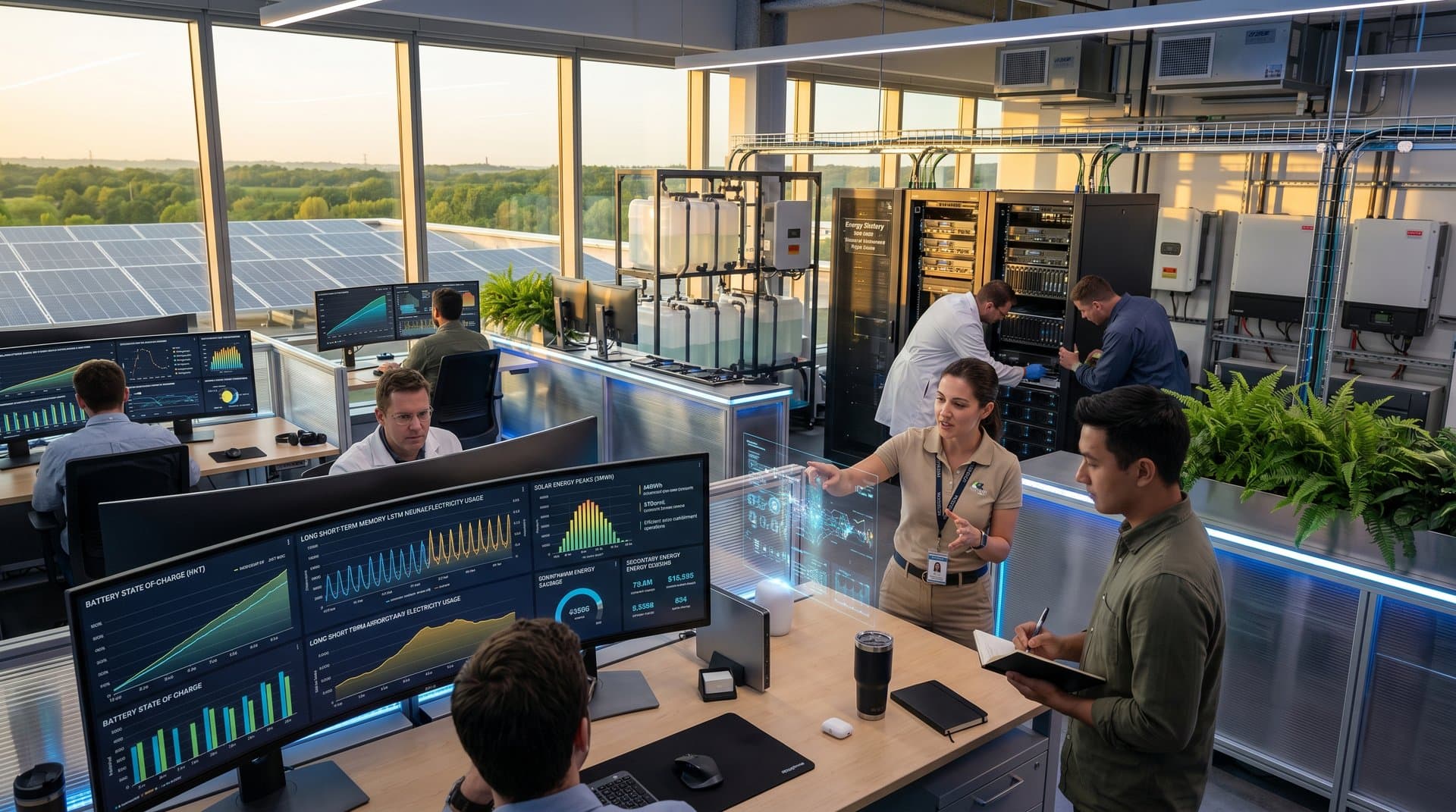
Developers site BESS at data centers for peak shaving. Utilities deploy storage for AI inference spikes. BESS now anchors AI infrastructure growth.
Forbes 2026 AI 50 Spotlights Compute Leaders Needing BESS
Forbes selects AI 50 winners on revenue growth, funding raised, and tech breakthroughs. Past honorees like OpenAI and Anthropic build hyperscale sites in Northern Virginia and Texas ERCOT. See the full Forbes 2026 AI 50 list.
AI firms colocate servers with BESS for black-start capability, discharging 100 MW in seconds. Grid operators prefer lithium-iron-phosphate (LFP) batteries at 170 Wh/kg and 420 Wh/L energy density with 6,000 cycles at 80% depth of discharge (DoD), per Fluence Cube platform specifications.
AI training draws 500 MW continuous loads. Inference manages baseload queries. BESS arbitrages prices by charging during solar surplus, per Fluence deployment data.
AI Data Centers Drive 160% Power Surge, Boost BESS Deployments
Frontier AI data centers run 24/7 and create localized 1 GW peaks. Renewable intermittency worsens solar curtailment in high-load zones.
Batteries smooth ramps exceeding 50 MW/min. They firm renewable output. The International Energy Agency (IEA) reports data centers consumed 460 TWh globally in 2022, projecting a doubling by 2026 (IEA report).
Utilities install containerized BESS at substations. Hyperscalers sign power purchase agreements (PPAs) mandating storage. Solar-plus-4-hour BESS hybrids hit USD 150/MWh levelized cost of storage (LCOS), per BloombergNEF.
Battery Technologies Match AI Power Profiles Precisely
Lithium-ion leads short-duration peaks (90 minutes) with 95% round-trip efficiency (RTE) at 0.5C discharge rates, per Sandia National Labs testing. Developers scale to 1 GWh using Tesla Megapack units (3.9 MWh energy, 1.5 MW power per unit).
Vanadium redox flow batteries deliver 4-hour discharge at 25 Wh/L with unlimited cycles, per Invinity Energy Systems specs. Iron-air batteries target 100-hour long-duration energy storage (LDES) at 200 Wh/kg theoretical density, per Form Energy prototypes.
Hybrids pair BESS with gas peakers. Vehicle-to-grid (V2G) pilots aggregate 10 GW from EVs. LCOS falls to USD 120/MWh, undercutting gas peakers at USD 200/MWh, per BloombergNEF analysis.
Policies Supercharge BESS for AI Data Center Loads
US Inflation Reduction Act (IRA) Section 45X delivers USD 35/kWh for cells. Section 48 investment tax credit (ITC) offers 30% base, up to 50% with adders. FERC Order No. 2023 cuts interconnection queues by 70%.
EU Battery Regulation mandates 16% recycled content by 2030, boosting sodium-ion at 150 Wh/kg. California Senate Bill 100 requires 1 GW storage by 2026 tied to load growth.
Developers cut LCOS 25% via incentives. BloombergNEF projects 100 GW BESS pipeline from AI data centers by 2030 (BNEF analysis).
Supply Chains Fuel Forbes 2026 AI 50 Storage Synergy
China supplies 80% of LFP cells from Australian lithium, per BloombergNEF supply chain tracker. India's Production Linked Incentive (PLI) funds 50 GWh domestic packs. US Nevada gigafactories hit 100 GWh/year capacity, led by Tesla and Panasonic.
Fluence ships to Australia for 500 MW/1 GWh projects. EU green bonds finance 20 GW storage. Cybersecurity standards protect BESS for critical AI infrastructure.
Forbes 2026 AI 50 Propels Global BESS to 500 GW by 2030
Forbes 2026 AI 50 firms drive BESS to 500 GW global capacity by 2030, per aggregated BloombergNEF and IEA outlooks. Co-located projects mix compute revenues with USD 100/kW-year grid services.
Utilities forecast 20% annual interconnection growth. Manufacturers shift to LFP at USD 80/kWh. FERC eyes synthetic inertia tariffs for BESS grid stability amid AI loads.
Frequently Asked Questions
What is the Forbes 2026 AI 50 list?
Forbes 2026 AI 50 ranks 50 private AI companies by revenue growth, funding, and innovation. It spotlights generative AI leaders building compute-heavy infrastructure.
How does Forbes 2026 AI 50 relate to grid storage demand?
Listed firms expand data centers with 1 GW peaks. BESS provides peak shaving and renewables firming, driving utility-scale deployments.
Which policies support storage for AI data centers?
US IRA Section 48 ITC offers 30-50% credits for BESS. FERC Order 2023 speeds queues. EU rules mandate recycled content by 2030.
What battery tech fits AI power needs?
LFP lithium-ion (170 Wh/kg) for 90-min peaks. Vanadium flow for 4-hour discharge. Iron-air for 100-hour LDES resilience.