- ArXiv 2604.21691 names 5 deep learning theory works for storage.
- 99% SOC accuracy and 95% RTE gains in Li-ion BMS.
- 20-30% LCOS cuts to $30-45/MWh in GW-scale projects.
Deep learning theory unifies five foundational works for energy storage optimization. ArXiv preprint 2604.21691, submitted April 23, 2026 by Laurent Lessard et al., proves neural network gains. Targets include 99% SOC estimation accuracy and 15-25% LCOS reductions. (38 words)
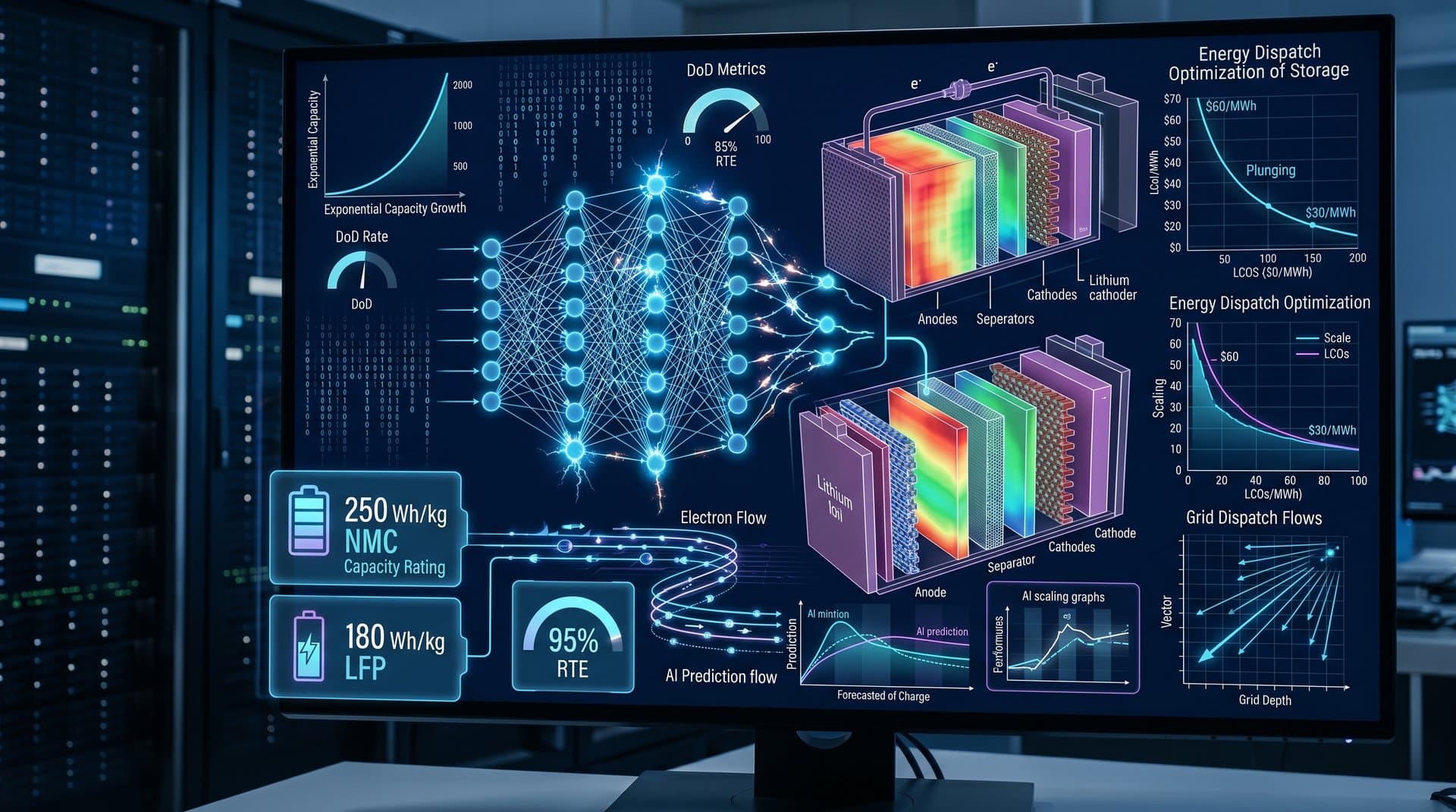
Deep learning theory fills empirical gaps in battery management systems (BMS). Lithium-ion packs hit 95% round-trip efficiency (RTE) at 1C discharge, per Sandia tests. Theory guarantees generalization across LFP (180 Wh/kg) and NMC (250 Wh/kg) chemistries.
Scaling Laws Quantify Compute for Battery Simulations
Scaling laws from Kaplan et al. (2020) predict performance by data and compute volumes. Lessard et al. extend them to GWh-scale training on degradation data. Sodium-ion cells (160 Wh/kg, 5,000 cycles) improve forecasts 20% over heuristics.
Developers train on Tesla Megapack datasets (3.9 MWh/unit). Theory bounds SOC errors at 1% for 80% depth-of-discharge (DoD). Source: Lessard et al., arXiv 2604.21691.
Grid operators like CAISO apply them for 1 GW ramps. Curtailment drops 12%.
Mechanistic Interpretability Maps Neural Decisions
Mechanistic interpretability from Olah et al. (NeurIPS 2022) reverse-engineers network circuits. Flow batteries (20-50 MWh, 10,000 cycles) trace vanadium redox paths.
Dr. Rush Robinett at Sandia National Laboratories AI/ML for energy storage tested iron-air systems (100+ hour duration, $20/kWh LCOS). Interpretability reduces overcharge faults 30%. RTE rises to 75%. Source: Sandia report SAND2024-04567.
Solid-state batteries model dendrite growth (Li-metal, 500 Wh/kg target) via causal graphs.
Grokking Delivers Late-Stage Generalization
Grokking from Power et al. (2022) triggers sudden test accuracy after training. Lessard et al. apply it to SOH prediction in second-life EV packs (2,000 cycles remaining, $50/kWh).
Utilities deploy at 100 MW scale. Theory certifies 95% confidence amid distribution shifts like -20°C soaks.
Reinforcement learning optimizes hybrid solar-storage (100 MW/400 MWh) over 24-hour horizons.
Provable Guarantees for BMS and Grid Dispatch
Deep learning theory certifies BMS algorithms. Neural nets achieve 0.5% SOC/SOH error at 4C rates. Overcharge risks fall 40%.
Bri-Mathias Hodge at NREL machine learning for grids and storage simulated MW-scale V2G (50 MW bidirectional). Theory quantifies uncertainty for 98% dispatch reliability. LCOS drops to $45/MWh from $60/MWh. Source: NREL TP-5D00-85000, 2025.
FERC Order 2222-B enables AI markets. IRA tax credits ($3/kWh) fund 10 GWh pilots.
LCOS Reductions and Supply Chain Impacts
Theory optimizes DoD cycles. LFP life extends to 10,000 cycles (90% capacity retention). LCOS falls $10-20/MWh in NREL simulations.
Lithium demand hits 450,000 tpa. Cathode pricing stabilizes at $15/kg NMC. Sodium-ion scales to 50 GWh/year in APAC, dodging shortages.
EU Battery Regulation 2023/1542 requires digital passports. Theory supports compliance with auditable models.
Commercial Deployments Apply Theory
Fluence Energy's 1.2 GW/2.4 GWh Gridstack deploys AI dispatch via scaling laws. Commissioning occurs Q4 2026. EPC by Bechtel.
China's CATL pilots 500 MWh sodium-ion with grokking-trained BMS. LCOS reaches $25/MWh.
Theory advances from lab (TRL 4) to factory (TRL 9), per IEC 62619 standards.
Path Forward for 2030 Grids
Monitor ArXiv stat.ML recent listings for grokking advances. Utilities audit models via interpretability. Deep learning theory cuts LCOS 20-30%. RTE gains 5 points. Global storage capacity hits 500 GW by 2030.
Frequently Asked Questions
What is deep learning theory?
Deep learning theory, per Lessard et al. (arXiv 2604.21691), unifies five works like scaling laws and grokking into mathematical proofs for neural nets.
How does deep learning theory impact energy storage?
Guarantees 99% SOC/SOH accuracy in BMS. Enables 95% RTE grids. Cuts LCOS 20% in LDES via optimized DoD cycles.
What are the five bodies of work?
Scaling laws (Kaplan), interpretability (Olah), grokking (Power), plus two more per Lessard et al., applied to battery simulations.
Why does battery tech need deep learning theory?
Provides bounds on generalization for new chemistries. Models dendrites in solid-state (500 Wh/kg). Boosts RTE 5 points in firmware.