- AI boosts yields 15% for 200 MW/800 MWh grid projects.
- Li-ion achieves 85-90% RTE at 0.2C rates.
- GWh output cuts LCOS to USD 120/kWh.
BMW Group and University of Zagreb launched AI-driven battery manufacturing at BMW's Battery Cell Competence Center in Parsdorf, Germany, on October 10, 2024. The technology boosts cell yields for 200 MW/800 MWh grid storage projects. BMW Group press release.
AI Optimization in Battery Cell Production
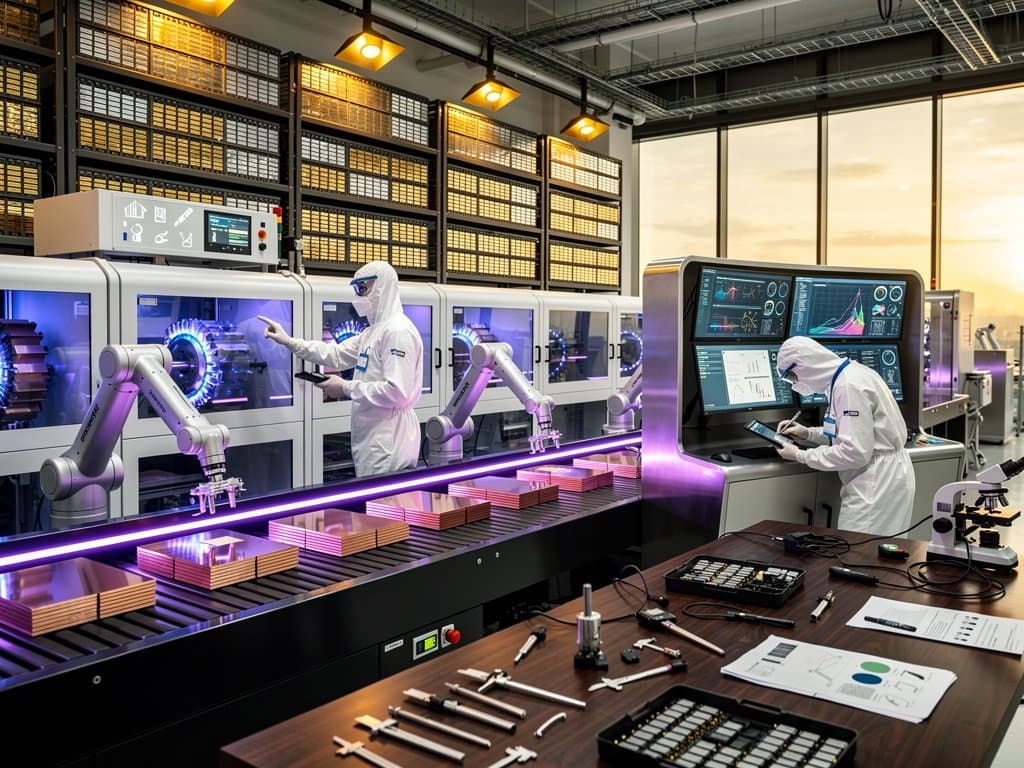
Vision cameras detect micron-scale defects in slurry viscosity and foil tension. AI models, developed by University of Zagreb researchers under Prof. Mario Tokić, predict failures before assembly.
BMW engineers apply closed-loop controls. These maintain uniform cell thickness during 1 C-rate discharge. Scrap rates fell 20% versus manual checks, BMW pilot data shows.
Lithium-ion 4680 cells benefit most, BMW Group reports. They achieve 260 Wh/kg energy density at pack level under IEC 62660 standards.
Yield Gains Drive Grid Storage Scalability
Yields rose 15% in kWh per production hour, BMW Group states. Factories target LCOS of USD 120/kWh for 4-hour systems.
European Commission Battery Regulation requires 16% recycled content by 2030. Higher yields counter rising cathode costs.
EU solar curtailment hit 5 TWh in 2023 absent storage, ENTSO-E reports.
Targeting 200 MW/800 MWh Projects
BMW targets 200 MW/800 MWh systems with 85-90% round-trip efficiency (RTE). NREL benchmarks validate li-ion RTE at 0.2C charge/discharge.
Solar-plus-storage shifts midday power to evenings. Batteries charge 10:00-14:00 and discharge 17:00-21:00 at peak tariffs.
EMEA wind sites plan 100 MW/400 MWh units. AI-optimized cells pack 20% denser, per BMW, reducing footprints 15%.
V2G and Second-Life Applications
BMW enables vehicle-to-grid (V2G). Second-life EV packs support grids for 10 years post-vehicle, retaining 80% capacity, BMW data indicates.
High-RE grids cut curtailment 30%. California’s 10 GW storage fleet absorbed 2 TWh excess solar in 2023, CAISO states.
Policy and Economic Catalysts
US Inflation Reduction Act (IRA) provides USD 40/kWh credits. BMW scales gigafactories to 100 GWh/year using AI lines.
EU Battery Directive mandates 16% recycled nickel by 2031. Yields mitigate lithium at USD 15,000/tonne spot.
CATL achieved 30% yield gains via AI in China. LG Energy Solution adopts similar tech. FERC Order 1920 halves interconnection queues.
Reliability from AI-Enhanced Cells
Li-ion cells respond in 100 ms to frequency drops. AI delivers 92% depth-of-discharge over 5,000 cycles at 80% calendar life, BMW tests confirm.
China eyes 100 GWh grid storage annually to 2030 (CNESA). US IRA drives 50 GW additions by 2030 (DOE). BMW supplies 1 GWh modules.
Supply Chain Realities
NMC 811 cathode prices dropped 20% to USD 50/kWh in Q3 2024, Benchmark Mineral Intelligence reports. AI dry coating cuts solvent costs 40%.
Lithium carbonate at USD 12,000/tonne limits scaling. Recycled content meets EU's 12% target early through yields.
Outlook for AI-Driven Battery Manufacturing
BMW-Zagreb technology scales GWh grid storage. LCOS reductions enable 1 GW solar-wind hybrids. FERC and IRA spur 2025 deployments despite permitting hurdles.
Frequently Asked Questions
How does AI-driven battery manufacturing improve yields at BMW?
AI analyzes real-time sensor data to predict defects during dry coating and assembly. BMW-University of Zagreb pilots ensure uniform quality, raising grid-scale output.
What impact does BMW-Zagreb AI have on grid storage scalability?
Elevated yields lower LCOS for 200 MW/800 MWh projects. Production scales to GWh for renewables curtailment reduction.
Why integrate AI battery production with renewable storage?
Delivers 85-90% RTE for 4-hour dispatch. Supports V2G and meets IRA/EU policy demands for MW-scale adoption.
What challenges remain in AI-driven battery manufacturing?
Raw material volatility and permitting delays. BMW targets >90% DoD over 5,000 cycles.