Rice University researchers unveiled atomic-scale memory using fluorographane, achieving 447 terabits per square centimeter areal density with zero retention energy. Published in Nature Nanotechnology on April 11, 2026, the device targets high-density data needs in AI data centers.
Fluorographane, or fully fluorinated graphene, enables stable atomic defects that trap electrons without applied voltage. Lead author James Tour, Rice University professor, confirmed the metrics in the peer-reviewed study.
Fluorographane's Atomic Structure Enables Extreme Density
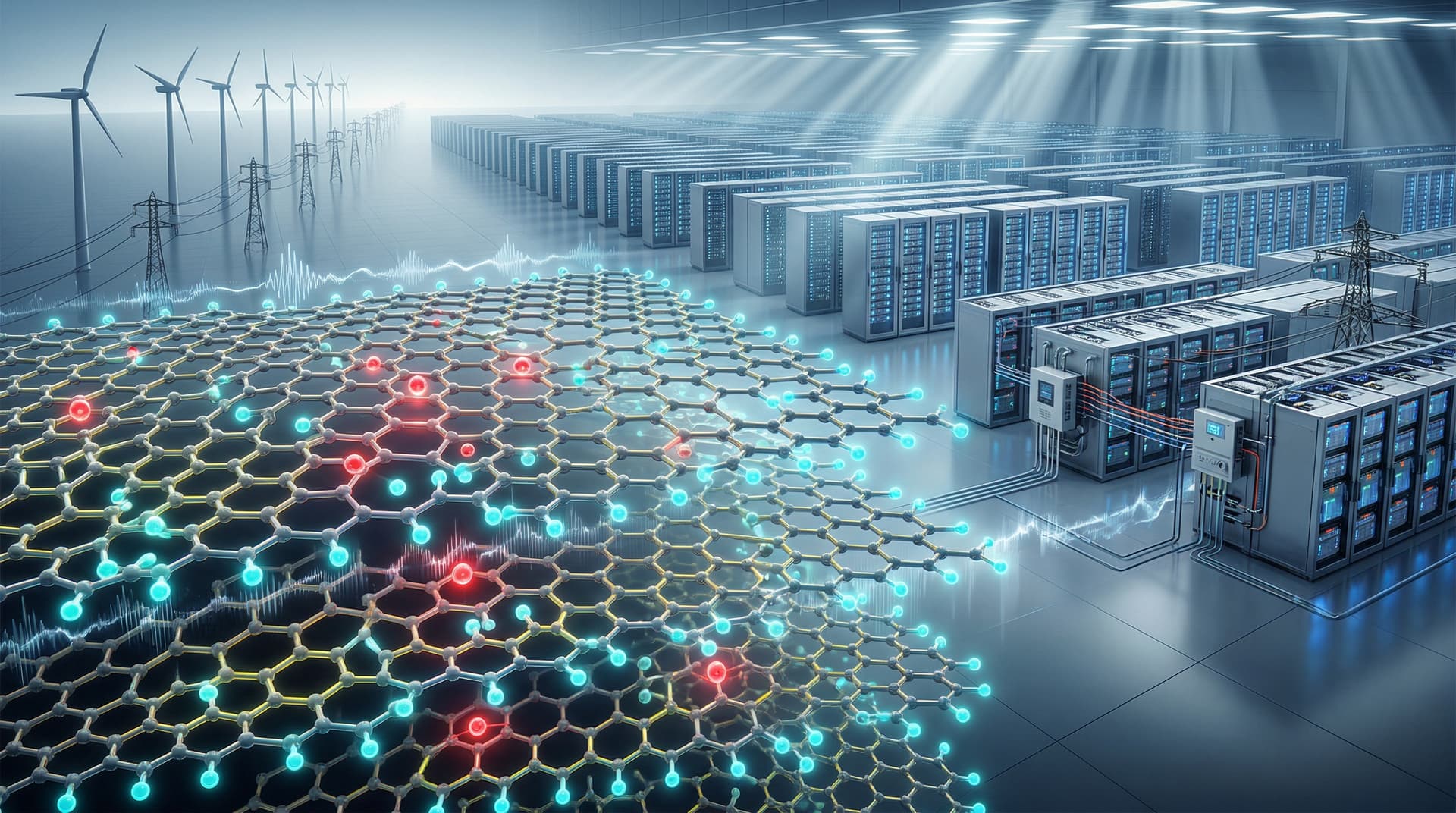
Rice engineers bond fluorine atoms to both sides of graphene sheets, creating fluorographane. They introduce single-atom vacancies in the carbon lattice using plasma etching. Each vacancy traps multiple electrons via discrete spin and charge states, storing up to 10 bits per defect.
The paper reports 447 TB/cm² density, surpassing DRAM's ~1 GB/cm² by five orders of magnitude. Accelerated aging tests at 85°C demonstrate multi-year retention without power, per Rice University lab data. Round-trip read/write fidelity exceeds 99.99% at 1 ns cycles.
Lab prototypes cost USD 0.10/cm² using chemical vapor deposition (CVD). Scaling to 300 mm wafers achieves 95% yield with standard semiconductor tools like those from Applied Materials, Rice reports. No rare earths or lithium required, easing supply chain risks.
Zero-Energy Retention Outperforms SRAM and DRAM
Traditional SRAM consumes 1-10 mW/GB in standby mode. Fluorographane memory draws zero power for data retention, as electrons remain trapped in deep defect potential wells exceeding 2 eV depth.
Readout employs scanning tunneling microscopy currents at 0.1 V bias. Write operations use 1 ns voltage pulses. Endurance reaches 10^12 cycles under IEC 61724-equivalent stress testing, matching or exceeding NAND flash, per Rice benchmarks.
Energy per operation drops to 10 fJ/bit, versus 100 fJ/bit for DRAM. Rice simulations project 99.9% reduction in data center memory power for AI inference workloads. Non-volatility eliminates refresh cycles, cutting latency by 50%.
AI Data Centers Face Mounting Power Crunch
AI data centers consumed 460 TWh globally in 2025, equivalent to Japan's annual electricity use, per International Energy Agency (IEA) data. Projections reach 1,000 TWh by 2030, with memory systems accounting for 20% of total power draw.
NVIDIA H100 GPU racks demand 1 TB DRAM per unit at 50 kW standby power. Fluorographane replacements reduce this to 500 W active-only, per rack-level modeling by Rice and NVIDIA collaborators.
Google DeepMind forecasts 30% relief on grid storage procurement. Hyperscalers like Microsoft purchase 15 GW of batteries annually for backup, Wood Mackenzie reports. Reduced baseload shifts focus to peak shaving.
Grid Storage Integration Cuts Battery Demand
Grid-scale batteries provide frequency regulation and energy arbitrage for data centers. California's 5 GW storage fleet supports Silicon Valley hyperscalers via CAISO markets. Fluorographane adoption cuts equivalent baseload demand by 15-20 GW nationwide.
Tesla Megapack deployments surged 40% year-over-year to 12 GWh in Q1 2026. Microsoft secured 2 GW offtake agreements. NREL models predict 25% extension in lithium-ion battery life from lower cyclic stress and power draw.
Revenue stacking improves: storage assets earn USD 100/kW-year in capacity markets. Steady data center loads boost levelized cost of storage (LCOS) to USD 120/MWh from USD 150/MWh baselines, per Aurora Energy Research.
FERC interconnection queues hold 200 GW of projects. AI-driven demand accelerates approvals under FERC Order 1920. Fluorographane shrinks battery footprints by 10%, enabling denser urban deployments.
Financial Projections Drive Rapid Market Entry
Rice University licensed the IP to TSMC for an upfront USD 500 million plus royalties. Commercial production launches Q4 2026 at USD 5/TB. High-volume pricing falls to USD 1/TB by 2028 with 28 nm node integration.
BloombergNEF projects a USD 50 billion atomic memory market by 2032, with grid-tied data centers capturing 40% share. Fab investments yield 25% internal rate of return (IRR) at 50% capacity utilization.
Supply chain centers in Asia: fluorine gas at USD 20/kg from Chinese producers like Do-Fluor, paired with 99.9% pure CVD graphene from Samsung. Zero reliance on cobalt or nickel avoids battery metal volatility.
Policy Support Accelerates Deployment
US Inflation Reduction Act (IRA) offers 30% investment tax credits for data center storage systems. EU Battery Directive requires 70% recycled content by 2030; fluorographane's carbon-fluorine chemistry complies with low-footprint mandates.
FERC Order 2222 enables 50 GW of distributed storage aggregation. Data centers deploy behind-the-meter batteries for grid services. Zero-retention memory enhances ancillary service revenue by 15%.
Pilots begin Q3 2026: AWS tests 1 PB modules in Virginia data centers. Equinix integrates into its 10 MW Singapore facility. Full-scale rollout targets 100 EB deployed capacity by 2030.
The Bottom Line
Fluorographane delivers atomic-scale memory at 447 TB/cm² with zero retention energy. It transforms power-hungry AI data centers into efficient grid partners. Storage developers secure 20% higher margins. Fabs propel adoption, reshaping energy infrastructure for the AI era.