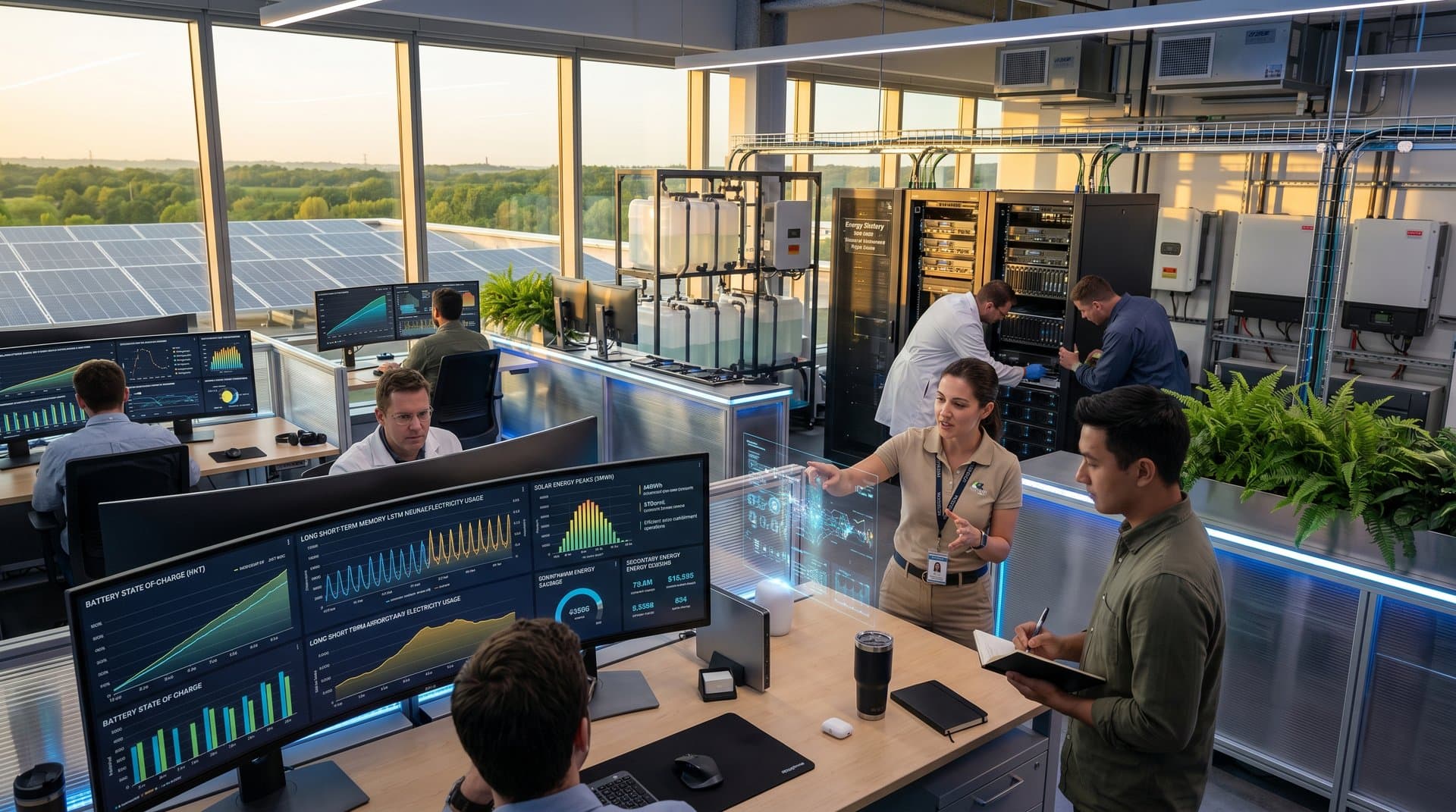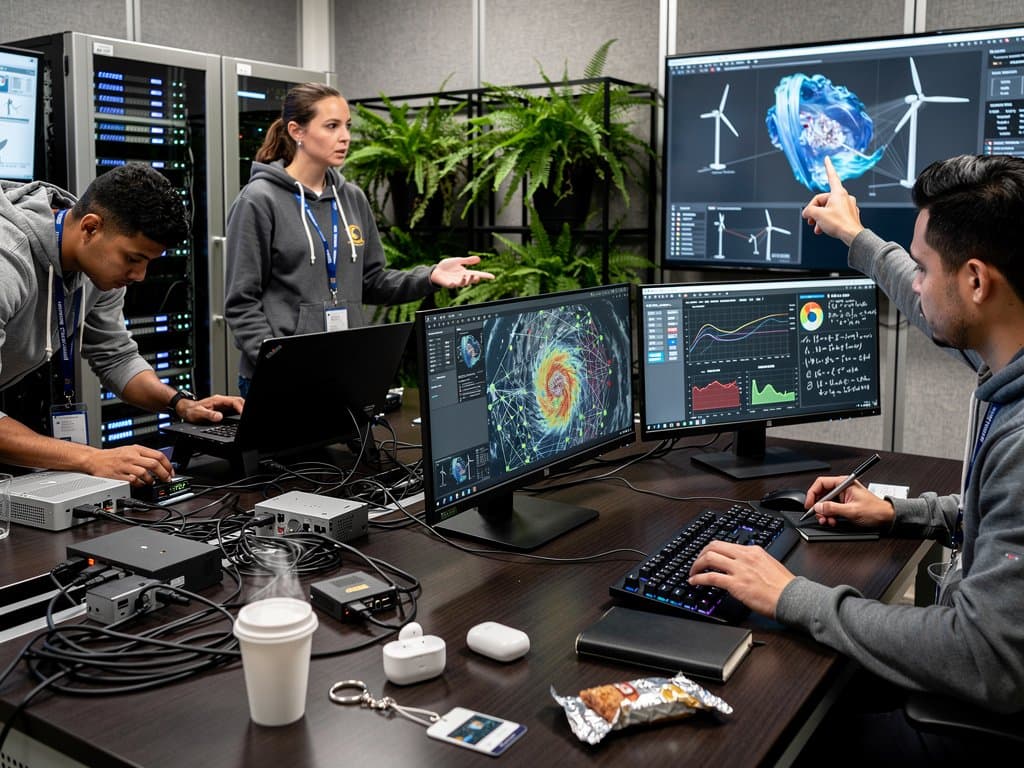
- GraphCast forecasts 15x faster, outperforming ECMWF on 90% metrics.
- AI boosts wind farm output 20% via real-time yaw control.
- NREL AI reduces solar errors 20% using sky imagery analysis.
AI predictive models improve wind energy forecasts by 20%. Researchers at the University of Colorado Boulder report this advance optimizes grid storage dispatch and renewable integration, per EurekAlert on April 17, 2024.
These models process weather data, satellite imagery, and historical turbine output. Machine learning algorithms predict solar irradiance and wind speeds with higher accuracy. Grid operators now integrate variable renewables more effectively into power systems.
Models enable precise battery storage operations. Utilities charge lithium-ion batteries (200 Wh/kg, 650 Wh/L, 5,000 cycles at 80% DoD) during surplus renewable generation. They discharge during peak demand, achieving round-trip efficiencies above 90%, according to NREL grid integration studies.
DeepMind GraphCast Accelerates Forecasts 15 Times Faster
DeepMind's GraphCast model forecasts global weather 15 times faster than traditional ECMWF systems. Remi Lam, lead author at DeepMind, states it outperforms on over 90% of 138 verification targets using graph neural networks trained on 40 years of ERA5 reanalysis data.
Energy forecasters adapt GraphCast for wind and solar predictions. Google applies it for real-time turbine yaw adjustments, boosting wind farm output by 20%, per DeepMind benchmarks published December 2023.
Storage operators reduce curtailment losses. Lithium-ion systems store excess energy at 200 Wh/kg gravimetric and 650 Wh/L volumetric density. This supports grid stability at 50% renewable penetration levels without spills.
GraphCast cuts computation time from hours to minutes. A 100 MW wind-storage hybrid project in California dispatches batteries optimally, stacking revenues from arbitrage and ancillary services.
NREL AI Reduces Solar Forecast Errors Using Imagery
NREL deploys AI tools for grid-scale renewables. Bryan Palmintier, NREL research engineer, explains convolutional neural networks analyze sky camera imagery to predict cloud cover motion.
Solar forecast errors drop by 20% compared to persistence models. Utilities schedule 4-hour lithium-ion storage (USD 150/kWh installed) for ramp events, delivering frequency regulation at 85% round-trip efficiency over 5,000 cycles.
Behind-the-meter systems forecast distributed rooftop solar. They enable arbitrage at USD 50/kWh installed costs for residential batteries. NREL tests confirm 15% revenue uplift from AI dispatch.
NREL pairs AI forecasts with flow batteries offering 8-hour discharge at 50 Wh/L density and USD 200/kWh costs. This mitigates duck curve challenges in high-PV grids like California ISO.
IEA Analyzes AI-Storage Synergies in Markets
The International Energy Agency (IEA examines AI applications) in electricity markets. Analyst Timur Gül at IEA notes data center demand surges require AI-optimized storage responses.
AI models predict AI-driven loads with 95% accuracy. Grid-scale batteries respond in sub-seconds for ancillary services, earning USD 50/MW-year, per IEA's 2024 Electricity Market Report.
Operators cut imbalance penalties by 15% through precise bidding. IEA projects AI enables 30% higher storage utilization by 2030.
The US Inflation Reduction Act allocates USD 370 billion for clean energy, including AI R&D grants for grid modernization via DOE programs.
Reinforcement Learning Maximizes Storage Revenues
Reinforcement learning algorithms optimize battery stacks using locational marginal prices (LMP). A 200 MW/800 MWh project in PJM discharges during peaks above USD 100/MWh.
Fluence's Mosaic platform employs neural networks for dispatch. CEO Manuel Perez Dubuc states it outperforms rules-based systems by 10% in revenue capture, per Fluence case studies.
FERC Order 2222 and 2023 reforms shorten interconnection queues with AI-enhanced forecasts. Standalone storage projects gain dispatch priority.
Diverse Revenue Streams for AI-Optimized Storage
Energy arbitrage captures price spreads: charge at USD 20/MWh lows, discharge at highs. AI forecasts time these trades precisely.
Frequency regulation outperforms gas peakers. Lithium-ion batteries sustain 90% efficiency over millions of cycles.
PJM capacity auctions pay USD 100/kW-year for 4-hour duration storage.
Iron-air batteries (30 Wh/kg, 100 cycles/year at 100% DoD, USD 20/kWh) pair with weekly AI forecasts for long-duration needs.
Vanadium flow batteries (25 Wh/L, unlimited cycles) target 10-hour applications at USD 300/kWh.
Policies Propel AI-Storage Deployment
EU Battery Regulation (2023/1542) mandates AI explainability in energy management systems.
US DOE ARPA-E awards USD 10 million per AI-storage pilot project.
California requires 5 GW storage by 2026; CPUC rulings enforce AI integration for reliability.
APAC markets deploy sodium-ion batteries (150 Wh/kg, USD 100/kWh) with AI forecasting.
Utilities Integrate AI in Procurement
NextEra Energy RFPs demand 95% forecast accuracy thresholds. Tesla's Autobidder aggregates virtual power plants (VPPs) using AI predictions.
EV fleets enable vehicle-to-grid (V2G) via precise forecasts. Wood Mackenzie projects 1 TWh global VPP storage by 2030.
AI predictive models unlock 20% gains in renewable utilization. Grid storage projects capture multi-million revenues as utilities accelerate procurement.