- Virtual battery teardowns image 100 kWh EV packs at 5-micron resolution.
- AI segments 1-2% contrasts for layers and dendrites non-destructively.
- Cuts R&D costs 30% and enables USD 100/kW-year V2G revenue.
Virtual Battery Teardowns Revolutionize EV R&D
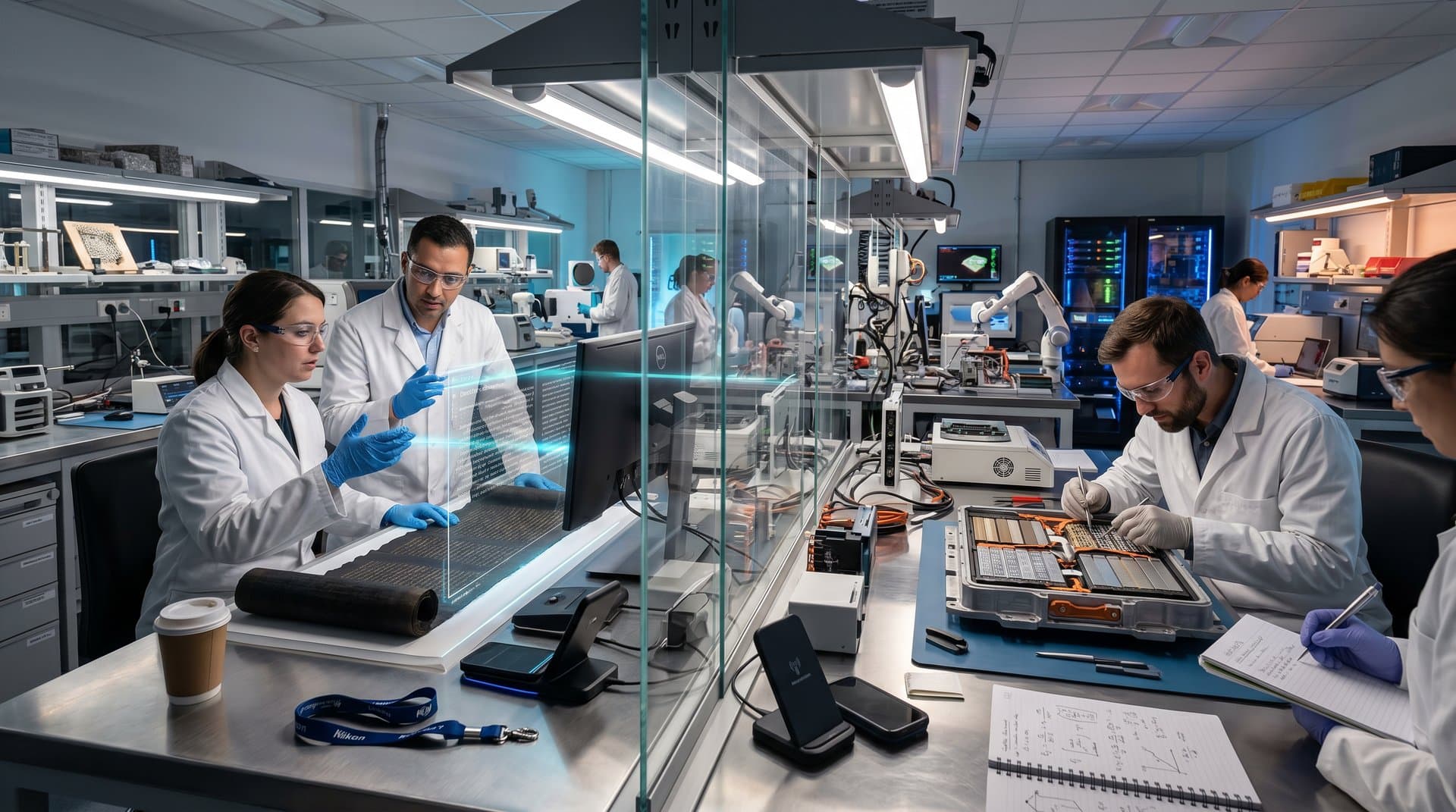
Vesuvius Challenge leader Brent Seales adapts AI papyrus-decoding algorithms for virtual battery teardowns of 100 kWh EV packs. X-ray CT scans and machine learning reveal lithium-ion internals non-destructively. Engineers image electrode layers, separators, and defects at micron resolution. Seales' team pivoted from Herculaneum scrolls in February 2024.
EV developers inspect USD 10,000 prototypes repeatedly. Traditional teardowns destroy cells after one use. Virtual methods enable cycle life studies at 250 Wh/kg for NMC chemistries, per Argonne National Laboratory data.
Papyrus AI Masters Low-Contrast Segmentation
Carbonized Herculaneum scrolls from 79 AD conceal ink at 1-2% density contrast. CT scans detect subtle fissures. AI models trained on texture patterns segment ink overnight from terabyte datasets.
Luke Farritor, Vesuvius Challenge winner and University of Nebraska-Lincoln student, decoded the first readable text. CNN reported this on February 5, 2024. Automakers like Tesla apply this to fleet-scale analysis. It reduces manual teardown time from weeks to hours.
Papyrus AI achieves 99% accuracy on known contrasts. The models adapt to battery interfaces reliably.
Lithium-Ion Layers Imaged at Micron Scale
EV packs stack graphite anodes (372 mAh/g capacity, 200-300 Wh/kg), NMC cathodes (180-200 Wh/L), and ceramic separators. Physical sectioning smears electrolytes. CT delivers 3D views at 5-micron voxels.
Papyrus AI isolates layers and flags lithium plating dendrites. These cause 20% capacity fade after 500 cycles. Argonne researchers Peter Chupas and Wenqian Xu mapped cycles in intact cells at 80% round-trip efficiency. See the Argonne 3D battery cycle mapping article and DOE report from March 2023.
Virtual teardowns quantify voids, electrolyte distribution, and swelling in 100 kWh packs. Thermal scans across 8,000 cells spot hotspots over 60°C. These signal fast-charge risks per IEC 62660-1 standards.
Chemistry Comparisons and Cost Savings
Virtual battery teardowns benchmark LFP (160 Wh/kg, 4,000 cycles at 80% DoD) against NMC (250 Wh/kg, 1,500 cycles). Engineers skip six-month supply chains for prototype validation.
Solid-state batteries validate interfaces without ceramic fracture. Sodium-ion cells targeting USD 50/kWh map grain boundaries non-destructively.
R&D timelines shrink to 1,000-cycle simulations in days. FMVSS 305 safety certification speeds up 40%. US IRA provides USD 35/kWh credits for domestic NMC cathodes with 40% North American content, per IRS guidance from 2023.
Vehicle-to-grid (V2G) revenue reaches USD 100/kW-year from optimized packs. BloombergNEF analyst Jenny Chase estimates this potential.
Supply chains benefit too. CT reveals cobalt sourcing inconsistencies. This aids EU Battery Regulation compliance at 16% recycled content by 2031.
CT and AI Challenges Addressed
Synchrotron sources like Argonne's APS achieve sub-micron resolution. Lab CT limits to 5 microns. AI training demands 10,000 labeled battery slices for silicon anodes with 3-4x graphite expansion.
Compute matches GPT-4 training scale. AWS EC2 p4d instances cut costs 40% to USD 0.50/scan. High-nickel artifacts in NMC811 shadow 10% of volumes. Dual-energy scans mitigate this.
Nature journal from January 2024 details Seales' team's virtual scroll unrolling. Argonne's AI platform analyzes materials at C/3 rates, per Argonne AI battery materials analysis (Nature Energy, 2023). Consortia use Uber's 1 million EV fleet data for model refinement.
BloombergNEF projects 30% global R&D savings by 2030. This totals USD 5 billion annually.
Geopolitics favors non-invasive tools. They reduce reliance on Chinese cell teardowns. This aligns with US CHIPS Act subsidies.
Reshaping Energy Storage with Precision
Virtual battery teardowns via AI papyrus tech deliver safer, cheaper EV packs. Sodium-ion scales at USD 50/kWh. Solid-state interfaces pass IEC tests. IRA credits and EU directives reward adopters. Data-driven engineering advances the field.
Frequently Asked Questions
What are virtual battery teardowns?
CT scans and AI create 3D models of 100 kWh EV battery internals non-destructively. This reveals defects in USD 10,000+ prototypes without destruction.
How do virtual battery teardowns benefit EV innovation?
Repeated analysis tracks 1,500-cycle NMC degradation at 250 Wh/kg. Faster iterations target solid-state and V2G revenue of USD 100/kW-year.
How does AI papyrus decoding apply to virtual battery teardowns?
Texture AI segments 1% contrast ink in scrolls; it isolates anodes and separators in cells. Vesuvius methods inform micron EV imaging.
Why choose non-invasive imaging for EV batteries?
Avoids one-shot physical destruction, supports IRA credits, and detects runaway risks in intact packs for grid services.