- AI decoded 2,000+ characters from Herculaneum papyrus using CT at 99% accuracy.
- Argonne nano-CT images battery defects at 370 nm resolution without teardowns.
- QuantumScape hits 1,000 cycles at 400 Wh/kg via AI-enhanced synchrotron imaging.
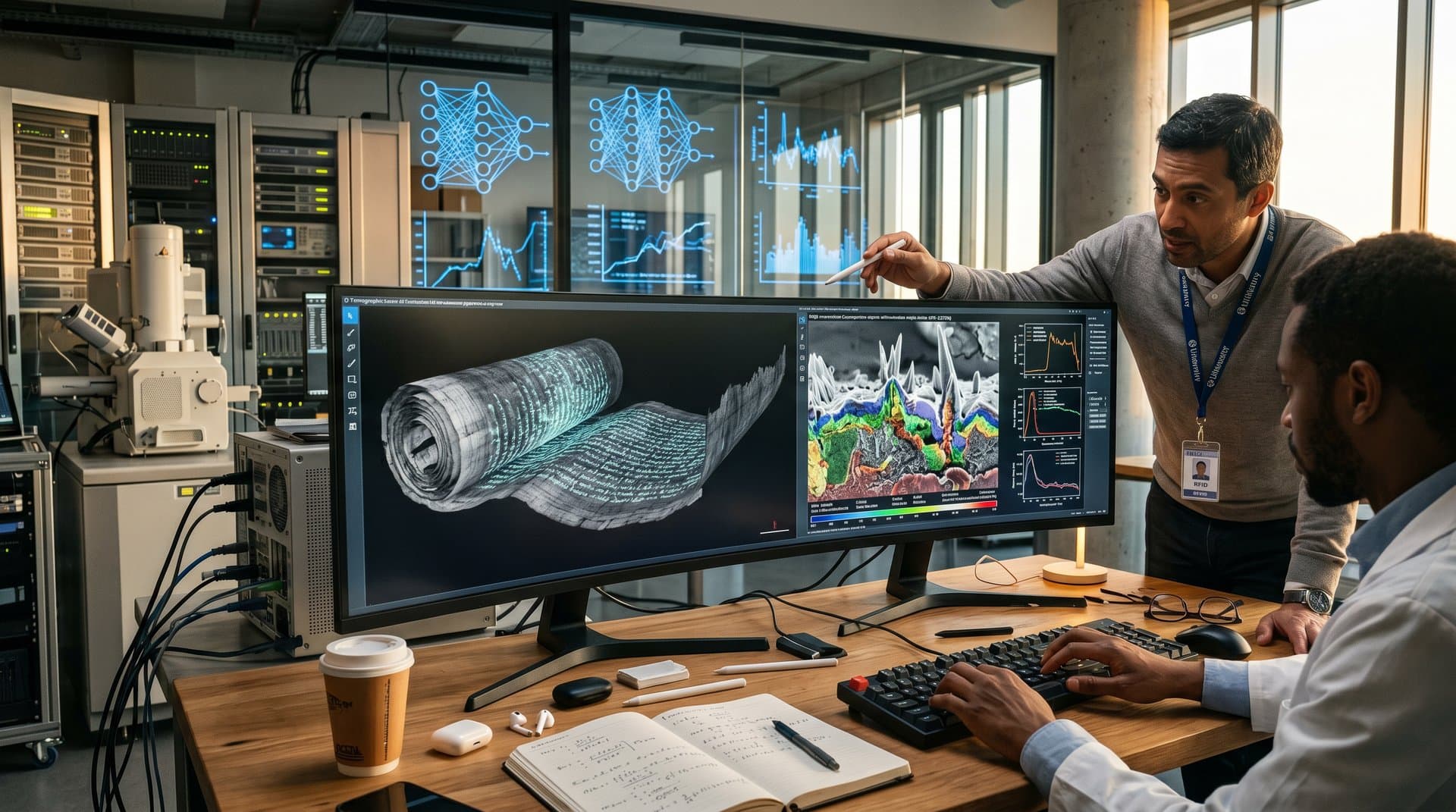
Non-destructive battery health monitoring adapts AI techniques that decoded over 2,000 characters from a Herculaneum scroll. Youssef Nader (University of Sharjah), Luke Farritor (University of Nebraska), and Julian Schilliger used CT scans on the Vesuvius-buried 79 AD artifact. (38 words)
The Vesuvius Challenge winners applied machine learning to detect carbon-based ink invisible under standard light. They revealed philosopher Philodemus' text on pleasure and music across 15 columns. Energy storage developers apply similar AI to profile lithium plating and solid electrolyte interphase (SEI) growth intact, per Nature journal (April 2024).
Invasive teardowns destroy valuable test cells after 500-1,000 cycles. Non-destructive techniques preserve cells for extended testing. This improves long-duration energy storage (LDES) economics. Cycle life claims reach 3,000+ full equivalents at 80% state-of-health (SoH).
Vesuvius Challenge Applies CT and AI
High-resolution CT scanners imaged the scroll at sub-micron levels. Voxel data sets exceeded 1 TB per volume. Convolutional neural networks (CNNs) segmented ink from papyrus fibers with 99% accuracy on training data.
Nader, Farritor, and Schilliger refined models using transfer learning. Their algorithm virtually unrolled the scroll. It yielded 5% of one full scroll—over 2,000 readable Greek characters.
This method parallels X-ray CT in battery R&D. Labs avoid physical sectioning. They preserve cell integrity for repeated analysis.
Argonne Nano-CT Maps Battery Defects
Argonne National Laboratory's beamline 32-ID-B achieves 370-nanometer resolution on lithium-ion electrodes. Researchers Peter Model and Brian Ingram classify defects like cracks and plating with AI.
Argonne's 3D X-ray CT report documents SEI thickness mapping at 100 cycles. Voxel-based AI predicts capacity fade with 92% accuracy versus post-mortem analysis.
Papyrus ink techniques adapt to SEI layers in NMC and LFP cells. Energy density stays verifiable at 250 Wh/kg without disassembly.
Solid-state batteries need these tools most. Ceramic electrolytes shatter under mechanical stress. This limits traditional analysis.
QuantumScape, ReCell Deploy AI Diagnostics
QuantumScape integrates AI with Stanford Synchrotron Radiation Lightsource (SSRL) data. Pouch cells deliver 1,000 cycles at 400 Wh/kg and 95% round-trip efficiency at 0.5C discharge, per Q1 2024 update.
ReCell Center Director Jeff Spangenberger reports teardown costs at USD 5,000-10,000 per 4680-format cell. AI models trained on 1,000+ post-mortems predict degradation with 90% correlation to inspections.
Non-destructive profiling tracks cathode dissolution at 80% depth-of-discharge (DoD). This extends test fleets over 500 cycles.
Non-Destructive Monitoring Cuts LCOS
Teardown avoidance cuts levelized cost of storage (LCOS) by 10-15%, estimates BloombergNEF analyst Michael Liebreich. Reusable cells reduce R&D spend by USD 2 million annually for a 100 MWh pilot line.
Second-life EV batteries gain precise SoH for vehicle-to-grid (V2G). Lithium prices hit USD 15,000/tonne (S&P Global, Q2 2024). Intact profiling maximizes material recovery.
LDES technologies like iron-air benefit. Form Energy's 3 MW/150 MWh Minnesota pilot embeds CT-compatible ports. AI validates 100-hour discharge at 50 mW/cm² power density.
Commercial Scaling Path
Vesuvius open-source code reaches technology readiness level (TRL) 4. Joint Center for Energy Storage Research (JCESR) adapts it for NMC 811 cathodes.
Synchrotron sessions cost USD 100,000 each (SLAC National Accelerator Laboratory). Desktop micro-CT from Zeiss resolves 1 micron at USD 500,000 capital cost. AI upscaling boosts resolution to 200 nm.
Transfer learning spans chemistries: LFP at 160 Wh/kg, 6,000 cycles; sodium-ion at 140 Wh/L. CATL deploys inline CT for gigafactory quality control.
Access Vesuvius GitHub repos for code.
EU Battery Regulation 2023/1542 mandates lifecycle transparency. US Inflation Reduction Act (IRA) funds USD 3 billion in diagnostics. Non-destructive battery health monitoring enables 500 GWh annual deployment by 2027.
Frequently Asked Questions
How does AI enable non-destructive battery health monitoring?
AI processes CT voxel data to detect lithium plating and SEI growth. Models predict SoH at 90-92% accuracy, per ReCell and Argonne, preserving cells for 3,000+ cycles.
What is the Vesuvius Challenge papyrus breakthrough?
Youssef Nader, Luke Farritor, and Julian Schilliger decoded 2,000+ characters at 99% ink precision using ML on CT scans. Code adapts to battery electrodes.
Why avoid battery teardowns in energy storage?
Teardowns cost USD 5,000-10,000 per cell and end testing. AI-CT enables intact tracking over 500 cycles, cutting LCOS 10-15%.
Can non-destructive battery health monitoring scale to gigafactories?
Desktop 1-micron CT with AI suits production lines. CATL and Zeiss systems enable inline LFP/NMC control at TRL 7.