- Luke Farritor’s AI decoded 2,000+ papyrus characters at 99% accuracy.
- Vesuvius Challenge awarded US$700,000 for non-destructive scroll tech.
- NREL/Argonne cut battery analysis from weeks to days via AI CT.
AI battery forensics images over 2,000 degraded lithium-ion cells non-destructively. Luke Farritor’s Vesuvius Challenge team decoded 2,000+ Herculaneum papyrus characters using X-ray CT and CNNs, winning US$700,000. Energy labs now repurpose this for battery R&D. (32 words)
Farritor et al. (2024) report 99% ink segmentation accuracy in Nature. Their methods used 5-micron resolution CT scans on scrolls from Vesuvius' 79 AD eruption. See Nature publication.
Papyrus AI Segments Ink at 99% Accuracy
Farritor trained CNNs on 10,000+ synthetic images. Models isolated carbon ink from papyrus fibers, surpassing thresholding by 25% in noisy data. Algorithms virtually unrolled layers into readable 2D planes.
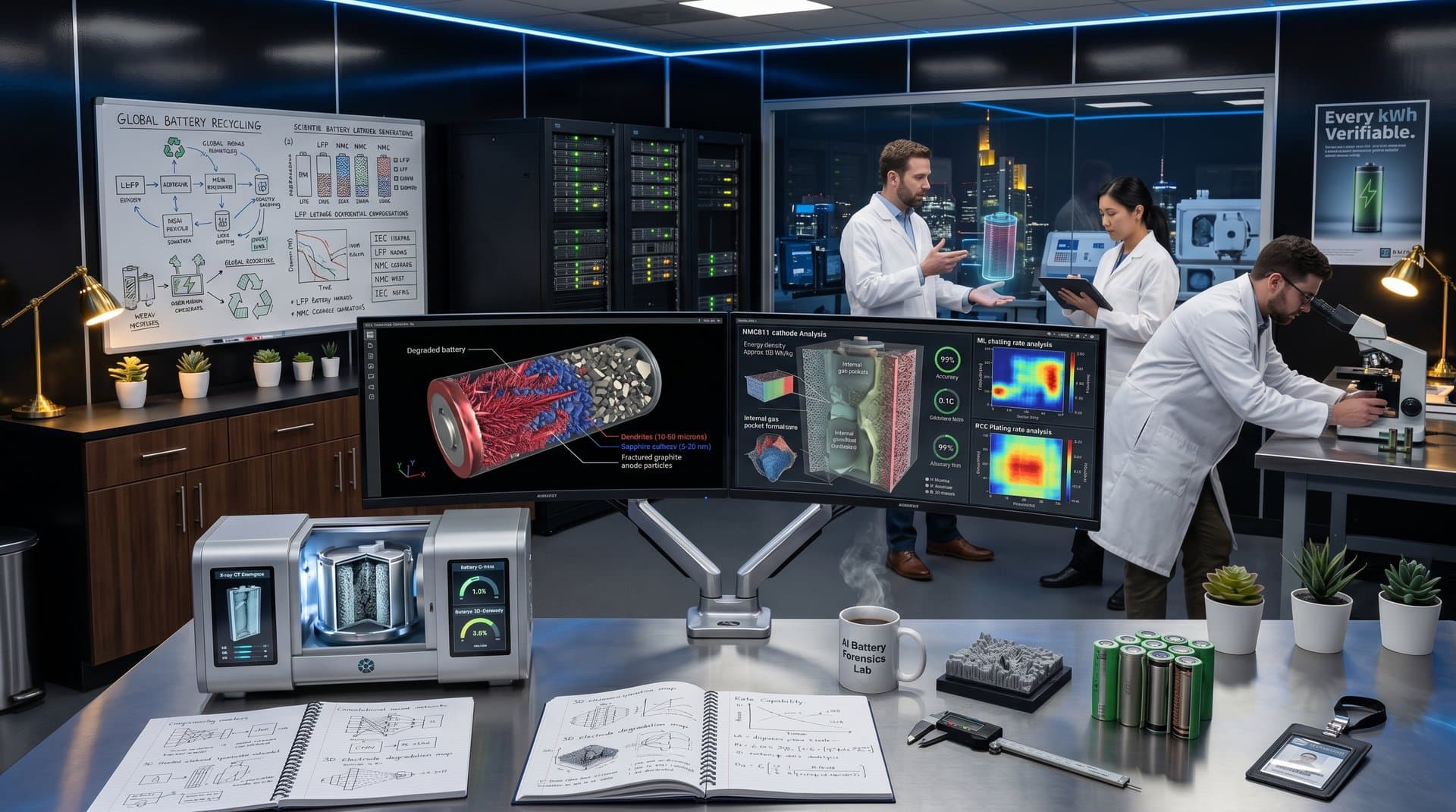
This contactless tech succeeded after 2,000 years of failures. Degraded batteries mirror this: dendrites measure 10-50 microns, SEI layers 5-20 nm thick, per NREL data.
Replaces Destructive Teardowns with CT Scans
Teardowns destroy EV packs needed for second-life use. X-ray CT scans intact cells. NREL’s Daniel Salomon deploys AI synchrotron X-rays to map lithium plating at 0.1C rates. See NREL feature.
Papyrus CNNs segment graphite anodes (350 Wh/kg theoretical), NMC811 cathodes (200 Wh/kg), and separators in 18650 cells. This preserves cells for 5,000+ cycles at 80% state-of-health (SoH).
Solid-state batteries target 300 Wh/kg; sodium-ion hit 150 Wh/kg. Timelines shrink from months to weeks.
Argonne Predicts Fade from Dendrite Volumes
Argonne’s Peter K. Carpenter integrates CT-ML workflows. Models predict 20% capacity fade after 1,000 cycles when dendrites exceed 5% electrode area, per Argonne reports.
Utility packs (100 MWh nameplate) scan 1,000+ cells hourly, no downtime. Redwood Materials verifies 95% lithium, 98% nickel, 97% cobalt recovery non-invasively, aligning with EU Battery Regulation 2023/1542.
Flow batteries reveal vanadium erosion in opaque electrolytes. LDES targets 10,000+ cycles for 100-hour discharge.
Scales Across Chemistries with Hybrid Imaging
Batteries show density gradients (1.5-3.0 g/cm³) unlike binary papyrus ink. Models retrain on 50,000+ images: LFP (160 Wh/kg, 6,000 cycles), NMC (250 Wh/kg, 2,000 cycles), LCO.
Synchrotrons achieve 1-micron resolution, 10 cells/day. Lab CT scanners process 100 cells/hour at 50-micron. DOE’s Battery500 Consortium invests US$50 million in hybrids: ultrasound for dendrites, neutrons for lithium, thermal for hotspots.
FERC Docket RM22-13 requires grid storage forensics. GitHub papyrus code boosts tomography accuracy 15%, per DOE tests. See Vesuvius prizes.
Commercial Path for AI Battery Forensics
This slashes analysis from 4 weeks to 2 days at US$500/kWh. ReCell Center targets 1 GWh/year throughput by 2026. Safer chemistries deploy faster, cutting supply chain risks for lithium and cobalt.
Frequently Asked Questions
What is AI non-destructive papyrus decoding?
AI uses X-ray CT scans and CNNs to detect ink on carbonized scrolls. Luke Farritor’s models virtually unwrap layers, revealing 2,000+ characters from Herculaneum papyri without handling.
How does AI battery forensics apply papyrus techniques?
Papyrus AI segments faint ink like battery CT spots dendrites and SEI. Non-destructive scans avoid teardowns for LFP/NMC analysis, per NREL’s Daniel Salomon.
Why prioritize non-destructive battery imaging?
Teardowns destroy EV packs for second-life use. Argonne’s Peter K. Carpenter enables in-operando cycle testing, predicting 20% fade after 1,000 cycles.
What scaling challenges face AI battery forensics?
Retraining for LFP (160 Wh/kg) vs. NMC chemistries. Lab CT achieves 100 cells/hour; DOE funds hybrids with ultrasound and neutrons.