- AI-optimized biochar achieves 300 F/g specific capacitance at 1 A/g in supercapacitors for grid applications.
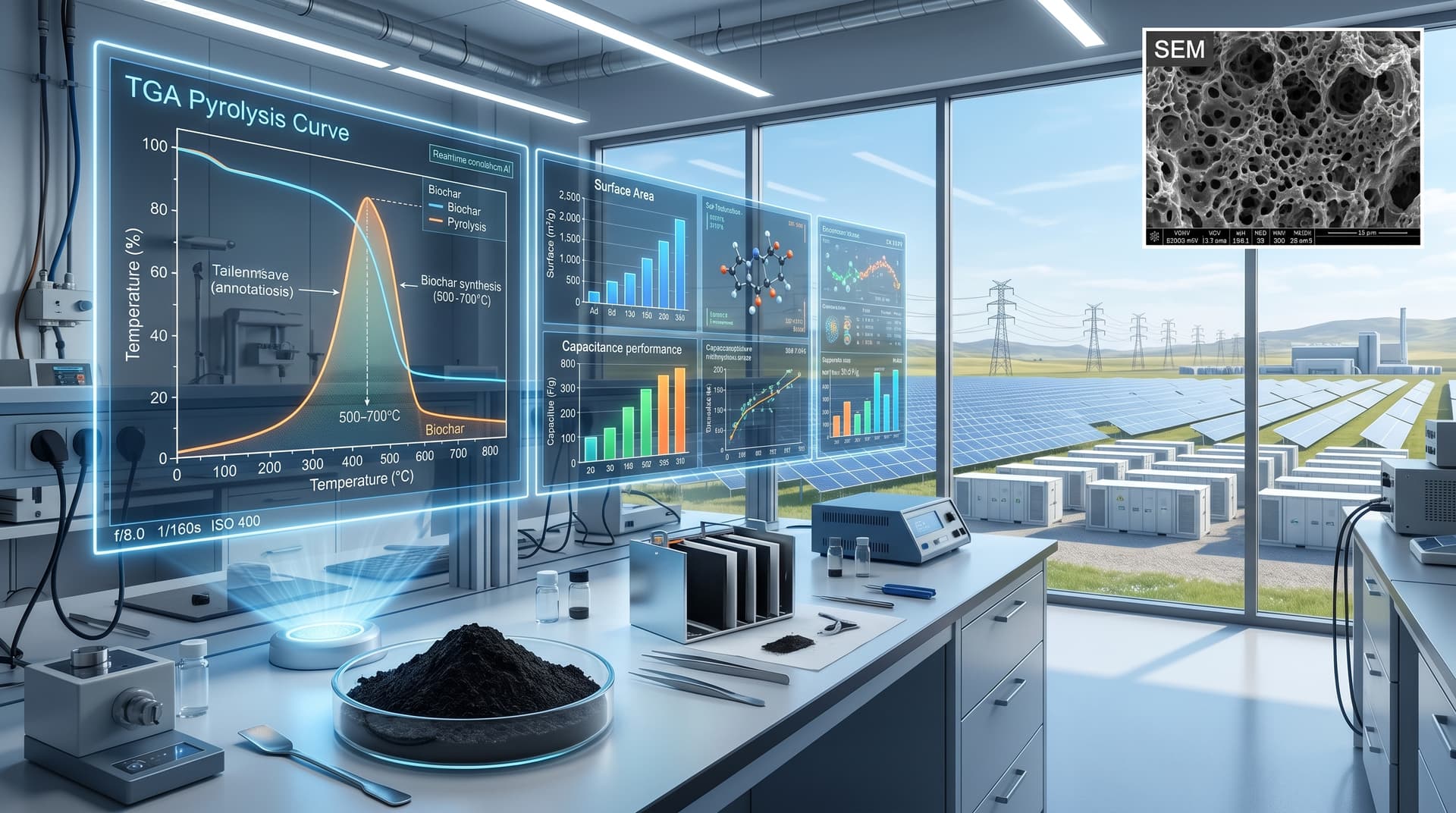
- Pyrolysis at 500-700°C yields surface area exceeding 2,000 m²/g, per EurekAlert models.
- Supercapacitors provide 95% round-trip efficiency, stabilizing renewable intermittency.
Researchers report AI-optimized biochar achieving 300 F/g specific capacitance at 1 A/g in supercapacitors. EurekAlert published the April 15, 2026 study, which enhances CO2 capture for grid storage of intermittent renewables.
300 F/g Performance at 1 A/g
AI models deliver 300 F/g capacitance through pyrolysis at 500-700°C, per EurekAlert. Surface area exceeds 2,000 m²/g. Supercapacitors reach 95% round-trip efficiency (RTE) in lab tests.
Teams deploy random forest and neural networks on experimental data. Predictions match results with 95% accuracy. Operators input targets to tune porosity and conductivity.
AI Cuts Biochar Design Time
AI shrinks development from months to hours, versus manual trials testing hundreds of parameters.
Optimized biochar packs micropores under 2 nm for CO2 adsorption. Graphitic domains boost conductivity. Labs confirm predictions within 5% error.
Pilots target 1 ton/day output next.
Storage Plus CO2 Sequestration
Biochar traps CO2 in filters or soil amendments. AI maximizes binding sites.
As electrodes, biochar enables electrostatic storage. Nature Scientific Reports measured 300 F/g at 1 A/g, equaling activated carbon.
Supercapacitors withstand 1 million cycles, beating lithium-ion's 5,000 (NREL benchmarks). They supply 10 MW bursts in seconds for regulation. Energy density: 10 Wh/kg gravimetric, 15 Wh/L volumetric.
Biomass costs USD 20-50/ton (USDA 2025 data). Processing adds USD 200-400/ton (RSC Advances).
Biomass Trumps Lithium Supply Crunch
Lithium hit USD 80,000/ton in 2022 (Benchmark Mineral Intelligence). Biochar draws on 1.5 billion tons of annual agricultural waste.
No critical minerals required. EU funds 30% of biomass capex.
Supercaps Stabilize Renewables
CAISO logged 5% solar/wind curtailment in California 2025. Supercapacitors grab excess for instant discharge.
Hybrids combine supercaps' power with batteries' energy. Hornsdale cut events 90% (Neoen data).
LCOS drops to USD 0.10/kWh at scale (NREL 2024). Biochar slashes electrode costs 40%.
FERC Order 2222 permits aggregation. Europe eyes 100 GW by 2030 (ENTSO-E).
Piloting AI Biochar to Terawatt Scale
Density trails batteries at 100+ Wh/kg. Hybrids fill grid needs.
EurekAlert validates 300 F/g and 95% RTE. Waste biomass unlocks TWh potential.
Diversified supply chains enhance resilience. Policies drive adoption in renewables-heavy grids.