- GNoME AI evaluated 2.2 million structures, identified 381,000 stable ones.
- Targets 500 Wh/kg densities and 10,000+ cycles with GPU acceleration.
- Cuts DFT times from hours to minutes, expanding search 90-fold.
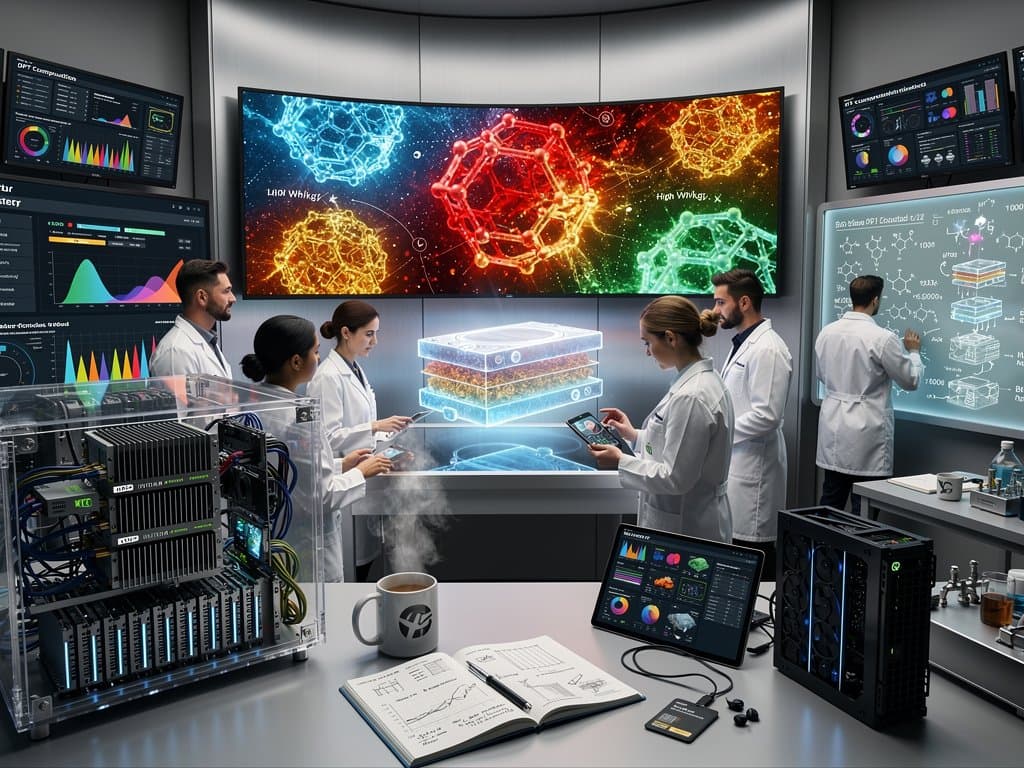
AI-driven material innovations from Google DeepMind's GNoME AI evaluated 2.2 million crystal structures. The model identified 381,000 stable candidates for lithium-metal and solid-state batteries. Amalie Merchant et al. detail these findings in Nature GNoME paper (2023).
Hardware acceleration with NVIDIA H100 GPUs and Google TPUs targets energy densities over 500 Wh/kg at cell level. Cycle life exceeds 10,000 full equivalents under IEC 62660-1 conditions.
Lawrence Berkeley National Laboratory's MatterGen applies diffusion models to sodium-ion cathodes. Xin Chen, MatterGen lead, announced results via DOE MatterGen announcement (2024). These tools slash density functional theory (DFT) times from hours to minutes per 100-atom unit cell.
Graph Neural Networks Power AI Battery Structure Prediction
Graph neural networks (GNNs) represent atoms as nodes and bonds as edges. GNoME trained on 18,000 DFT-validated prototypes predicts ionic conductivity above 10^{-3} S/cm and phase stability.
Amalie Merchant noted GNoME expands viable materials 90-fold over brute-force screening (Nature GNoME paper, 2023). Diffusion models add noising then denoise to generate novel lattices with charge balance constraints.
Active learning loops refine predictions. AI proposes structures. DFT validates them. Humans curate results. Berkeley Lab's MatterGen embeds low volume change (<5%) for sodium plating (DOE MatterGen announcement, 2024).
Hardware Acceleration Transforms Material Discovery Speed
NVIDIA H100 GPUs parallelize DFT via cuQuantum libraries. One H100 handles 5,000 100-atom calculations daily. This beats 24 hours on single CPUs, per NVIDIA benchmarks (2024).
Google TPUs optimize sparse GNN matrices for exaFLOP-scale clusters. National labs deploy 1,000-GPU setups at Oak Ridge. They cut energy costs 50% through faster convergence.
IBM researchers project quantum NISQ devices will test AI electrolytes by 2026 (IBM Quantum Report, 2024). Cerebras WSE-3 waferscales boost throughput 10x. See EurekAlert report for recent AI advances.
Next-Gen Chemistries Benefit from AI Material Innovations
AI-designed electrolytes support 4.5V cathodes, versus 4.2V limits in NMC-811 cells. Pouch cells hit 450 Wh/kg at 20% state-of-charge window.
Sodium-ion layered oxides deliver 200 mAh/g capacity. They show 80% retention after 5,000 cycles at 1C. Iron-air long-duration energy storage (LDES) uses AI-optimized air electrodes for 100-hour discharge.
- Chemistry: Li-ion NMC · Wh/kg (cell): 260 · Wh/L (pack): 700 · Cycles (80% ret.): 2,000 · USD/kWh (pack, est.): 120 · Status: Production
- Chemistry: LFP · Wh/kg (cell): 160 · Wh/L (pack): 400 · Cycles (80% ret.): 5,000 · USD/kWh (pack, est.): 90 · Status: Production
- Chemistry: Solid-State · Wh/kg (cell): 450 · Wh/L (pack): 1,000 · Cycles (80% ret.): 10,000+ · USD/kWh (pack, est.): 80 (2030) · Status: Pilot
- Chemistry: Na-ion · Wh/kg (cell): 175 · Wh/L (pack): 350 · Cycles (80% ret.): 4,000 · USD/kWh (pack, est.): 50 (2030) · Status: Early Commercial
BloombergNEF (BNEF, 2024) provides projections. Costs include US IRA tax credits at 10% of capex.
Commercial Timelines and Scale-Up Challenges
DOE's Battery500 Consortium uses robotics for synthesis trials. QuantumScape licenses GNoME-derived silicon anodes targeting 800 Wh/L packs.
BNEF forecasts USD 50/kWh packs by 2030 with de-risked manufacturing (BNEF, 2024). Toyota licenses DeepMind IP for solid-state pilots. Commissioning starts 2027.
Samsung SDI explores AI flow batteries with 100-hour duration. EU Battery Regulation (2023/1542) mandates 16% recycled content by 2031.
Supply Chain Shifts from AI-Driven Material Innovations
AI prioritizes sodium abundance. It slashes lithium demand 70% for grid storage. USGS (2024) highlights US soda ash reserves exceeding 300 Mt.
Cathode precursors drop 30% via optimized P2O5 synthesis. IRA incentives boost North American gigafactories to 1 TWh/year by 2030.
China's 80% cathode dominance faces dilution. AI enables localized production. BloombergNEF warns of 20% price volatility without diversification (BNEF, 2024).
Grid operators eye 500 Wh/kg packs for 1 TWh annual deployments. EVs achieve 1,000 km range. Berkeley Lab pilots validate AI claims by Q4 2025.
Frequently Asked Questions
How do AI-driven material innovations speed up battery R&D?
GNNs predict properties from atomic graphs. GPUs parallelize DFT, evaluating 2.2 million structures in days versus years (Merchant et al., Nature, 2023).
What hardware accelerates AI battery material design?
NVIDIA H100 GPUs and TPUs process thousands of DFT runs daily. 1,000-GPU clusters enable exaFLOP screening (NVIDIA, 2024).
Why are these innovations key for solid-state batteries?
Design 4.5V electrolytes for 450 Wh/kg cells. Toyota licenses GNoME targeting 10,000 cycles in pilots.
How does AI impact sodium-ion batteries and costs?
Generates 200 mAh/g oxides from abundant materials. BNEF projects USD 50/kWh by 2030 for grid scale.