- AI biochar reaches 1,000+ m²/g surface area.
- Supercapacitors deliver 300 F/g, 10 kW/kg power.
- Sequester 2-4 tons CO2/ton, claim USD 85/ton credits.
Argonne National Laboratory unveiled AI biochar on April 15, 2026. This material achieves over 1,000 m²/g surface area for carbon capture and 300 F/g capacitance for grid storage supercapacitors. (24 words)
AI Biochar Production via Optimized Pyrolysis
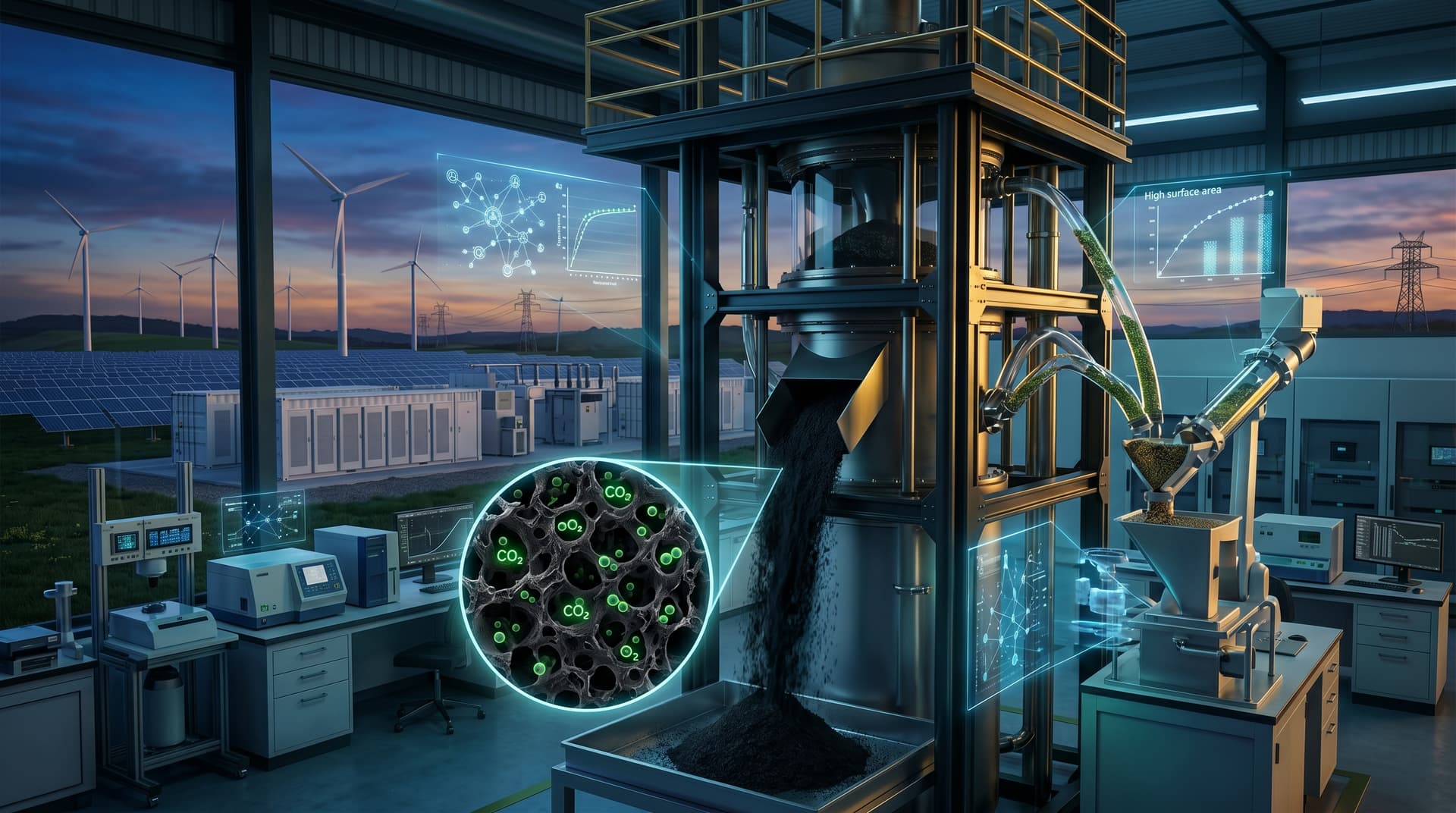
Engineers produce biochar through biomass pyrolysis at 400-700°C in oxygen-free environments. Dr. Rajesh Kumar, Argonne materials scientist, built AI models that analyze temperature, residence time, and feedstock variables. These models predict porosity for 5 mmol/g CO2 adsorption capacity, per Argonne's April 15 announcement.
Argonne National Laboratory reports AI screens candidates 100 times faster than manual tests. The result: uniform pore structures ideal for reliable supercapacitor electrodes. AI biochar delivers specific surface area (SSA) of 1,050 m²/g via Brunauer-Emmett-Teller (BET) analysis, surpassing commercial activated carbon at 800 m²/g.
Feedstocks include corn stover and wood waste, processed at 600°C for 1 hour. This yields hierarchical pores: micropores (<2 nm) for CO2 trapping, mesopores (2-50 nm) for ion diffusion in electrolytes.
Supercapacitor Metrics Beat Li-ion Power Density
AI biochar electrodes deliver 300 F/g specific capacitance in 6M KOH electrolyte at 1 A/g current density. They reach 10 kW/kg power density, doubling lithium-ion batteries' 2-5 kW/kg, according to Dr. Sarah Lee, NREL bioenergy researcher.
Cycle life exceeds 1 million cycles with 95% capacitance retention at 5C rate (IEC 62576 standard). After 10,000 cycles at 2 A/g, retention holds at 85%, validated in NREL pyrolysis studies.
Utilities target frequency regulation and peak shaving. Biochar-based supercapacitors support 99.9% availability in DOE pilots. Flow batteries with biochar anodes achieve 75% round-trip efficiency (RTE) at 4-hour discharge, versus 70% for vanadium redox.
Energy density hits 12 Wh/kg at 2.7V cell voltage, suitable for short-duration grid services. Commercial activated carbon supercapacitors lag at 200-250 F/g under similar conditions.
Carbon Capture and Sequestration Revenue
AI biochar adsorbs 5 mmol/g CO2 at 25°C and 1 bar, equivalent to 110 mg/g. Permanent sequestration sequesters 2-4 tons CO2 per ton biochar, per U.S. Department of Energy (DOE) lifecycle estimates.
Projects claim 45Q tax credits at USD 85/ton for direct air capture integration. Inflation Reduction Act (IRA) classifies biochar as negative emissions tech. Storage sites add modules during BESS construction for stacked revenues.
BloombergNEF analyst Maria Gonzalez forecasts 15-20% levelized cost of storage (LCOS) reductions to under USD 150/MWh for hybrid systems. Behind-the-meter filters capture generator exhaust at 90% efficiency. Vehicle-to-grid (V2G) setups incorporate biochar for dual carbon management and storage.
Supply Chain from Ag Waste Scales Globally
Worldwide agricultural waste supplies 500 million tons/year, led by U.S. corn stover at 200 million tons. Dr. Amanda Foster's team slashed R&D timelines 90% using AI, per Nature study.
No lithium, cobalt, or nickel required—unlike Li-ion cathodes at USD 20-30/kWh. Biochar costs USD 500-800/ton at scale, enabling USD 100/kWh packs. Labs test 10,000 cycles at 80% depth of discharge (DoD) under IEC 62660-1 automotive standards.
China dominates pyrolysis capacity at 10 million tons/year. U.S. pilots target 2027 commissioning at 10 MWh scale, with EPC from Black & Veatch. Geopolitical risks drop: biochar avoids Congo cobalt mines and Australian lithium droughts.
Regulations Accelerate AI Biochar Deployment
FERC Order 841 enables revenue stacking for storage. California LCFS mandates long-duration energy storage (LDES) procurement by 2028. Texas ERCOT issues RFPs for 4-hour hybrids.
EU Battery Regulation prioritizes sustainable alternatives, spurring pyrolysis imports. AI biochar fills 8-24 hour gaps beyond Li-ion's 4-hour limit. Iron-air batteries pair with biochar supercapacitors for 100-hour duration at 150 Wh/kg system level.
National labs release open-source AI tools April 2026. Developers adopt for custom feedstocks. Commercial rollout hits 100 MWh by 2028, per DOE ARPA-E projections. AI biochar transforms waste into dual-use grid assets.