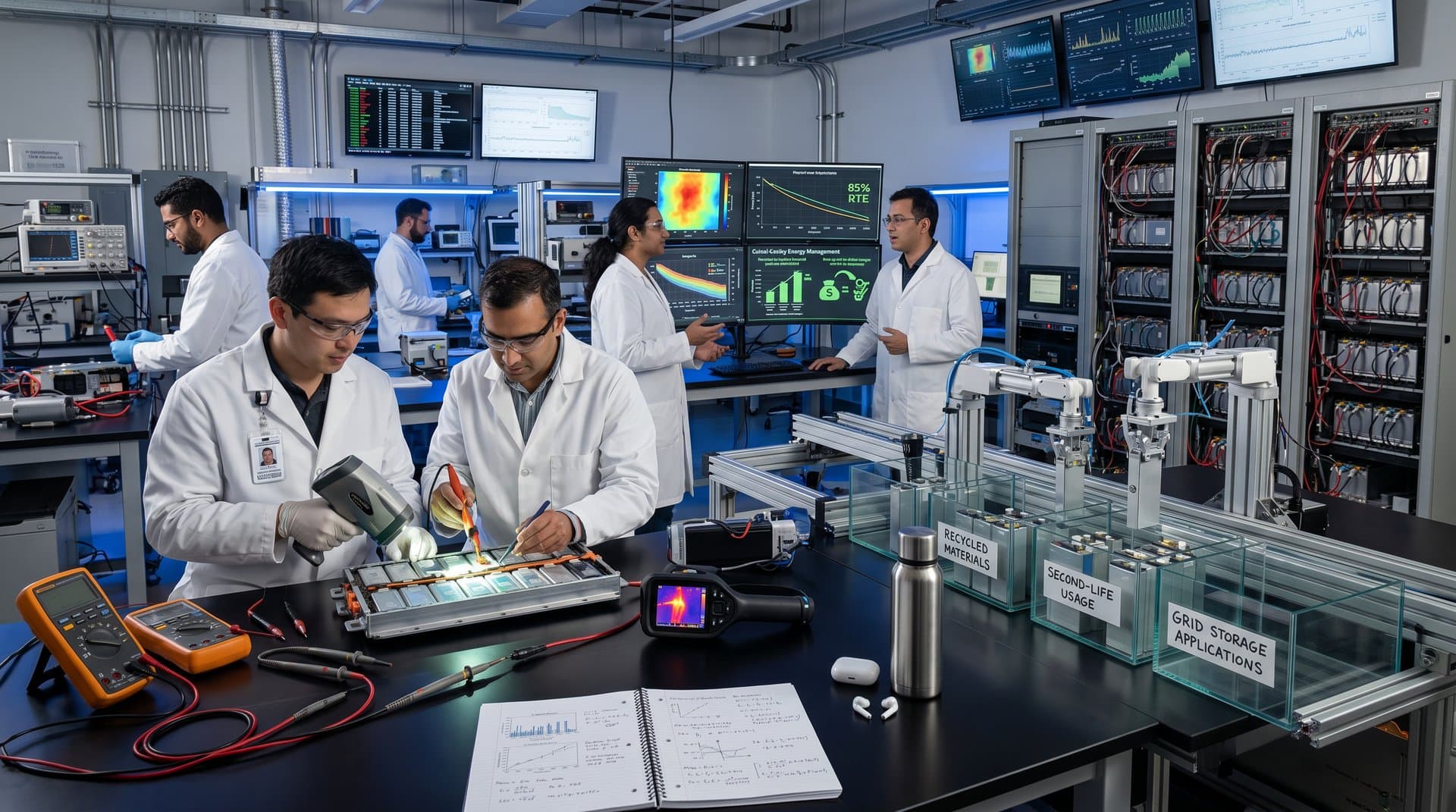
- AI battery reuse boosts IRA NPV by 30% (Argonne).
- Second-life packs cost USD 50-80/kWh vs USD 150-200 new (NREL).
- LCOS drops 20-25% for four-hour profiles (NREL).
By Philip Trask, Renewables Correspondent
AI battery reuse from Argonne National Laboratory unlocks 30% more Inflation Reduction Act (IRA) value for US grid storage (Argonne). Its machine learning assesses lithium-ion EV pack state-of-health (SOH), directing modules to second-life uses or recycling as solar hits 200 GW (EIA, Q1 2024).
AI Battery Reuse Boosts Grid Storage Economics
Grid operators pair solar with second-life packs. Argonne's AI forecasts 2,000-3,000 cycles at 80% depth-of-discharge (DoD), 85% round-trip efficiency (RTE) at 0.5C per IEC 62660-1.
Remanufactured packs cost USD 50-80/kWh, beating new LFP at USD 150-200/kWh (NREL/TP-5700-85088). IRA's 30% Investment Tax Credit (ITC) covers systems over 3 kWh, including US-remanufactured batteries. Argonne calculates 30% net present value (NPV) gains.
AI Enhances Battery Sorting Precision
AI analyzes X-ray images and voltage curves to detect lithium plating. Manual checks miss 20% faults; AI routes packs to behind-the-meter, grid, or recovery paths.
Argonne National Laboratory shows AI cuts recycling energy 40%, enables 95% lithium and 90% cathode recovery. Second-life packs hold 80-90% capacity (180-220 Wh/kg), suiting four-hour grid needs.
Solar farms store midday peaks; wind balances nights. DOE projects 1 GWh annual EV retirements by 2030.
IRA Incentives Maximize Second-Life Value
IRA offers 30% ITC for standalone storage over 3 hours. Second-life batteries qualify via domestic remanufacturing, cell balancing, firmware.
US Department of Energy verifies ITC stacks with Section 45X production credits. AI grid tests unlock recycled mineral bonuses.
NREL models show 20-25% LCOS drops to USD 120-150/MWh over 15 years (NREL).
AI Battery Reuse Accelerates Renewables Integration
CAISO saw 5-10% solar curtailment in 2023. Second-life storage shifts power evenings; AI tunes frequency regulation at 1 MW/MW.
ERCOT runs 100 MW/400 MWh wind-plus-storage. Reused packs replace fossil peakers. NREL sees LCOS savings to 2030.
AI dashboards track fleet SOH, plan swaps. AI battery reuse builds circular chains, cuts lithium imports amid tensions.
A 200 MW solar farm adds 800 MWh storage at 85% RTE via optimized cycles.
Scaling AI for Long-Duration Storage
Long-duration needs 10+ hour discharge, <1% self-discharge. AI picks stable packs; hybrids pair with flow batteries.
DOE aims 100 GWh US recycling yearly by 2030. AI enables cathode remanufacturing.
FERC Order 2023 speeds interconnections. EU rules demand 70% recycling by 2030.
Solar-plus-storage wins auctions. AI battery reuse flattens duck curves, prevents blackouts, scales renewables to 2030 goals.
Frequently Asked Questions
How does AI battery reuse optimize grid storage?
AI evaluates SOH via X-rays and curves, directing packs for 80-90% capacity retention and IRA qualification (Argonne).
What IRA incentives apply to second-life batteries?
30% ITC for >3 kWh systems, stackable with 45X credits for domestic remanufacturing (DOE).
What cost savings does AI battery reuse deliver?
USD 50-80/kWh packs yield 20-25% LCOS cuts, 85% RTE at 0.5C (NREL).
How does AI support long-term grid scaling?
Predicts cycles, enables 95% recovery, supplies 1 GWh/year by 2030 for LDES hybrids (DOE).