- AI unlocks 30% more value from EV batteries per Nature.
- ML predicts RUL 25% better; recovers 95%+ metals.
- Second-life packs at USD 50/kWh, 160-180 Wh/kg.
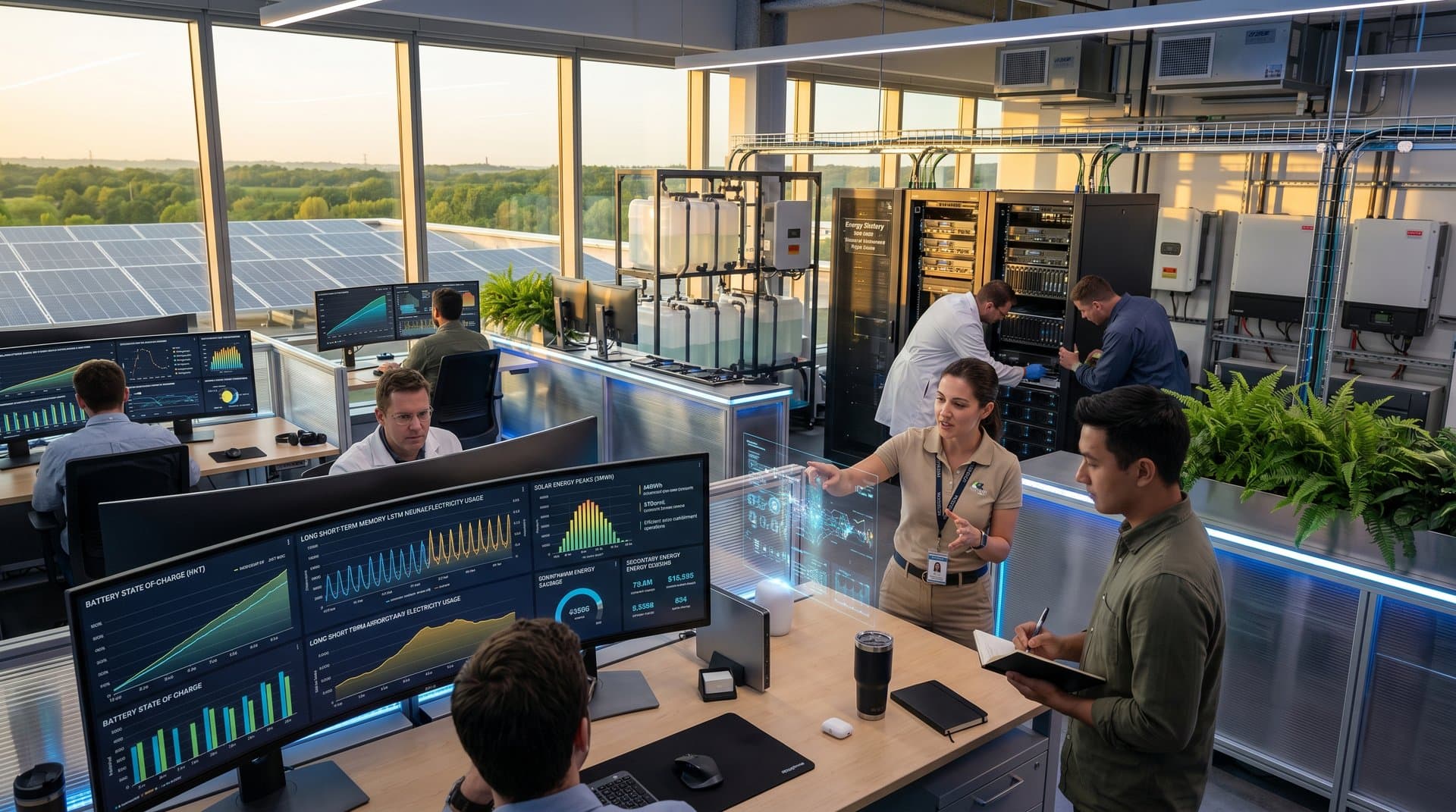
A Nature Energy review led by Daniel Hellström at KTH Royal Institute of Technology reveals AI battery recycling unlocks 30% more value from retired EV batteries. Machine learning (ML) optimizes reuse, recycling, and remanufacturing via precise state-of-health (SoH) estimation for second-life grid storage (Hellström et al., 2024).
AI analyzes cycle data like depth-of-discharge (DoD) and round-trip efficiency at 0.5C. It sorts NMC and LFP cells to address lithium-nickel shortages.
BloombergNEF forecasts recycling capacity grows 10-fold by 2030, enabling 50 GW second-life grid storage by 2025 across regions.
AI Enhances Reuse with 25% Better RUL Predictions
AI forecasts remaining useful life (RUL) 25% more accurately than coulomb counting. Neural networks process electrochemical impedance spectroscopy (EIS) for degradation modes per IEC 62660 standards.
LFP cells achieve 3,000-5,000 cycles at 80% DoD, retaining 80% capacity (Sandia National Laboratories). Second-life packs offer 160-180 Wh/kg and 400-500 Wh/L for behind-the-meter use.
ML cuts repurposing errors 40%. Argonne National Laboratory's ReCell Center deploys AI diagnostics. It detects micro-shorts in V2G candidates, boosting safety.
Computer Vision Powers High-Throughput Recycling
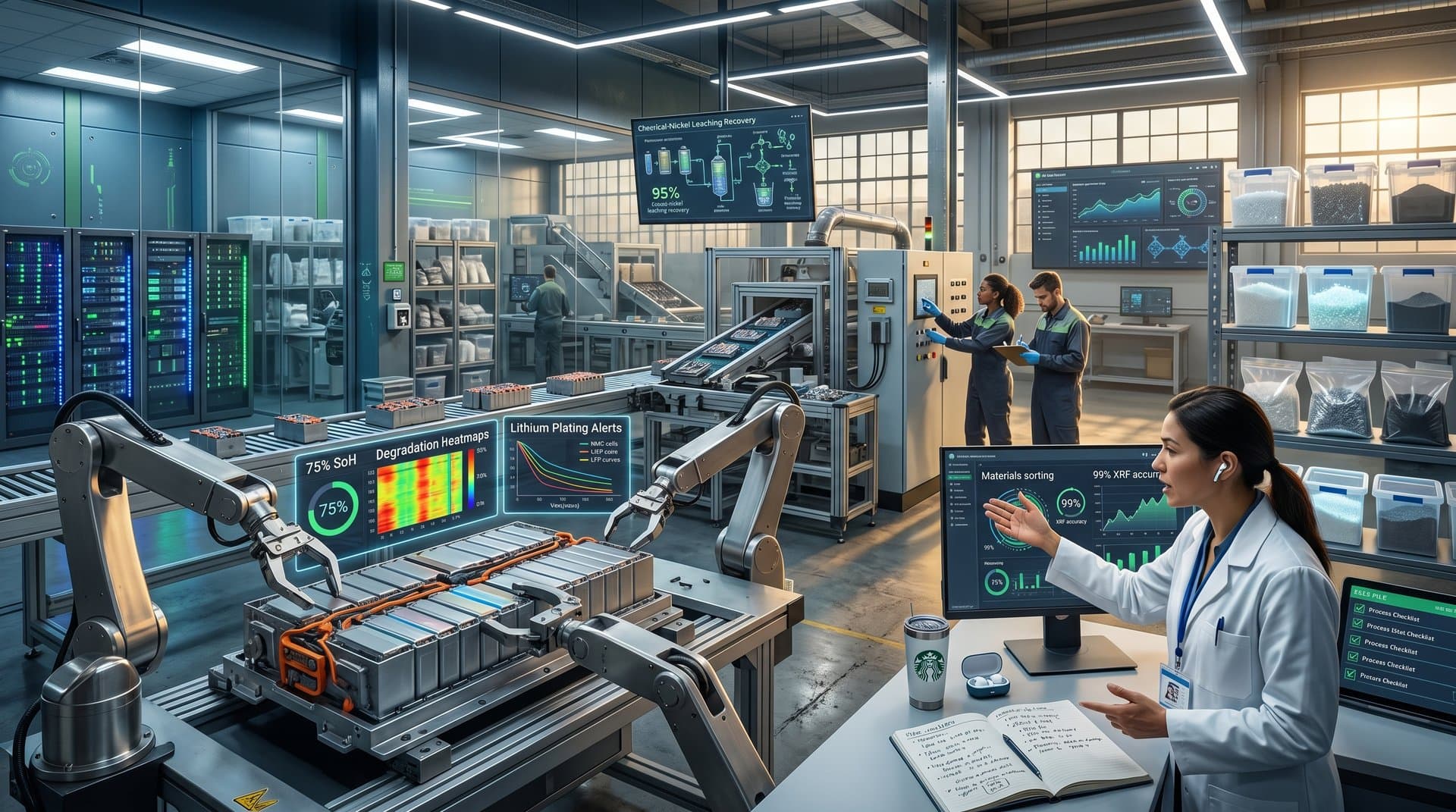
AI computer vision identifies chemistries via X-ray fluorescence at 99% accuracy. It sorts NMC, LFP, and sodium-ion cells at >1,000 units/hour.
Reinforcement learning guides robotic disassembly. ML optimizes hydrometallurgical leaching for 95%+ cobalt-nickel recovery from black mass. Digital twins reduce energy use 20%.
Blockchain tracks from OEM to recycler. Argonne prototypes lower LCOS to <USD 80/kWh.
Remanufacturing Achieves 30% Value Uplift
AI matches cells with <2% capacity variance. Rebuilt packs match virgin performance at 60-70% lower cost.
The 30% uplift stems from extended reuse, higher yields, and less downtime (Nature Energy). EU Battery Regulation 2023/1542 mandates 95% cobalt recovery by 2030.
US IRA funds USD 3 billion recycling hubs. BloombergNEF sees LDES >100 GW globally by 2030.
AI Eases Supply Chain Pressures
Lithium carbonate hit USD 82,000/tonne in 2022 (Benchmark Mineral Intelligence). AI recovers 92-97% lithium, reducing reliance on Australia-South America mines.
Nickel tightens with Indonesia bans. China holds 85% cathode production (S&P Global Platts). AI scales US-EU facilities to 500 GWh/year by 2030.
GWh-Scale Pilots Confirm Gains
Northvolt hits MRL 7-8 for AI diagnostics, processing 10,000 cells/day at 98% accuracy. Rollout targets 2028.
Second-life costs drop to USD 50/kWh from USD 100-120/kWh. Tesla-BYD data trains models. FERC Order 2222 enables V2G revenue.
Reuters reports AI cuts R&D timelines 90%. Pilots validate 30% value uplift from lab to factory.
Frequently Asked Questions
How does AI battery recycling optimize lifecycle management?
AI uses ML for precise SoH and RUL estimation, sorting chemistries. Nature review details 30% value boost via reuse, remanufacturing for grid storage.
What role does AI play in battery remanufacturing?
AI achieves <2% cell variance in packs matching virgin cells at 60-70% lower cost. Robotics and vision enable high-throughput.
Why is AI important for energy storage recycling?
AI recovers 92-97% lithium, eases supply chains under IRA/EU rules. Pilots hit USD 50/kWh second-life packs.
What challenges remain in AI battery recycling?
Dataset biases persist; OEM data sharing (Tesla/BYD) improves models. FERC 2222 aids V2G commercialization.