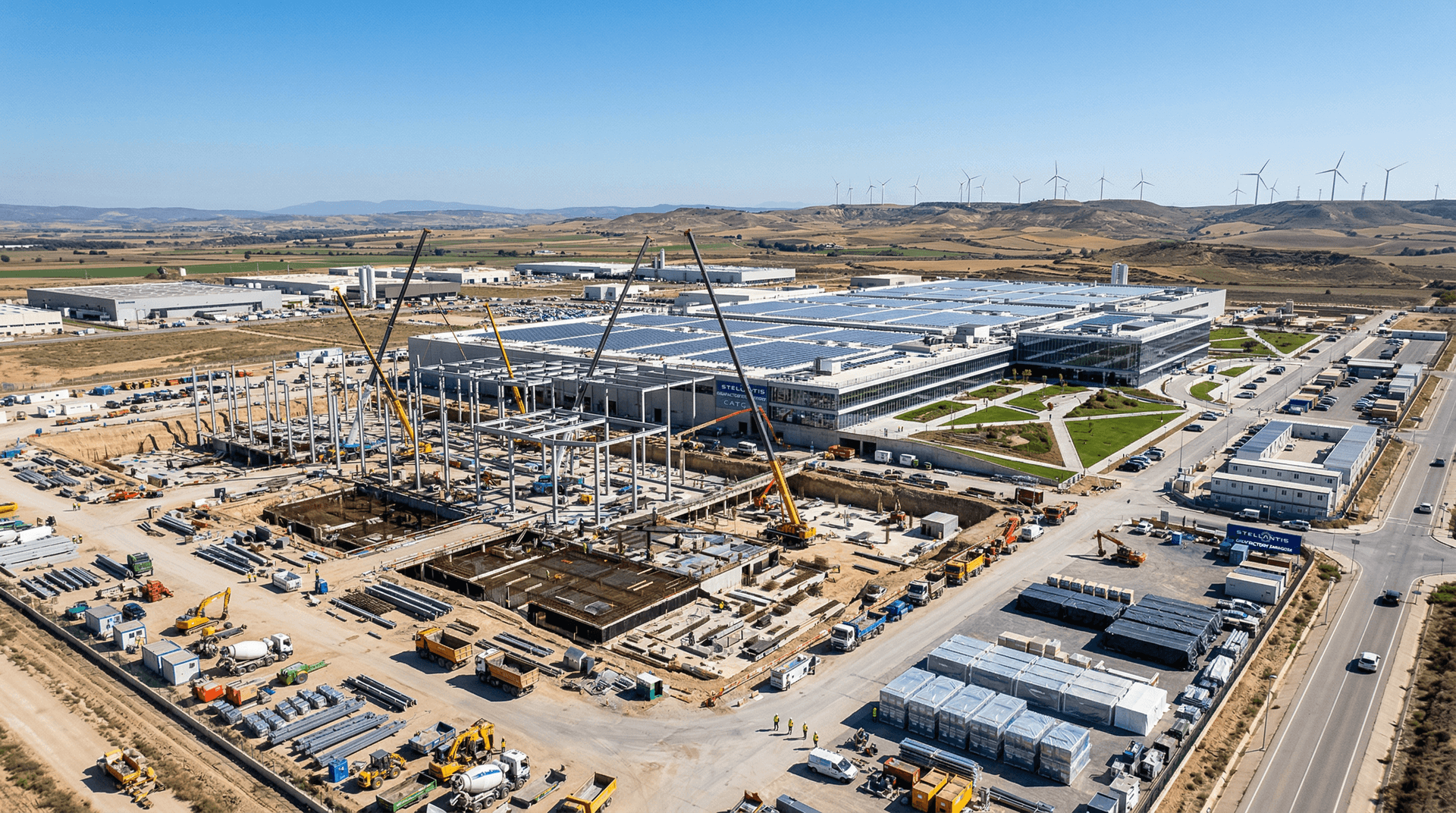
In a significant boost to Europe's electric vehicle (EV) ambitions, Stellantis N.V. and China's Contemporary Amperex Technology Co. Limited (CATL), the world's largest EV battery maker, announced on April 21, 2022, a joint venture to construct a state-of-the-art lithium iron phosphate (LFP) battery gigafactory in Zaragoza, Spain. The project, with a total investment of up to €4.1 billion ($4.5 billion), will have an annual capacity of 50 gigawatt-hours (GWh), enough to power around 600,000 to 1 million EVs depending on battery sizes.
The facility will be built on a greenfield site near CATL's existing lithium-ion battery plant in Zaragoza, which the Chinese firm opened in 2019 in partnership with a Spanish energy company. This new LFP plant marks CATL's first dedicated LFP production site in Europe, complementing its existing operations and addressing the growing demand for cost-effective, cobalt-free battery chemistries.
Strategic Details and Timeline
Under the joint venture agreement, Stellantis and CATL will each hold a 50% stake. Production is slated to ramp up in phases, with the first output expected before the end of 2026. The plant will manufacture LFP battery cells and modules primarily for Stellantis' lineup of passenger vehicles, including mainstream models from brands like Peugeot, Citroën, Opel, and Fiat.
Stellantis CEO Carlos Tavares hailed the deal as a "major step toward achieving our Dare Forward 2030 strategic plan," which targets carbon net zero by 2038 and 100% BEV sales in Europe by 2030. "This partnership with CATL will enable us to produce high-quality LFP batteries at competitive costs in Europe, supporting our goal of offering affordable EVs to the mass market," Tavares stated in the announcement.
CATL founder and CEO Dr. Robin Zeng emphasized the collaboration's role in sustainable mobility: "By bringing our advanced LFP technology to Europe, we are helping build a resilient, localized supply chain that meets the highest environmental and performance standards. This gigafactory will create high-skilled jobs and drive innovation in battery manufacturing."
The project is expected to generate up to 2,500 direct jobs and thousands more indirectly through the supply chain, injecting vitality into the Aragon region's economy. It aligns with Spain's National Energy and Climate Plan, which prioritizes battery production as a pillar of industrial strategy.
Why LFP? Advantages in a Competitive Landscape
Lithium iron phosphate (LFP) batteries have surged in popularity due to their inherent advantages over nickel-manganese-cobalt (NMC) chemistries. LFP cells offer superior thermal stability, reducing fire risks, and longer cycle life—often exceeding 3,000 charge-discharge cycles. They also eliminate scarce and ethically contentious materials like cobalt and nickel, lowering costs and environmental impact.
Recent market data underscores LFP's momentum. BloombergNEF reported just days earlier, on April 21, that global lithium-ion battery pack prices fell 6% in 2021 to a record low of $132 per kWh, with LFP packs becoming price-competitive even in premium applications. Tesla's adoption of LFP for its Model 3 and Model Y in North America and Europe has further validated the technology, with the company deploying a record 3.9 GWh of energy storage in Q1 2022 alone.
For Stellantis, LFP represents a pathway to affordable EVs. Entry-level models using 50-60 kWh LFP packs could retail under €25,000 ($27,500), making zero-emission mobility accessible to mainstream consumers. This is crucial as Europe grapples with stringent CO2 regulations and subsidy phase-outs.
Broader Industry Implications
The Zaragoza gigafactory is part of a wave of investments reshaping Europe's battery ecosystem. The European Battery Alliance, launched in 2017, has mobilized over €100 billion in commitments, with projects from Northvolt in Sweden, ACC (Automotive Cells Company) in France, and Inobat in Slovakia. Spain has emerged as a hub, leveraging low energy costs, renewable resources, and skilled labor.
CATL's expansion underscores Asian giants' strategy to onshore production amid geopolitical tensions and EU policies like the proposed Battery Regulation, which mandates high recycled content and carbon footprint disclosures by 2027. By localizing manufacturing, the JV mitigates risks from supply chain disruptions, such as those exacerbated by the Russia-Ukraine conflict affecting raw materials like nickel.
Financially, the €4.1 billion commitment—€1.3 billion initial investment scaling up—reflects confidence in LFP's scalability. CATL, which supplied 32.6% of global EV batteries in 2021 per SNE Research, reported revenues of RMB 130.5 billion ($20.4 billion) last year, up 96%. Stellantis, post its 2021 merger of PSA and FCA, posted €152 billion in revenue and is aggressively electrifying its 14 million annual vehicle sales.
Challenges and Outlook
Building a gigafactory is no small feat. Securing permits, sourcing sustainable lithium iron phosphate precursors, and achieving yield targets will test the partnership. Europe faces skilled labor shortages and competition from low-cost Asian producers. However, EU funding via the Important Projects of Common European Interest (IPCEI) could provide grants, as seen with prior battery initiatives.
Looking ahead, this JV positions Stellantis at the forefront of affordable EV production while deepening CATL's European footprint. As battery prices continue to plummet—potentially below $100/kWh by 2024 per BNEF forecasts—the stage is set for mass adoption. For the energy storage sector, it signals LFP's maturation beyond EVs into stationary applications, where safety and longevity shine.
Energy Storage News will monitor construction progress and technological updates from Zaragoza, a project poised to redefine Europe's battery independence.
Word count: 912