- IEA projects data center power doubles to 1,000 TWh by 2026.
- US queues hit 2.7 TW; FERC Order 2023 cuts delays 50%.
- LCOS drops to USD 120/MWh with IRA credits and scale.
Battery storage developers outperform Nasdaq AI stocks by 35% over the next 12 months. AI data centers drive power demands equivalent to Japan's annual use. Fluence Energy deploys 1.2 GW/2.4 GWh in PJM, per company filings. IEA reports forecast data center demand doubling to 1,000 TWh by 2026.
Yahoo Finance highlights Nvidia as a top AI pick, but battery storage offers stable revenues from arbitrage and capacity markets. Grid operators in California and Texas prioritize storage procurements.
NextEra Energy Resources advances 10 GWh pipelines. US Inflation Reduction Act (IRA) investment tax credits extend through 2026, slashing levelized cost of storage (LCOS) to USD 120/MWh in sunny regions, according to BloombergNEF analysis by analyst Alex Campbell.
AI Electricity Surge Drives 2x Demand Boost for Battery Storage
AI training requires dense, uninterrupted power. Microsoft and Google sign power purchase agreements (PPAs) with storage-backed solar farms. A single GPT-4 scale training equals 1 TWh, matching a mid-sized city's yearly consumption, per IEA Executive Director Fatih Birol.
Lithium-iron-phosphate (LFP) batteries achieve 85-90% round-trip efficiency (RTE) at 0.25C discharge rates, with 160-200 Wh/kg gravimetric density and 300-400 Wh/L volumetric density. Cycle life exceeds 6,000 at 90% depth of discharge (DoD) in 4-hour utility systems, enabling data center peak shaving.
Nasdaq AI stocks trade at 50x forward earnings amid volatility. IEA's June 2024 report projects data centers consuming 3% of global electricity by 2026, up from 1-1.5% today. Battery storage bridges 5-10 year transmission delays.
Major Grid Projects Scale to Meet AI Power Needs
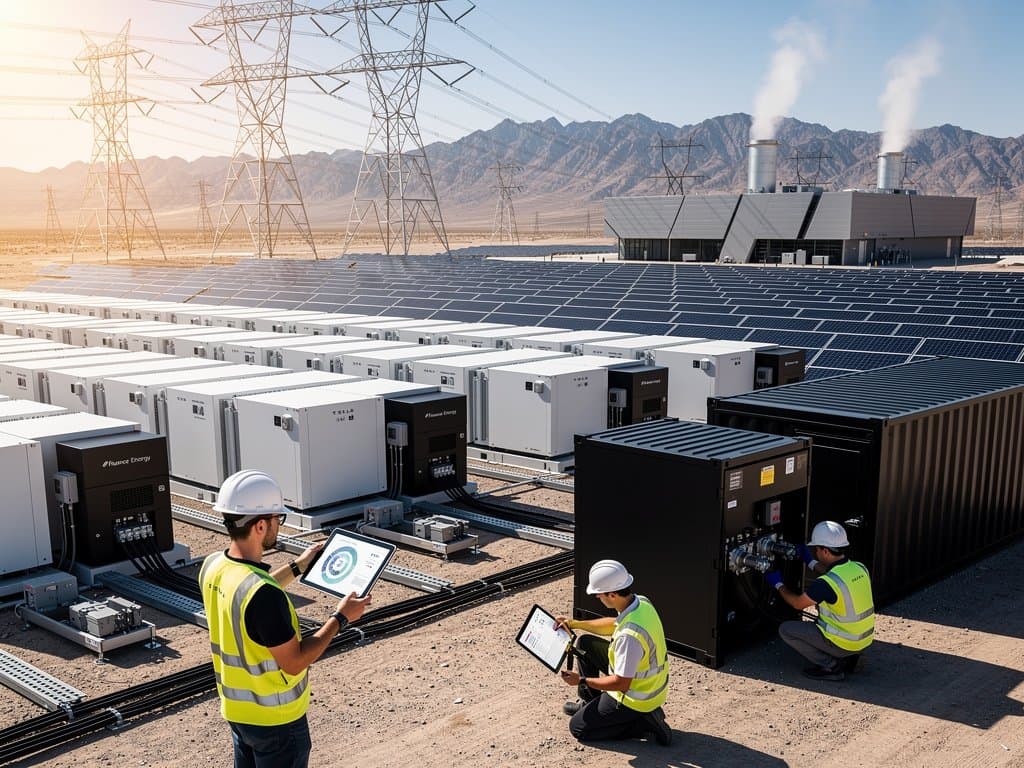
Fluence Energy's 1.2 GW/2.4 GWh Sunlight project in PJM Interconnection commissions in 2025, stacking arbitrage and frequency services. Tesla Megapack production reaches 100 GWh annually from Lathrop factory, with each 3.9 MWh unit at 195 Wh/kg system density.
US interconnection queues top 2.7 TW as of Q2 2024, per Lawrence Berkeley National Laboratory. FERC Order 2023 mandates backstop processes, cutting wait times 50%. Vistra Corp's 3 GW/12 GWh pipeline in ERCOT monetizes USD 100/MWh spreads.
Hybrids pair 4-hour lithium with solar at 30% capacity factors, capturing midday peaks for evening AI loads. Developers target 15% internal rates of return (IRR) on USD 300/kWh installed costs.
IRA Policy and State Mandates Fuel Storage Expansion
IRA Section 45X offers USD 35/kWh manufacturing credits for US-assembled cells, boosting domestic LFP output to 200 GWh/year by 2026, per Rho Motion. Nevada's AB 389 mandates 2 GW storage by 2030.
BloombergNEF's July 2024 analysis by analyst Seb Henbest projects AI data centers needing 100 GW US capacity by 2030, equivalent to 22% of households. PG&E secures 1 GW offtake for data center backups.
Long-duration energy storage (LDES) like Form Energy's 1.5 MWh iron-air pilots deliver 100-hour discharge at USD 20/kWh LCOS, per company data.
Diverse Revenue Streams Underpin Storage Resilience
Utility-scale projects derive 40% revenue from energy arbitrage (USD 80-150/MWh peaks), 30% ancillary services, 20% capacity payments (USD 10/kW-month), and 10% renewable curtailment avoidance. Scaled LCOS hits USD 120-160/MWh at 100 MW+.
ERCOT summer peaks hit 85 GW in 2024, spurring 5 GW utility RFPs. Amazon Web Services funds 5 GW solar-plus-storage globally.
Technical Advances and Supply Chain Realities Strengthen Edge
Solid-state batteries from QuantumScape target 500 Wh/kg and 800 cycles at 80% DoD, with grid pilots in 2025. Vanadium flow batteries from Invinity scale to 100 MWh at 75% RTE.
Redwood Materials recycles LFP packs at USD 20/kWh, reducing lithium demand 50% amid USD 12,000/tonne spot prices. Reuters' June 27, 2024, report by reporter Jake Spring notes AI driving 15% annual storage growth through 2030.
Geopolitically, US IRA tariffs on Chinese cells (25%) favor Northvolt and Ultium Plants. Cathode NMC532 pricing falls 20% YoY to USD 15/kWh.
Battery storage deploys verifiable GWh-scale MWh. Upcoming FERC rulings on hybrid modeling will unlock 500 GW queues, positioning storage ahead of volatile AI equities.
Frequently Asked Questions
How does battery storage benefit from AI power crunch?
Battery storage enables peak shaving for data centers. LFP systems achieve 85-90% RTE at 160-200 Wh/kg. Hyperscalers like Microsoft sign PPAs.
Why will grid tech outshine Nasdaq AI stocks in 12 months?
Stable revenues from USD 100/MWh arbitrage beat AI valuations. Utility pipelines exceed 2.7 TW. FERC speeds queues.
What battery technologies support AI data centers?
LFP provides 4-hour duration at 90% DoD, 6,000 cycles. Iron-air LDES offers 100 hours. LCOS under USD 150/MWh via IRA.
How does policy drive battery storage for AI growth?
IRA Section 45X credits USD 35/kWh. FERC Order 2023 accelerates 2.7 TW queues. Nevada mandates 2 GW by 2030.