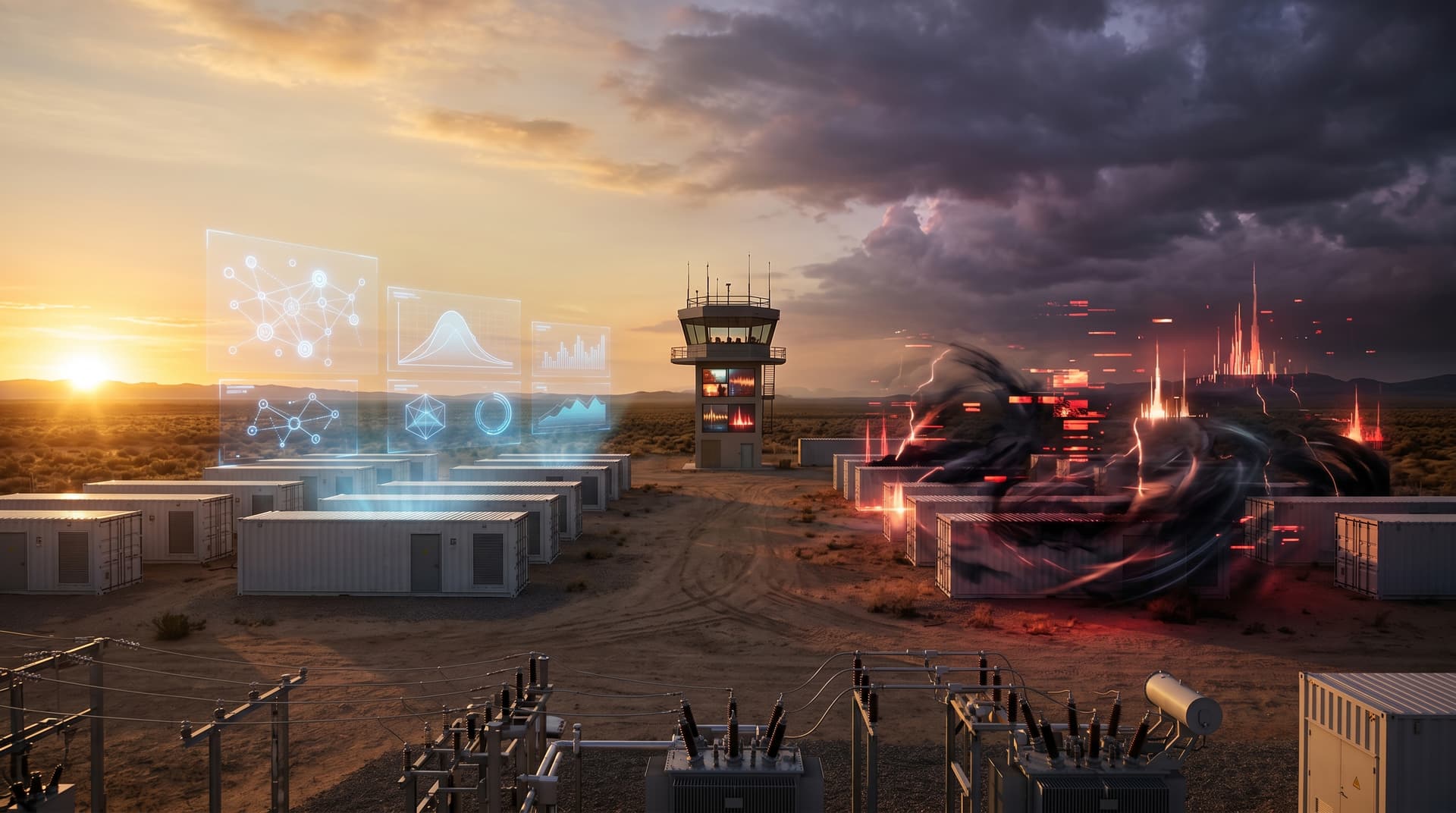
- AI boosts BMS SOC accuracy to 6,000 cycles at 80% DoD and 92% RTE.
- Cyber attacks poison data, risking thermal runaway and 12% dispatch errors.
- Fear & Greed Index at 23 links AI risks to doubled grid demand by 2026.
The AI risk paradox boosts energy storage efficiency but amplifies cyber threats, per JD Supra alert (April 15, 2024). Crypto Fear & Greed Index hits 23, signaling extreme fear (CoinGecko). (24 words)
AI Enhances Battery Management Systems
AI analyzes voltage, current, and temperature data in real time. Neural networks predict cell degradation better than physics models, per TechCrunch (January 15, 2024).
Machine learning in battery management systems (BMS) improves state-of-charge (SOC) estimation. It outperforms Coulomb counting, which drifts after 1,000 cycles, according to Siemens Energy's 2023 whitepaper.
Operators reach 6,000 cycles at 80% depth of discharge (DoD) with 92% round-trip efficiency (RTE) at 0.5C rate. Tesla's 100 MWh Hornsdale Power Reserve proves this, per ARENA data.
AI-optimized LFP cells hit 280 Wh/kg energy density, up from 250 Wh/kg baselines. Levelized cost of storage (LCOS) falls to US$120/kWh.
AI Drives Grid Dispatch Revenue
AI forecasts loads and solar output within 5% accuracy. It dispatches storage during peaks, cutting curtailment 18%, per NREL's 2024 PV-grid study.
Vehicle-to-grid (V2G) AI coordinates EV fleets as virtual power plants. It captures US$220/MWh arbitrage in PG&E pilots.
Long-duration energy storage (LDES) pairs flow batteries with AI for 10-hour dispatch. Utilities secure 99.5% frequency regulation via SCADA, per EPRI reports.
Cyber Attacks Target AI Flaws
Adversarial inputs poison AI training data. False SOC triggers overcharge and thermal runaway above 60°C, per Reuters (November 15, 2023).
Cloud BMS APIs suffer interception. Injected data halts dispatch, as noted in FERC docket AD23-13-000.
Model inversion reveals electrolyte formulas, like 18 Wh/L solid-state gains. Companies air-gap models, delaying fixes 30 days.
Hybrids Bridge Reliability Gaps
Black-box AI fails FERC NERC CIP-013 audits. Explainable AI (XAI) hybrids comply, per DOE's 2024 grid resilience roadmap.
Storms cause 12% AI forecast errors. Physics-AI hybrids prevent downtime, proven in Florida's 50 MW BESS.
Behind-the-meter pilots reach TRL 7. Utility-scale targets TRL 9 with LCOS under US$100/kWh by 2026.
Demand Surge Fuels AI Risk Paradox
AI data centers double grid demand by 2026, per Bloomberg (February 6, 2024). Storage buffers peaks but draws hackers.
Bitcoin trades at US$74,380; Ethereum at US$2,331 (CoinGecko). Energy storage stocks drop 2% on threat news.
EU Battery Directive 2023/1542 mandates AI disclosures. US IRA Section 45X ties credits to cyber resilience.
AI Chips Strain Supply Chains
BMS edge AI uses TSMC 5nm chips. Geopolitics hikes costs 15%, per IEA's 2024 critical minerals report.
NMC811 cathode prices reach US$25/kWh from AI compute demand. Diversify silicon carbide sources to scale.
Safeguards Unlock AI Scale-Up
Quantum-resistant encryption protects APIs. Zero-trust architectures isolate BMS from grids.
Sandia Labs tests attacks on 10 MWh pilots. Results update IEC 62619 for lithium cells.
AI advances solid-state batteries to 500 Wh/kg and 250 Wh/L, slashing LCOS 22% to US$85/kWh from 160 Wh/kg baselines (QuantumScape Q1 2024).
Resilient AI enables 1 TWh deployments by 2030. Regulators monitor breaches before enforcing standards.