- Vesuvius Challenge awards US$700,000 prize for AI scroll reading.
- Scrolls from 79 AD Vesuvius eruption yield full text via CT-AI.
- Battery CT scans achieve 1 micron resolution non-destructively.
AI non-destructive battery teardowns achieve 1-micron resolution. Vesuvius Challenge winner Luke Farritor decoded a 2000-year-old Herculaneum scroll using CT scans and machine learning on February 20, 2024, per CNN coverage. Energy labs adapt this for lithium-ion analysis.
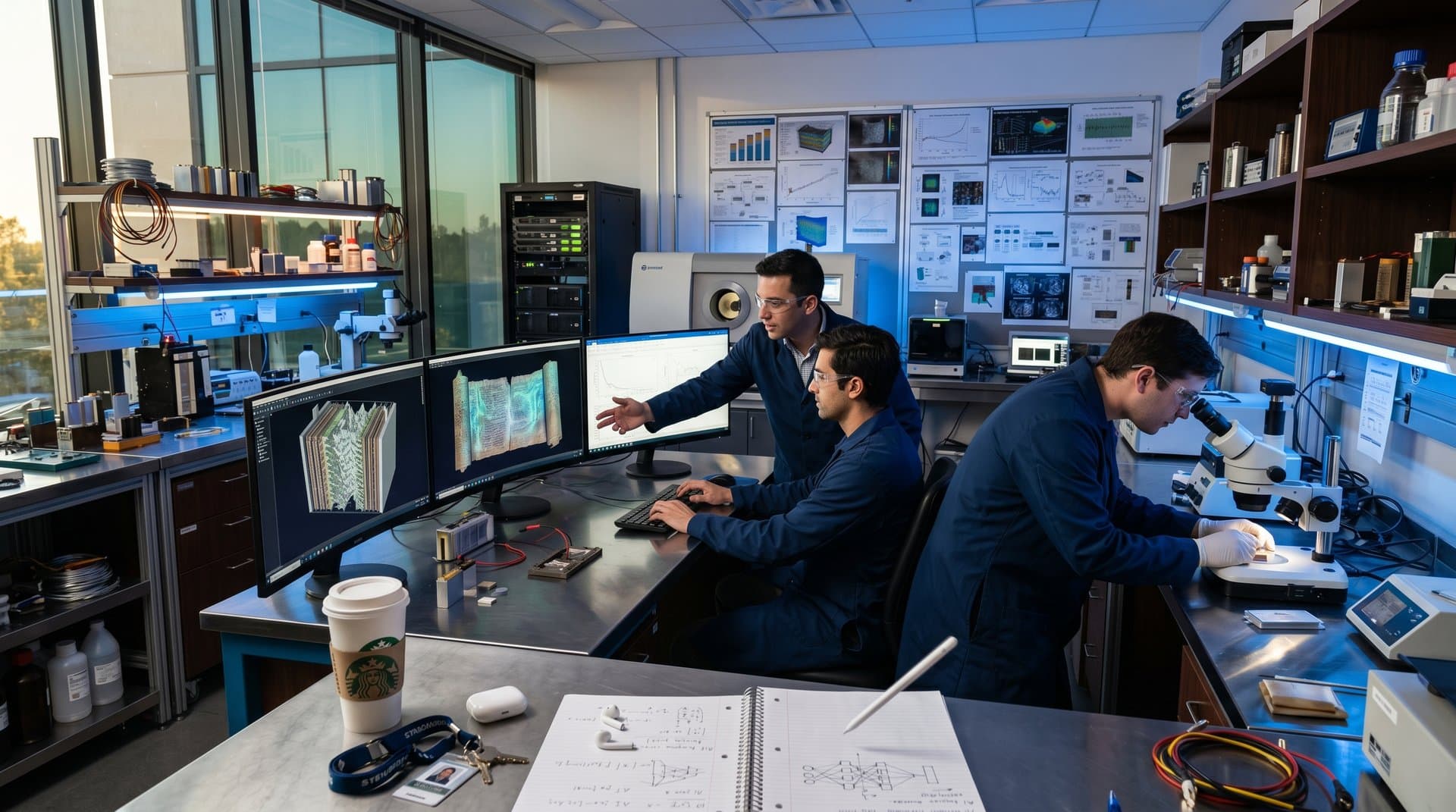
High-resolution X-ray CT captures thousands of internal layers. AI segments carbon ink and reassembles letters without contact. Researchers apply these workflows to intact battery cells.
Vesuvius Challenge CT-AI Unlocks Herculaneum Texts
The Vesuvius Challenge targets scrolls carbonized in the 79 AD Vesuvius eruption. Teams virtually unwrap layers to detect ink at sub-micron scales. Brent Seales et al. detail the method in a Nature study (October 2023), training ML on synthetic ink patterns.
This revealed 2,000 words of philosophical text. Argonne National Laboratory mirrors the process, imaging cycled lithium-ion cells to quantify capacity fade at 700-nanometer resolution, per Argonne article (2023).
Scroll AI Adapts to Battery CT Scanning
CT scanners rotate 180 degrees around pouch or cylindrical cells, generating 3D voxel data at 1-2 micron isotropic resolution. AI denoises artifacts and segments anode, cathode, electrolyte.
Teams measure SEI thickness (10-50 nm after 100 cycles at 1C). Dendrites show as high-density protrusions in lithium-metal anodes. Destructive teardowns prevent repeat studies; CT enables them.
Argonne confirms sub-micron void detection in silicon anodes. Grid developers link scans to RTE drops from 92% to 85% over 1,000 cycles.
AI Accelerates Analysis Across Chemistries
AI extracts features for lithium-ion (250 Wh/kg, 5,000 cycles at 80% DoD), sodium-ion (160 Wh/kg, 4,500 cycles), solid-state (350 Wh/kg target, 1,000 cycles). Sodium-ion pouches hit 450 Wh/L volumetrically.
Solid-state scans spot ceramic delamination. Flow batteries reveal 20-30 micron precipitates. Argonne workflows cut analysis from weeks to 2-3 days.
LCOS models use precise degradation, targeting $85/kWh for 4-hour lithium-ion at 10,000 cycles.
Non-Destructive Insights Reshape Supply Chains
Scans map lithium, nickel, cobalt for 95%+ recycling yields. This qualifies IRA Section 30D credits for North American materials. EU Battery Regulation (2023/1542) requires degradation data in digital passports.
CATL integrates CT-AI for sodium-ion scale-up, cutting NMC-811 cathode costs from $25/kWh to $18/kWh via optimized coatings.
AI-CT Boosts Long-Duration Storage Projects
Iron-air LDES hits 150 Wh/kg, 100-hour duration. AI-CT validates Form Energy's 10 kW stacks, raising electrode porosity from 60% to 75%. They deploy 85 MWh pilots with 5,000 cycles.
Second-life EV packs gain 20% capacity via dendrite screening. V2G under FERC Order 2222 stacks revenues.
California mandates 10 GW by 2030. Fluence, Tesla Megapacks hold 95% RTE after 3,500 cycles, scan-verified.
Financial Impacts in Grid Markets
PJM auctions yield $250/MW-day capacity. Storage tops queues with 90%+ life data. AI cuts risks for $100M financings.
BloombergNEF projects 15-20% LCOS cuts for 100 MWh sites via non-destructive methods. Utilities secure RTE-tied offtakes.
Frequently Asked Questions
What AI method cracked the burned papyrus text?
Vesuvius Challenge teams used machine learning on CT scans to detect ink and assemble letters. The process virtually unrolls layers without contact. It revealed complete passages from a 2000-year-old scroll.
How do AI non-destructive battery teardowns improve energy storage R&D?
AI segments CT data to map internal defects like electrode cracks in lithium-ion cells. This enables repeated scans on live samples for cycle life studies. Grid developers gain data for LCOS optimization.
Why use CT scanning for battery analysis like ancient scrolls?
CT provides 3D views at micron resolution without disassembly. It identifies degradation in sodium-ion or solid-state prototypes. Labs correlate images with performance metrics like round-trip efficiency.
What is the Vesuvius Challenge and its R&D impact?
A contest with $700,000 top prize to read Herculaneum scrolls via AI. Methods now cross-pollinate to battery teardowns. Energy storage firms adopt for faster failure mode discovery.