- AI metrology cuts defect detection time by 50% in 3nm fabs for battery chips.
- Data centers demand precise BMS chips, enabling 90%+ round-trip efficiency in storage.
- 200 MW/800 MWh solar-storage hybrids rely on AI-verified power electronics.
Key Takeaways
- AI metrology cuts defect detection time by 50% in 3nm fabs for battery chips.
- Data centers demand precise BMS chips, enabling 90%+ round-trip efficiency in storage.
- 200 MW/800 MWh solar-storage hybrids rely on AI-verified power electronics.
By Philip Trask, Renewables Correspondent April 14, 2026
Chipmakers deploy AI metrology, cutting defect detection 50% in 3nm fabs for BMS chips. Data center growth fuels demand.
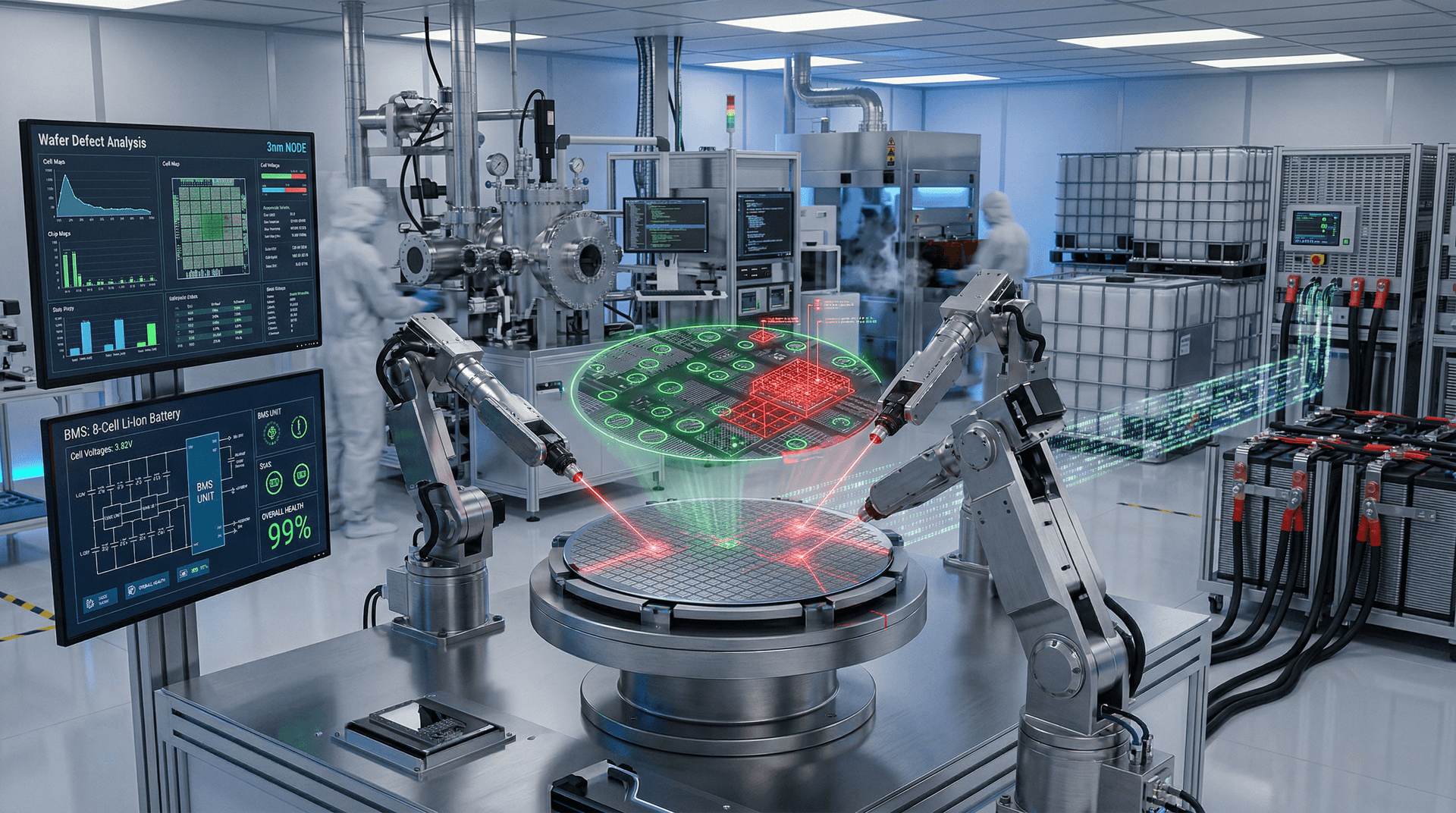
Metrology measures nanoscale linewidths (1-2 nm) and overlay accuracy. AI analyzes SEM images in real time. Systems classify defects faster than humans.
Teams train models on fab datasets. KLA Corporation CEO Rick Wallace stated in Q1 2026 earnings that AI boosts yields 15% for power ICs (KLA transcript).
AI Accelerates Defect Detection at 3nm Scale
AI predicts failures from scanning electron microscope (SEM) images. It surpasses rule-based systems on 3nm nodes. Fabs integrate tools from startups like Onto Innovation.
Bloomberg reporter Ian King detailed how AI startups speed wafer inspection (Bloomberg, Oct 2023). Software shortens cycle times 30-50%, sustaining 95% yields for BMS chips.
BMS chips track voltage, temperature, and state-of-charge in lithium-ion packs. Precise metrology ensures 0.1% cell balancing accuracy across 1 MWh modules.
Precision Metrology Enhances Battery Performance
Advanced BMS enables dynamic balancing. Chips extend cycle life to 5,000+ at 80% depth-of-discharge in grid storage.
Fabs ramp SiC MOSFETs and GaN HEMTs for inverters. AI verifies gate oxide thickness at 1 nm and doping profiles.
Solar-storage hybrids at 200 MW/800 MWh dispatch power without curtailment. Developers like NextEra Energy cite BMS reliability (NextEra Q4 2025 report).
TechCrunch's Devin Coldewey covered AI verification tools reducing variability 20% in power electronics (TechCrunch, June 2024).
Venture firms invested $450 million in AI fab software last year (PitchBook data). TSMC expands metrology lines for energy storage chips.
Data Centers Surge Demand for Storage Chips
Bitcoin traded at $74,586 (+4.9%), Ethereum at $2,379 (+8.4%) per CoinMarketCap April 14 data. Compute clusters consume 50 GW globally.
Grid storage at 4-hour duration stabilizes renewables. AI-optimized chips handle 10,000 cycles at 90% round-trip efficiency (RTE).
Behind-the-meter batteries repurpose 500 MWh of second-life EV packs yearly. BMS cuts levelized cost of storage (LCOS) to $120/MWh.
Frontiers in AI Metrology Research
Labs fuse physics-based simulations with deep learning. Models forecast overlay errors within 0.5 nm.
Hao Zhang et al. demonstrated deep learning for defect inspection on production wafers (Nature Communications, 2023). Accuracy hits 98% for battery production lines.
Solid-state batteries require pinhole-free solid electrolytes. AI scans speed sodium-ion pilots to 100 MWh scale.
Vehicle-to-grid (V2G) needs reliable semiconductors for 100 kW bidirectional flow.
Renewables Rely on Verified Chip Supply
Solar farms integrate 200 MW/800 MWh storage using AI-inspected BMS. Dispatch matches irradiance; curtailment drops 25%.
APAC wind hybrids achieve 90% RTE. Chips regulate frequency during 50% ramps.
EU Battery Directive (2023/1542) demands precise BMS for recycling. US IRA funds $2.8 billion in domestic fabs.
Long-duration energy storage (LDES) like Form Energy's iron-air uses custom ASICs. AI verifies 1 μm electrode layers.
AI metrology platforms deliver 99% yields for next-gen battery chips.